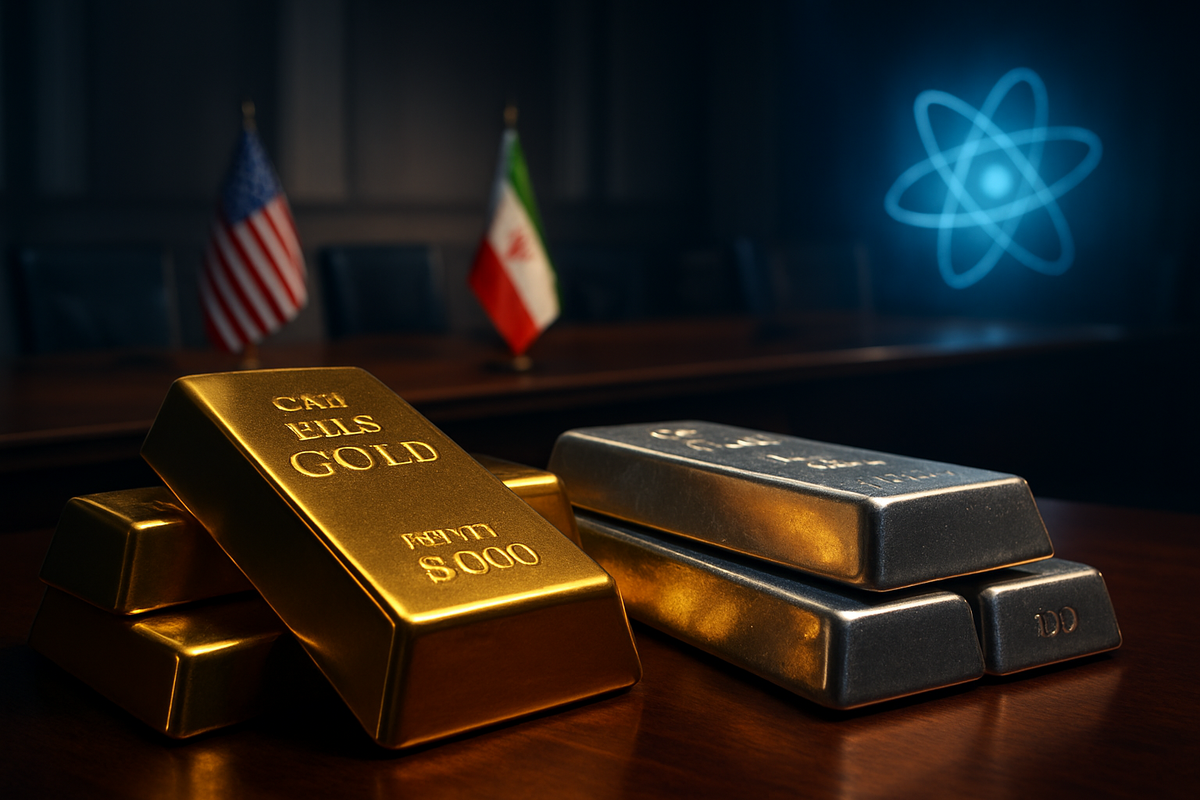
MUSCAT, OMAN — Precious metals markets are maintaining a defiant stance this week as the safe-haven allure of gold and silver continues to overshadow a surging US dollar. Following high-stakes diplomatic talks in Muscat on Friday, February 6, 2026, intended to de-escalate long-standing friction between Washington and Tehran, the global commodities market has found a firm "geopolitical floor." Despite intensified pressure from a strengthening greenback and a wave of profit-taking following a massive price surge on Monday, gold remains remarkably resilient, trading near the psychological milestone of $5,050 per ounce.
The refusal of Iranian negotiators to concede on nuclear fuel enrichment has reignited fears of a secondary escalation in the Middle East, barely eight months after the direct military exchanges of 2025. For investors, the message is clear: while macroeconomic headwinds like high interest rates and a robust dollar typically weigh on non-yielding assets, the threat of renewed conflict is currently the more potent market driver. Silver has followed a similar trajectory, buoyed by its dual identity as a crisis hedge and an essential component in the burgeoning 2026 green-tech sector.
Enrichment Standoff in Muscat: A Diplomatic Wall
The Friday, February 6th summit in Muscat was widely viewed as a "last-chance" diplomatic effort to prevent a return to active hostilities. Facilitated by Omani Foreign Minister Badr al-Busaidi, the talks brought together high-level delegations, including U.S. special envoys Steve Witkoff and Jared Kushner, alongside Iranian Foreign Minister Abbas Araghchi. The atmosphere was reportedly chilled by the shadow of "Operation Midnight Hammer"—the June 2025 U.S. strikes on Iranian facilities—which analysts say has made Tehran even more defensive regarding its nuclear program.
During the sessions, Tehran categorically rejected a proposed "enrichment freeze" that would have seen international sanctions lifted in exchange for a total halt of uranium processing. Iranian officials maintained that enrichment is a "sovereign right," a stance that led to an immediate breakdown in the primary objectives of the meeting. The lack of progress triggered a "flight to safety" when markets opened on Monday, February 9th, driving gold prices to their current levels around $5,050. While Tuesday has seen some technical cooling as traders lock in gains, the failure to reach a consensus in Oman ensures that the risk premium attached to precious metals remains intact.
Mining Giants and the "New Gold Standard"
The current price environment has transformed the financial landscape for major miners, who are reaping the benefits of margins unseen in previous decades. Newmont (NYSE: NEM), the world's largest gold producer, has seen its stock price surge over 170% in the last year, recently trading near $115.27. The company is expected to report record-breaking earnings later this month, driven by realized prices that have consistently stayed above the $4,500 mark throughout the winter of 2025-2026.
Similarly, Barrick Gold (NYSE: GOLD) has leveraged the geopolitical volatility to fortify its balance sheet. Following its 2025 year-end report, which showed record operating cash flow of $2.73 billion, the company announced a staggering 140% increase in its quarterly dividend. Barrick’s strategy to potentially IPO its North American assets, including the Nevada Gold Mines, highlights a industry-wide trend of "unlocking value" during a bull market. However, these companies face the challenge of rising operational costs, as energy and labor inflation—exacerbated by the same geopolitical tensions driving gold prices—continue to nibble at their bottom lines.
The Shift in Global Safe-Haven Dynamics
The 2026 gold rally represents a fundamental shift in how the market perceives risk. Traditionally, gold and the US dollar share an inverse relationship; when the dollar is strong, gold usually falls. However, the current cycle has seen both assets rise in tandem. This phenomenon suggests that global investors are engaging in a "debasement trade," seeking protection against not just geopolitical conflict, but also the potential long-term instability of fiat currencies in a bifurcated global economy.
Historically, this mirrors the market behavior seen during the oil shocks of the 1970s, though on a much larger scale. The "Oman Deadlock" serves as a reminder that the world’s transition away from traditional energy and the restructuring of Middle Eastern alliances are decades-long processes fraught with volatility. The persistence of the gold floor at $5,050 indicates that the market has priced in a state of "perpetual friction" between the West and regional powers like Iran, making gold a permanent fixture in diversified portfolios rather than a temporary hedge.
The Road Ahead: Sanctions and Technical Resistance
Looking forward, the immediate focus for traders will be the next report from the International Atomic Energy Agency (IAEA) and any potential retaliatory sanctions from the U.S. Department of the Treasury. If Washington moves to further restrict Iranian oil exports or targets third-party facilitators, the resulting supply-chain anxieties could push gold toward the $5,200 resistance level. Conversely, a sustained climb in the US Dollar Index (DXY) could spark a deeper correction if diplomatic channels unexpectedly reopen.
Strategic pivots are already visible among institutional players. Many are rotating out of high-growth tech and into "hard assets" as a safeguard against a potential "black swan" event in the Strait of Hormuz. In the short term, expect gold to oscillate between $4,900 and $5,100 as the market digests the outcome of the Oman talks. The long-term trajectory, however, appears tilted to the upside so long as the nuclear enrichment issue remains unresolved and the geopolitical map remains in a state of flux.
Summary and Investor Outlook
The events of early February 2026 have solidified gold’s status as the ultimate arbiter of global anxiety. The failure of the Muscat talks to secure a nuclear freeze in Iran has provided a robust floor for precious metals, even as the US dollar attempts to assert dominance. With gold hovering around $5,050, the market is signaling that the era of low-volatility diplomacy is over, replaced by a more complex landscape where hard assets are the only perceived certainty.
For investors, the coming months will require a close watch on both the Muscat diplomatic track and technical indicators in the gold market. While the "Monday surge" provided a glimpse of the metal’s explosive potential, the underlying support from companies like Newmont (NYSE: NEM) and Barrick Gold (NYSE: GOLD) suggests a sector that is fundamentally stronger than it was five years ago. As the deadlock in Oman persists, the "golden floor" is likely to hold, making any price dips a potential entry point for those seeking a haven in a fractured world.
This content is intended for informational purposes only and is not financial advice.