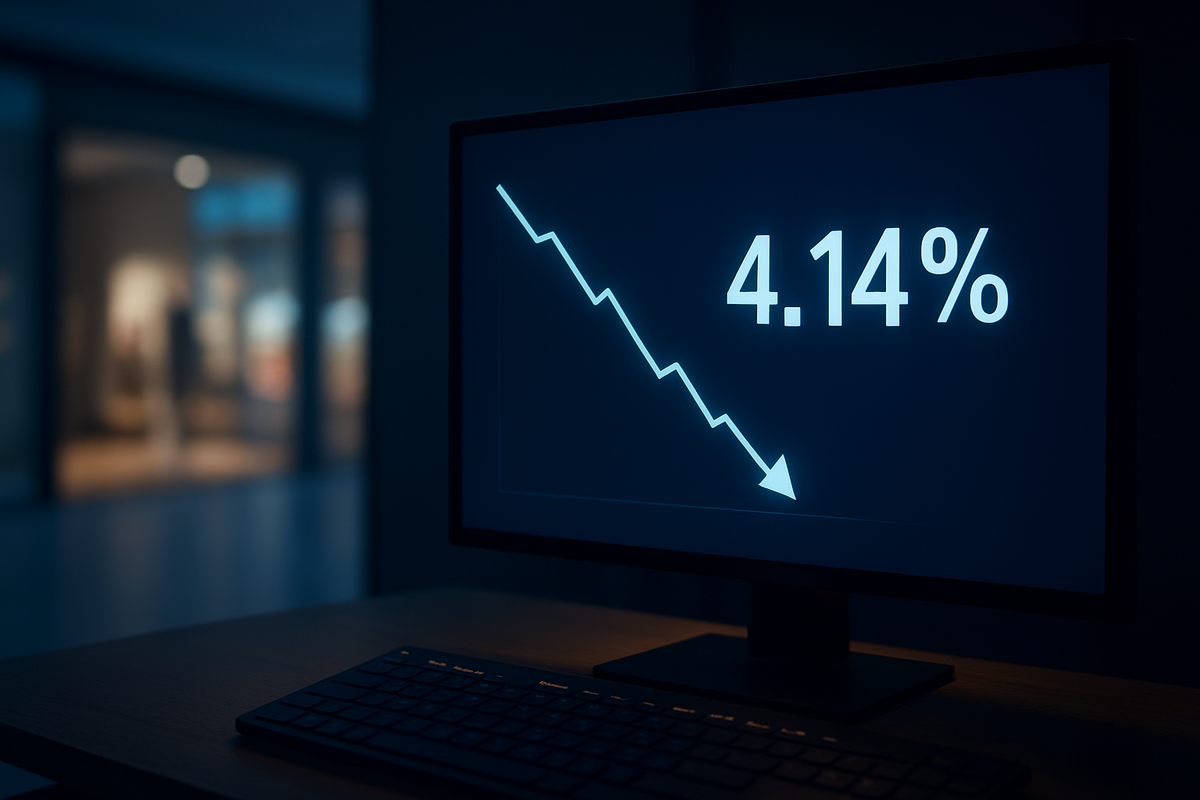
The benchmark 10-year U.S. Treasury yield plummeted to 4.14% on Tuesday, February 10, 2026, as investors aggressively repositioned for a more dovish Federal Reserve following a starkly disappointing retail sales report. The move represents a significant departure from the 4.30% levels seen earlier this year, signaling that the "higher-for-longer" narrative may finally be yielding to the reality of a fatigued American consumer.
This sudden repricing in the bond market has immediate and profound implications for equity valuations, particularly in the technology and real estate sectors. As the yield on the "risk-free" benchmark drops, the present value of future corporate cash flows increases, providing a much-needed tailwind for growth-oriented stocks that had been pressured by the high-interest-rate regime of 2025.
The catalyst for Tuesday's market volatility was the release of the January retail sales data, which showed a surprise 0.2% contraction, far missing the consensus forecast of a 0.3% gain. This data, combined with downward revisions to the December holiday spending figures, suggests that the post-pandemic resilience of the U.S. consumer may have finally hit a wall. Market participants quickly interpreted the cooling demand as a green light for the Federal Reserve to reconsider its "strategic patience" stance. According to the CME FedWatch Tool, the probability of a 25-basis-point rate cut at the upcoming March meeting surged from 35% to nearly 68% within hours of the report's release.
The timeline leading to this shift has been marked by a tug-of-war between fiscal stimulus and monetary restraint. Throughout late 2025, the market was buoyed by the passage of the One Big Beautiful Bill Act (OBBBA), which promised tax relief and industrial incentives. However, the inflationary "tariff passthrough" effects seen in January appear to have dampened the real purchasing power of those tax refunds. Large-cap retailers, including Walmart (NYSE: WMT) and Target (NYSE: TGT), had already signaled caution in late January earnings calls, noting a shift toward non-discretionary goods and private-label brands.
Initial market reactions were swift. The iShares 20+ Year Treasury Bond ETF (NASDAQ: TLT) saw its highest one-day volume in three months as investors sought the safety of duration. In the currency markets, the U.S. Dollar Index (DXY) dipped below the 103 level, reflecting lower yield expectations relative to the Eurozone and Japan. The move to 4.14% on the 10-year Treasury is now being viewed as a critical technical breakdown, with some analysts forecasting a move toward the 3.95% floor if labor market data follows the retail trend.
The retreat in yields creates a clear divergence in the corporate landscape. Large-cap technology companies, such as Apple (NASDAQ: AAPL) and Microsoft (NASDAQ: MSFT), are the primary beneficiaries. These "cash-rich" entities see their valuations expand in a lower-rate environment, as the discount rate applied to their massive future earnings streams declines. Furthermore, the lower 10-year yield reduces the cost of "synthetic" borrowing and improves the attractiveness of their dividend yields relative to fixed income.
The real estate sector, which spent most of 2025 in a deep freeze, is also showing signs of life. Real Estate Investment Trusts (REITs) like Realty Income (NYSE: O) and Prologis (NYSE: PLD) rallied on the news, as lower yields decrease their cost of capital for new acquisitions and debt refinancing. For these companies, a sustained move below 4.2% on the 10-year Treasury represents a "thawing" of the credit markets that could lead to a resurgence in M&A activity.
Conversely, the banking sector faces renewed pressure. Financial giants such as JPMorgan Chase (NYSE: JPM) and Bank of America (NYSE: BAC) saw their share prices soften as the yield curve continued its "stalling steepener" pattern. Lower long-term rates typically compress net interest margins—the difference between what banks earn on loans and what they pay on deposits. If the 10-year yield continues to slide while short-term rates remain relatively high, the profitability of traditional lending models could be severely challenged throughout the remainder of 2026.
The drop to 4.14% is more than just a daily fluctuation; it represents a pivot in the macro narrative of 2026. For much of the past year, the market has been obsessed with "tariff-driven inflation" and the fiscal deficit. However, the retail sales miss suggests that the "K-shaped" economy is widening, where high-income wealth effects from a record-breaking stock market are no longer enough to offset the exhaustion of middle- and lower-income savings. This event fits into a broader global trend of slowing growth, as major economies in Europe and Asia also struggle with the lagged effects of high borrowing costs.
Historical precedents, such as the growth scares of late 2018 and the pre-pandemic cooling of 2019, suggest that the Federal Reserve often reacts aggressively once consumer data turns negative. While the incoming Fed leadership transition toward Kevin Warsh was expected to bring a more hawkish lean, the "Warsh Pivot" may now be forced toward a "Warsh Pause" or even a "Warsh Cut" if the economic data continues to deteriorate. The ripple effects will likely be felt in corporate boardrooms, where CFOs of large-cap firms are now weighing the benefits of locking in long-term debt at these lower rates before the next bout of volatility.
Regulatory implications may also emerge. With the OBBBA's tax provisions now in full effect, any further economic slowing might prompt calls for additional fiscal intervention, potentially complicating the Fed's inflation-fighting mandate. The market is effectively betting that the Fed will have to choose between its 2% inflation target and the stability of the American consumer—and today's yield move suggests the market believes the consumer will win that argument.
In the short term, markets will be hypersensitive to the upcoming Consumer Price Index (CPI) and labor market reports. If inflation remains "sticky" while retail sales remain soft, the dreaded "stagflation" narrative could replace the current "soft landing" optimism. Investors should watch for a potential strategic pivot from large-cap companies, which may move away from aggressive capital expenditure and toward defensive share buybacks and dividend increases to support stock prices in a slowing growth environment.
The market opportunity now lies in "quality" companies with strong balance sheets that can thrive regardless of the Fed's next move. However, the challenge will be navigating the volatility inherent in a leadership transition at the Federal Reserve. The "Warsh era" is slated to begin in May, and his initial communications will be scrutinized for whether he intends to follow the market's lead or re-anchor expectations toward a higher terminal rate.
The drop in the 10-year Treasury yield to 4.14% on February 10, 2026, marks a definitive shift in investor sentiment, triggered by an undeniable cooling of the U.S. consumer. As retail sales falter, the burden of proof has shifted to the "hawks" on the Federal Open Market Committee. For large-cap companies, the reprieve in borrowing costs and the boost to equity valuations provide a temporary cushion against the specter of slowing demand.
Moving forward, the market is likely to remain in a "data-dependent" holding pattern. The resilience of the technology and real estate sectors will depend on whether this yield drop is a precursor to a healthy "soft landing" or a warning sign of a deeper economic contraction. Investors should keep a close eye on the 4.10% level on the 10-year Treasury; a breach below that could signal a more profound regime shift in the global financial landscape.
This content is intended for informational purposes only and is not financial advice.