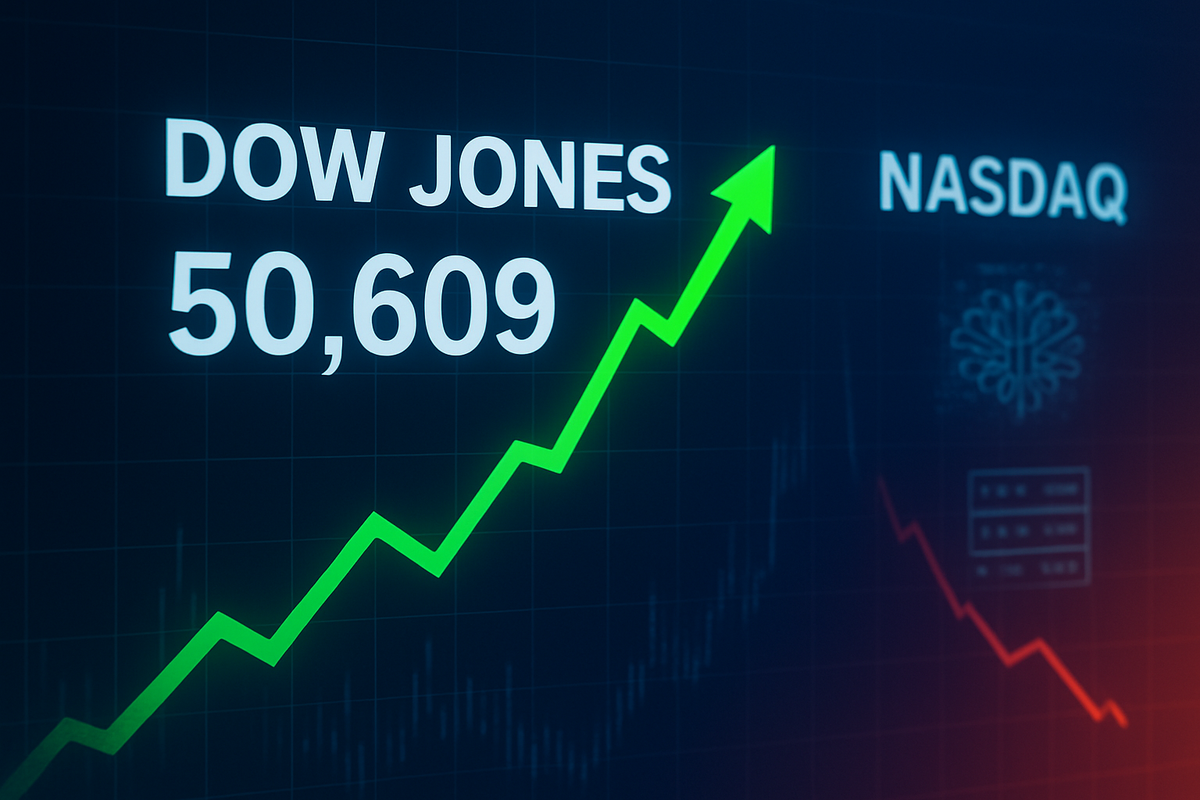
In a striking display of market divergence, the Dow Jones Industrial Average surged to its third consecutive record high on Tuesday, February 10, 2026, momentarily piercing the 50,609 mark intraday. This milestone marks a significant psychological and technical breakthrough for the "blue-chip" index, which has found a second wind in an economic landscape increasingly favoring "real economy" sectors over high-growth technology. The Dow's ascent reflects a robust rotation into industrials and financials, even as broader market sentiment remains clouded by softening consumer data.
However, the celebratory mood on the New York Stock Exchange was not mirrored across the Hudson at the Nasdaq. While the Dow celebrated its historic peak, the tech-heavy Nasdaq Composite struggled to stay afloat, dragged down by a sell-off in major technology constituents. Leading the retreat was Alphabet Inc. (NASDAQ: GOOGL), which faced investor scrutiny over its massive infrastructure spending. This "tale of two markets" highlights a growing divide between established value and the speculative future of artificial intelligence, as investors weigh the reality of flat retail sales against the towering valuations of Silicon Valley.
A Three-Day Sprint to 50,609
The Dow’s climb to 50,609 during Tuesday's trading session was the culmination of a powerful three-day rally that began late last week. Market participants point to a series of better-than-expected earnings from industrial heavyweights and a stabilizing bond market as the primary catalysts. The index, which serves as a barometer for thirty of the most significant companies in the United States, has benefited from a "flight to quality" as investors seek dividends and tangible earnings in an environment of global uncertainty.
The timeline leading up to this record was paved with anticipation. After flirting with the 50,000 level throughout January, a late-session surge on Friday provided the initial breakout. By Monday, the momentum was undeniable, closing at a then-record of 50,188. Tuesday’s intraday jump to 50,609 was driven by early-morning optimism, though the index pared some of those gains to close slightly lower as profit-taking ensued. Key stakeholders, including institutional fund managers and pension funds, have reportedly been shifting allocations away from "growth at any price" toward the defensive posture offered by the Dow's price-weighted structure.
Initial market reactions were a mix of euphoria and caution. Traders on the floor noted that while the 50,600 level represents a massive achievement, the volume of trading suggests that the rally is being fueled by a narrow corridor of sectors. UnitedHealth Group (NYSE: UNH) and Goldman Sachs Group Inc. (NYSE: GS) were among the primary drivers of the Dow's performance on Tuesday, providing the necessary lift to offset the malaise seen in other parts of the equity market.
Winners and Losers: The Great Sector Divide
The primary "winner" of the current market cycle is undoubtedly the financial sector. With the Federal Reserve signaling a cautious approach to rate cuts under the potential leadership of Kevin Warsh, banks like JPMorgan Chase & Co. (NYSE: JPM) have seen their margins remain resilient. Similarly, industrial giants like Caterpillar Inc. (NYSE: CAT) have capitalized on continued infrastructure spending and a domestic manufacturing renaissance, pushing the Dow higher while other indices stagnate. These companies, often referred to as the "bedrock" of the American economy, are currently seen as safe harbors.
Conversely, the "losers" of Tuesday's session were concentrated in the technology and consumer discretionary sectors. Alphabet Inc. (NASDAQ: GOOGL) served as the primary anchor for the Nasdaq, with its stock price sliding as investors digested the company's staggering capital expenditure forecasts. Reports indicate that Alphabet plans to spend upwards of $180 billion in 2026 on AI infrastructure—a figure that has sparked "AI fatigue" among shareholders who are beginning to demand more immediate returns on these massive investments. The sell-off in Alphabet rippled through other tech giants, including Amazon.com Inc. (NASDAQ: AMZN) and Microsoft Corp. (NASDAQ: MSFT), both of which also faced pressure.
Furthermore, consumer-facing companies are beginning to feel the heat from a cooling economy. Retailers like Target Corp. (NYSE: TGT) and Nike Inc. (NYSE: NKE) have struggled to find momentum as the latest economic data suggests the American consumer may finally be reaching a breaking point. The divergence between the "industrial" Dow and the "consumer/tech" Nasdaq has rarely been this pronounced, creating a challenging environment for diversified portfolios that are over-weighted in growth stocks.
Macro Headwinds and the Retail Sales Slump
The broader significance of the Dow's record high is tempered by the reality of the U.S. consumer. Recent data showed that retail sales remained flat in the latest reporting period, a disappointing result that suggests high interest rates and persistent inflation are finally curbing discretionary spending. This stagnation is a critical headwind for the Nasdaq, which relies heavily on consumer tech and e-commerce. The "flatness" of the data has injected a dose of realism into the market, reminding investors that while the Dow's components may be thriving on B2B contracts and global trade, the domestic "Main Street" economy is decelerating.
Historically, such a divergence often precedes a broader market consolidation. The current trend mirrors the late-1990s value-to-growth rotations, though in reverse, as the "AI bubble" faces its first true test of sustainability. Additionally, the geopolitical landscape remains a significant factor; with ongoing tensions in Europe and the Middle East, the Dow’s defensive, multinational components are seen as better positioned to weather supply chain shocks than the high-multiple tech firms that dominate the Nasdaq and S&P 500.
Regulatory scrutiny is also playing a role. As the Department of Justice continues its focus on big tech, companies like Alphabet are fighting battles on two fronts: the need to out-spend competitors in the AI arms race and the need to defend their market dominance in court. This regulatory overhang, combined with the flat retail sales data, has created a "perfect storm" of skepticism for the technology sector, even as the "old guard" of the Dow marches to new heights.
Future Outlook: Can the 50,000 Floor Hold?
Looking ahead, the short-term question for investors is whether the Dow can maintain its position above the 50,000 threshold. Market analysts suggest that while the psychological barrier has been broken, a "retest" of this level is likely in the coming weeks. If the Dow can consolidate its gains around 50,300, it could set the stage for a run toward 55,000 by year-end. However, if the weakness in the Nasdaq begins to bleed into the broader market, even the blue chips may find it difficult to maintain their solo rally.
The strategic pivot required for the Nasdaq's recovery lies in "AI monetization." For companies like Alphabet, the challenge is no longer just building the technology, but proving that it can generate the margins necessary to justify nearly $200 billion in annual spending. Until the tech sector can show a clear path from capex to profit, the Dow's dominance in 2026 is likely to persist. Investors should watch for upcoming earnings reports from the remaining "Magnificent Seven" companies to see if they can provide the "spark" needed to bridge the gap with the Dow.
Wrap-Up and Investor Takeaways
The Dow Jones Industrial Average hitting an intraday high of 50,609 on February 10, 2026, is a landmark event that underscores the resilience of the traditional American corporate sector. While the milestone is a cause for celebration among value investors, the simultaneous struggle of the Nasdaq serves as a sober reminder of the risks inherent in the tech-heavy growth model. The "flat" retail sales data acts as the ultimate reality check, signaling that the path forward for the U.S. economy may be more uphill than the Dow’s record-breaking streak suggests.
Moving forward, the market appears to be entering a phase of "quality over growth." Investors should prioritize companies with strong balance sheets, consistent dividend histories, and exposure to industrial tailwinds. While the allure of the AI revolution remains, the 2026 market is proving that even the most innovative technology cannot outrun the fundamentals of capital expenditure and consumer demand indefinitely. For the coming months, the 50,000 mark on the Dow will be the most watched number on Wall Street—a symbol of either a new era of industrial strength or a final peak before a broader economic cooling.
This content is intended for informational purposes only and is not financial advice