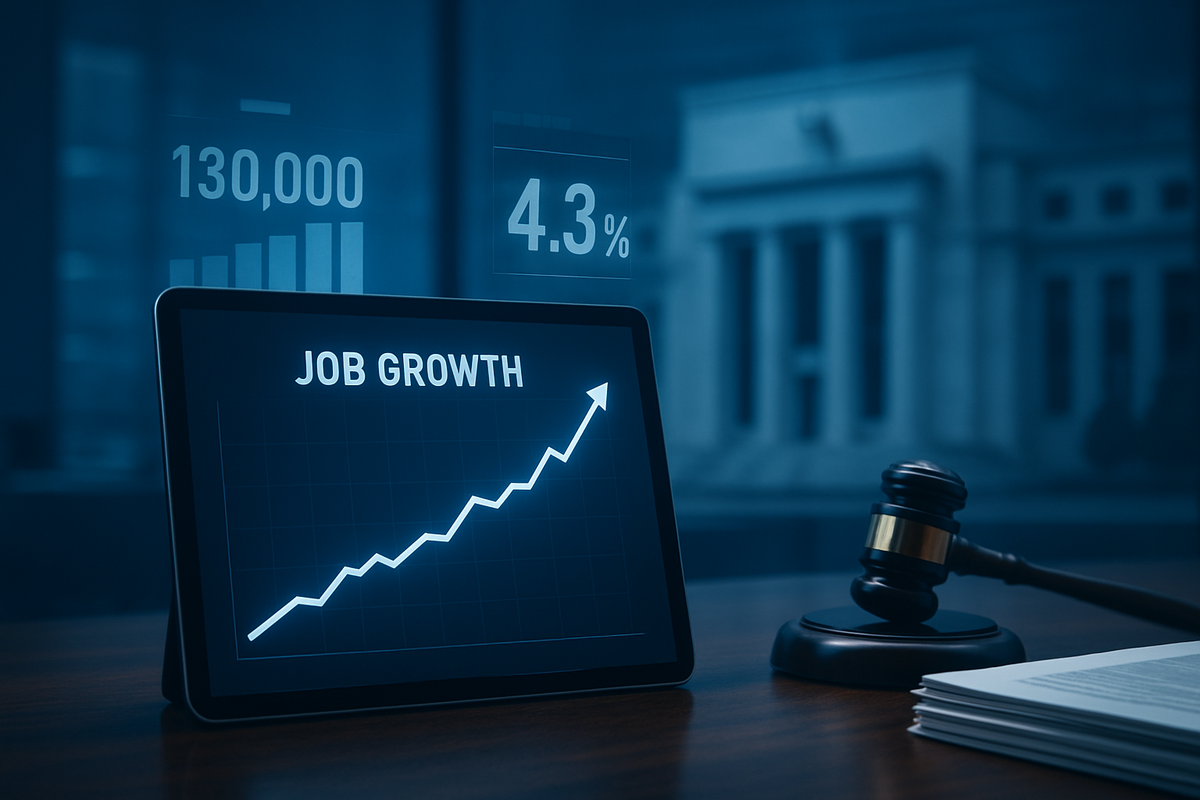
The U.S. labor market kicked off 2026 with a surprising display of resilience, as the January Jobs Report revealed a surge of 130,000 nonfarm payroll positions. This figure, released by the Bureau of Labor Statistics on February 6, 2026, has forced a recalibration of market expectations regarding the Federal Reserve's long-awaited pivot toward lower interest rates. While the 130,000 gain is more moderate than the triple-digit explosions of years past, it represents a significant "beat" against the backdrop of late-2025 volatility and growing fears of a winter slowdown.
The immediate implications for the financial markets have been a mixture of relief and renewed caution. While the "surprise surge" suggests the U.S. economy is successfully navigating toward a "soft landing," it also complicates the Federal Reserve’s timeline. Investors who had been betting on aggressive, back-to-back rate cuts starting in the first quarter of 2026 are now faced with a labor market that is "too healthy" to justify an emergency easing of monetary policy, yet stable enough to suggest that a recession is not imminent.
The January Data: A Stabilizing Force
The addition of 130,000 jobs in January exceeded the more pessimistic "whisper numbers" that had been circulating among Wall Street analysts, who feared the high-interest-rate environment of 2025 might finally trigger a contraction. Instead, the report showed a steady hand in the American economy. The unemployment rate held firm at 4.3%, a level that remains historically low even as it has ticked up from the record-breaking lows of the previous three years. Wage growth also showed signs of normalization, rising 0.2% for the month and 3.4% on an annual basis, signaling that the inflationary "wage-price spiral" is largely under control.
The timeline leading up to this report was one of intense speculation. Following a turbulent fourth quarter in 2025, where hiring in the retail and manufacturing sectors dipped due to high borrowing costs, many expected January to follow suit. However, growth in the healthcare and government sectors provided the necessary support to keep the labor market in expansion territory. Key stakeholders, including Federal Reserve Chair Jerome Powell and various regional Fed presidents, have spent the last month emphasizing "data dependence," and this latest report provides them with a clear, if complex, data point to digest ahead of the March meeting.
Initial market reactions were swift. Treasury yields, particularly the 10-year note, saw a slight uptick as traders pushed back the expected "certainty" of a March rate cut. However, the equity markets responded with a "Goldilocks" rally; the S&P 500 saw modest gains as the report suggested that the economy is neither overheating nor collapsing. The narrative of 2026 is rapidly becoming one of "sustainable growth," a far cry from the volatility that defined the start of the decade.
Winners and Losers: Navigating the "Higher for Longer" Transition
The surprise resilience of the labor market has created a distinct set of winners and losers across various sectors. Real estate investment trusts (REITs) are seeing a resurgence of interest as the 130,000 job figure reinforces the case for a gradual easing of rates. Prologis, Inc. (NYSE: PLD), the global leader in logistics real estate, stands to benefit as a stable labor market ensures consistent consumer demand for e-commerce, while the looming rate cuts will eventually lower the cost of capital for new warehouse developments. Similarly, American Tower Corporation (NYSE: AMT) is finding favor among investors who see the potential for cheaper refinancing of its infrastructure debt as the Fed eventually moves toward its "neutral" rate target.
The banking sector, however, presents a more nuanced picture. Traditional giants like JPMorgan Chase & Co. (NYSE: JPM) and Bank of America Corp. (NYSE: BAC) are navigating the end of the high-interest-margin era. While a strong labor market means fewer credit defaults—a major win for JPM and BAC—the prospect of falling rates later this year will compress the "spread" they earn on loans. Nevertheless, the return of corporate confidence and a stabilizing economy are expected to reignite the IPO and M&A markets, providing a much-needed boost to investment banking fees for these institutions.
In the healthcare space, companies like HCA Healthcare, Inc. (NYSE: HCA) are emerging as clear winners. The January report highlighted healthcare as a primary driver of job growth, and a stable labor market ensures that employer-sponsored insurance coverage remains high. For HCA, this translates to consistent patient volumes and a more manageable labor cost environment compared to the nursing shortages that plagued the sector in 2023 and 2024. Conversely, sectors that rely heavily on discretionary "big-ticket" spending, such as high-end retail, may find the "slow and steady" growth of 2026 less exhilarating than the post-pandemic boom years.
Wider Significance: The "Soft Landing" Archetype
The January jobs data is more than just a monthly statistic; it is a critical piece of evidence in the broader "Soft Landing" vs. "No Landing" debate that has dominated 2026. Historically, when the Federal Reserve has raised rates as aggressively as it did in 2023-2024, the outcome has almost always been a recession. However, the 2026 labor market is defying these precedents. The ability of the U.S. economy to add 130,000 jobs while inflation cools is being viewed as a potential masterclass in monetary policy, or perhaps a sign of a structural shift in how the labor market operates in a post-AI-integration world.
This event also highlights a shifting regulatory and policy focus. With the labor market stabilized, the Fed can afford to be more patient. This "patience" has ripple effects on global partners, as the U.S. dollar remains relatively strong, complicating the easing cycles of the European Central Bank and the Bank of Japan. Compared to the Great Recession of 2008 or the dot-com bubble of 2000, the 2026 environment is unique in its lack of a "crisis" catalyst. The surge of 130,000 jobs suggests that the U.S. economy is not just surviving high rates—it is adapting to them.
Furthermore, the sectoral breakdown of the report underscores a long-term trend toward a service- and healthcare-dominated economy. As manufacturing remains flat due to high automation and global supply chain realignments, the "human-centric" sectors are becoming the bedrock of American employment. This shift has profound implications for future labor policy and educational focus, as the "surprises" in the data are increasingly coming from sectors that cannot be easily outsourced or automated.
What Comes Next: The March FOMC Countdown
As we look toward the remainder of the first quarter, the focus shifts squarely to the Federal Open Market Committee (FOMC) meeting in March. Following the 130,000 job surge, the CME FedWatch Tool currently shows a 75% probability of a 25-basis-point rate cut. This indicates that while the "surge" was surprising, it wasn't strong enough to derail the Fed's easing bias entirely. However, any further "beats" in the February data could see those odds drop, potentially pushing the first cut into the second quarter of 2026.
Strategic pivots will be required for companies that have been operating in "survival mode." If rates stay higher for just a few months longer than expected, smaller, debt-heavy tech firms may need to seek additional private funding or reconsider their growth targets. Conversely, cash-rich tech giants like Amazon.com, Inc. (NASDAQ: AMZN) may use this period of relative stability to continue their aggressive investments in AI and logistics, knowing that their competitors are more constrained by the cost of capital.
The short-term scenario suggests a period of "low volatility" but "high scrutiny." Investors will be parsing every piece of data—from CPI reports to retail sales—to see if the January jobs surge was a one-off anomaly or the start of a re-acceleration. If the economy re-accelerates, the Fed may be forced to hold rates at their current levels, a "Higher for Much Longer" scenario that could eventually put renewed pressure on the banking and real estate sectors.
Closing Thoughts: A Market in Transition
The January 2026 Jobs Report serves as a definitive marker of an economy in transition. The surprise addition of 130,000 jobs has provided a much-needed confidence boost to the American public and the financial markets, proving that the labor market has not "fallen off a cliff" despite years of restrictive monetary policy. The key takeaway is that the "Goldilocks" scenario remains intact: growth is present, but it is not so hot that it threatens to reignite the flames of inflation.
Moving forward, the market is likely to remain in a "wait-and-see" pattern. The Federal Reserve's path is clearer than it was six months ago, but the January data reminds us that the economy still has the power to surprise. For investors, the coming months will require a focus on quality and resilience. Companies with strong balance sheets and the ability to thrive in a "moderate growth" environment will likely lead the way.
As we move toward the spring, the watchword for the market is "balance." Investors should keep a close eye on the February jobs report and the subsequent inflation readings. The 130,000 job surge in January was a victory for those rooting for a soft landing, but the final chapter of this economic cycle is still being written. The Federal Reserve now has the enviable, yet difficult, task of timing its exit from restrictive territory without disturbing the hard-won stability of the American labor force.
This content is intended for informational purposes only and is not financial advice.