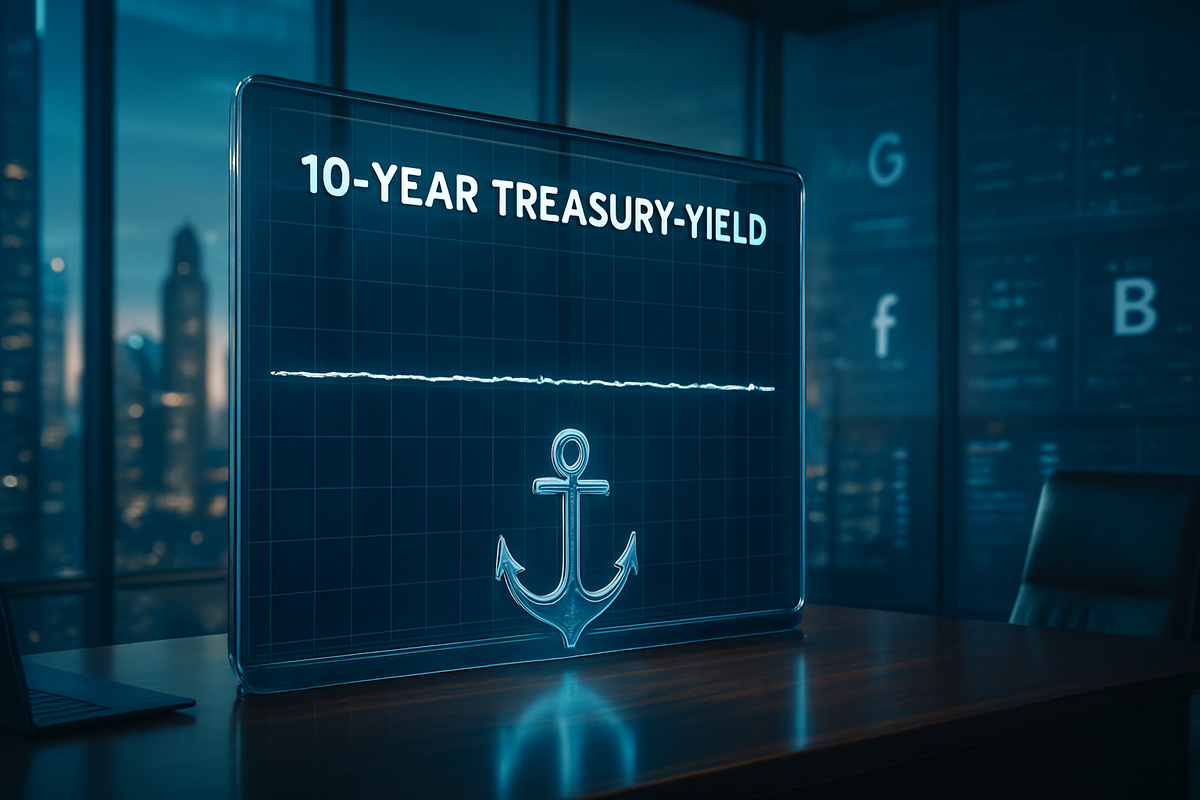
As of February 11, 2026, a sense of "hard-won equilibrium" has finally settled over the U.S. Treasury market. After years of post-pandemic turbulence, the benchmark 10-year Treasury note yield has found a steady home in a tight corridor between 4.14% and 4.26%. This newfound stability—often referred to by Wall Street as the "Yield Anchor"—is providing a much-needed foundation for stock valuations, allowing investors to shift their focus from interest-rate anxiety to the fundamental earnings potential of the artificial intelligence (AI) revolution.
The immediate implications of this "bond market boredom" are profound. With the Merrill Lynch Option Volatility Estimate (MOVE) index hitting a four-year low in early 2026, the cost of capital has become predictable for the first time in recent memory. This predictability is fueling a resurgence in corporate deal-making and providing a tailwind for growth-oriented sectors that were previously battered by the "higher-for-longer" regime of 2023 and 2024.
A Timeline of Normalization: From Chaos to Calm
The path to the current stability was anything but smooth. The journey began in late 2024 when the Federal Reserve executed a historic pivot, delivering three consecutive rate cuts that signaled the end of its aggressive tightening cycle. However, 2025 brought its own challenges; mid-year yields spiked toward 5.0% as "tariff-driven inflation" concerns and a surprisingly resilient labor market forced a temporary repricing of risk. To prevent a hard landing, the Fed delivered three "insurance cuts" in late 2025, effectively steering the 10-year yield into its current "Goldilocks" zone.
A critical moment in this timeline occurred on January 30, 2026, with the nomination of Kevin Warsh to succeed Jerome Powell as Federal Reserve Chair. While Warsh is known as an inflation hawk, his nomination was initially met with a "Warsh Shock"—a sharp but brief spike in yields as traders braced for a more aggressive stance on the Fed's balance sheet. However, the market quickly digested the news, viewing the transition as an "orderly repricing" rather than a chaotic regime change. This resilience has solidified the belief that the market has completed a permanent shift away from the era of ultra-low rates to a "new normal" of 4% yields.
Key stakeholders, including institutional giants like J.P. Morgan and Nuveen, have championed this stability. They argue that the 10-year yield at 4.2% serves as a critical linchpin for the 2026 narrative. By removing the "discount rate shock" that haunted markets in 2023, the current environment allows for more confident pricing of long-term capital expenditures, particularly in the tech and infrastructure sectors.
The Corporate Scoreboard: Tech Giants and Banking Titans
The stabilization of the 10-year yield has created clear winners and losers across the S&P 500. Technology titans, particularly those with massive cash reserves and high growth expectations, have been the primary beneficiaries. Apple Inc. (NASDAQ: AAPL) has successfully transitioned into a defensive "safety" play. With yields stable, Apple’s forward P/E of 34x is seen as justifiable, supported by its $130 billion cash pile and a massive $100 billion share buyback program. Similarly, Nvidia Corp. (NASDAQ: NVDA) continues to command a hypergrowth multiple exceeding 40x. The predictable rate environment allows Nvidia to finance its massive R&D and customer-financing initiatives with greater clarity, even as it navigates the high capital requirements of the AI buildout.
In the financial sector, the banking industry is reaping a "windfall" from an un-inverted yield curve. JPMorgan Chase & Co. (NYSE: JPM) recently crossed a record $900 billion market capitalization, benefiting from a "banner year" in M&A advisory fees. The bank’s strategic acquisition of the Apple credit card business from Goldman Sachs exemplifies the aggressive expansion currently underway. Meanwhile, Bank of America Corp. (NYSE: BAC) is projecting a 5%–7% growth in Net Interest Income (NII) for 2026, using the stable environment to expand its physical footprint and digital underwriting capabilities.
However, the news is more nuanced for Real Estate Investment Trusts (REITs). While the "thawing" of the transaction market has helped specialized firms like American Tower Corp. (NYSE: AMT), which is divesting non-core international assets to focus on AI-driven data centers, traditional residential REITs still face headwinds from oversupply. Digital Realty Trust (NYSE: DLR) and Equinix Inc. (NASDAQ: EQIX) are outperforming as they leverage stable rates to refinance high-cost revolving debt into cheaper senior notes, specifically to fund the "AI 2.0" infrastructure buildout.
A Global Shift: The Ripple Effects of 4% Stability
The significance of the 10-year Treasury yield finding its footing at 4% extends far beyond U.S. borders. This "Great Anchoring" fits into a broader global regime shift where the "risk-free" rate is being redefined. In Japan, for instance, 10-year JGB yields surged to 2.38% in early 2026, ending decades of yield suppression. The stability of the U.S. 10-year has prevented this global volatility from spiraling into a systemic crisis, acting as a global stabilizer even as other nations struggle with their own inflationary pressures.
Domestically, the stability is driving a massive resurgence in the M&A and IPO markets. Investment banks report that the predictable valuation floor provided by a stable 10-year yield has allowed companies that were "waiting on the sidelines" in 2024 and 2025 to finally go public or pursue strategic mergers. This trend is a stark contrast to the 2022-2023 period, where fluctuating rates made it impossible to agree on company valuations.
Historically, periods of low bond volatility have preceded sustained equity bull markets. By comparing the current "normalization" to the mid-1990s, some analysts suggest we are entering a phase where productivity gains—this time driven by AI—can flourish without the constant threat of a Federal Reserve "over-tightening" error. The policy implication is a shift toward a "neutral" rate of approximately 3.0%–3.25% by the end of 2026, a goal that seems increasingly achievable under the current conditions.
Looking Ahead: The Warsh Era and the 4% Benchmark
In the short term, the market will be laser-focused on the leadership transition at the Federal Reserve. As Kevin Warsh prepares to take the helm in May 2026, investors will watch for any signs of a "strategic pivot" toward a faster balance sheet reduction (Quantitative Tightening). While the current stability is robust, it is not immune to policy shocks. Any aggressive move to dismantle the Fed's holdings could test the 4.2% ceiling of the 10-year yield.
Longer term, the challenge will be maintaining this stability in the face of structural inflation, which remains sticky at around 2.8%. The "new stability" at 4% suggests that the market has accepted a higher floor for interest rates than in the previous decade. For investors, the opportunity lies in identifying companies that can maintain margins in a 4% world, rather than those that relied on the "free money" of the ZIRP (Zero Interest Rate Policy) era.
Potential scenarios for the remainder of 2026 include a "melt-up" in equities if the Fed delivers one or two more modest rate cuts, or a "valuation squeeze" if fiscal deficits force the 10-year yield to break above 4.5%. However, the prevailing sentiment is one of cautious optimism, with the "Yield Anchor" providing the most reliable market signal in over five years.
Summary: The Investor’s Playbook for a Stable 2026
The takeaway for February 2026 is clear: the Treasury market has moved from a source of chaos to a source of clarity. The "Great Anchoring" of the 10-year yield at approximately 4.2% has removed the primary hurdle for equity valuations and corporate strategic planning. For the market moving forward, this stability means that earnings—not interest rate speculation—will once again be the primary driver of stock performance.
Investors should watch the MOVE index and the upcoming Fed transition for any signs of cracks in this stability. While the current environment favors "fortress balance sheet" stocks like JPMorgan Chase & Co. (NYSE: JPM) and AI infrastructure plays like Nvidia Corp. (NASDAQ: NVDA), the ultimate test will be whether the economy can sustain growth as the Fed targets its neutral rate. For now, the "Yield Anchor" is holding firm, providing a rare and welcome period of predictability in an era of rapid technological and geopolitical change.
This content is intended for informational purposes only and is not financial advice.