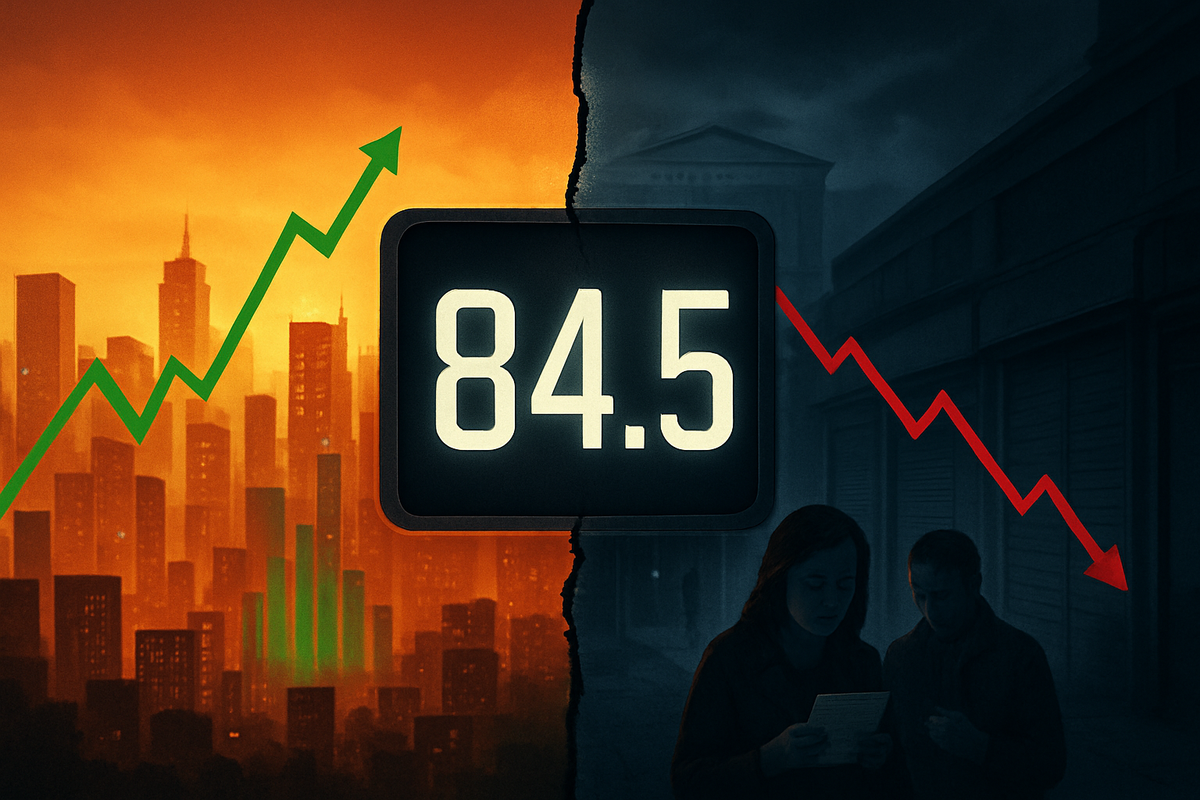
The American consumer is currently living in two different realities. In early 2026, the Conference Board’s Consumer Confidence Index plummeted to a 12-year low of 84.5, a level not seen since the sluggish recovery of 2014. This sharp decline from December’s 94.2 reading has sent shockwaves through Wall Street, signaling a "psychological recession" that threatens to derail the post-pandemic economic narrative.
The immediate implications are dire for the retail sector and the Federal Reserve alike. While "hard" economic data like employment remains relatively stable, the "soft" data of consumer sentiment is flashing a bright red warning. An Expectations Index reading of 65.1—well below the 80-point threshold that traditionally signals an impending recession—suggests that the American public is bracing for a significant downturn, driven by a combination of geopolitical friction and a fractured domestic political landscape.
A Perfect Storm: Tariffs, Shutdowns, and the 84.5 Floor
The collapse in sentiment did not happen in a vacuum. The timeline leading to the February 2026 low began in late 2025, when a 45-day federal government shutdown paralyzed Washington and disrupted social safety nets. Following the resolution of the shutdown, the administration's pivot toward an aggressive "America First" trade policy saw the implementation of 25% across-the-board tariffs on goods from Canada, Mexico, and China. This move, intended to bolster domestic manufacturing, resulted in immediate "shelf-shock" for consumers as retailers passed through the added costs of imported electronics, produce, and automotive parts.
Key stakeholders, including the National Retail Federation and major logistics hubs, have noted that the volatility of early 2026 is unlike previous cycles. The market's initial reaction has been a flight to safety, with Treasury yields fluctuating as investors weigh the possibility of a "stagflation-lite" scenario—where growth stalls while inflation remains "sticky" due to trade-related cost pressures. The Conference Board's report confirms that the "labor market differential," which measures the gap between consumers saying jobs are "plentiful" versus "hard to get," has narrowed significantly for younger workers, adding a generational layer to the malaise.
The Bifurcated Marketplace: Retail Winners and Losers
The 12-year low in confidence has created a starkly divided landscape for public companies. Walmart (NYSE: WMT) has emerged as a primary beneficiary of the "trade-down" effect. As middle-class families feel the squeeze of 25% tariffs, they are increasingly abandoning traditional grocery chains in favor of Walmart’s value-driven ecosystem. The retail giant recently hit a historic $1 trillion market cap, fueled by its dominance in high-margin retail media and a robust supply chain that has partially mitigated tariff impacts. Similarly, Costco Wholesale Corp. (NASDAQ: COST) and Ross Stores (NASDAQ: ROST) have seen resilient foot traffic as consumers seek to maximize the value of every dollar spent.
Conversely, Target Corp. (NYSE: TGT) is facing one of its most challenging periods in a decade. Heavily reliant on discretionary categories like home decor and "cheap-chic" apparel—items consumers are the first to cut during a sentiment crisis—Target’s stock has lagged the broader market by nearly 20% over the last year. The luxury sector is also seeing a dramatic split; while LVMH Moët Hennessy Louis Vuitton (OTC: LVMUY) continues to see modest growth from the ultra-wealthy "top 1%," the "aspirational" luxury buyer has vanished. This was punctuated by the early 2026 bankruptcy filing of Saks Global, which serves as a cautionary tale for any retailer caught in the "squeezed middle" of the American economy. Meanwhile, Amazon.com, Inc. (NASDAQ: AMZN) remains in a state of flux, with its retail growth flattening while it aggressively pivots toward $200 billion in AI-related capital expenditures to offset slowing consumer transactions.
The Partisan Trap: Why the Fed is Flying Blind
The most significant hurdle for economic policy is the unprecedented partisan divergence in sentiment. In early 2026, the gap has reached a fever pitch: Republicans report a confidence level of 120, a figure representing boom-time optimism, while Democrats and Independents have cratered to a reading of 70. This 50-point "sentiment chasm" is largely driven by differing views on trade policy; while 71% of Republicans view the new tariffs as a necessary long-term gain, over 90% of Democrats view them as an immediate tax on the working class.
This divergence complicates the Federal Reserve’s mandate. Traditionally, the Fed uses consumer sentiment as a leading indicator for future spending. However, when half the country views the economy through a lens of total optimism and the other half through total despair, the "aggregate" number of 84.5 becomes an unreliable signal. Fed Chair Jerome Powell and his colleagues are currently maintaining a federal funds rate of 3.50%–3.75%. The Fed is in a "wait-and-see" pause, but the partisan noise makes it nearly impossible to determine if the "vibecession" will eventually lead to a real-world collapse in spending that necessitates a drastic rate cut in May.
What Lies Ahead: Pivot or Plunge?
The short-term outlook depends heavily on whether the high-confidence group (Republicans) continues to spend at a rate that offsets the pullback from the low-confidence group (Democrats/Independents). If the "wealth effect" from a still-buoyant stock market persists, the economy may narrowly avoid a technical recession. However, if the tariffs lead to a sustained second wave of inflation, the Fed may be forced to keep rates higher for longer, potentially turning the "psychological recession" into a structural one.
Retailers will likely need to undergo strategic pivots. We expect more companies to follow the lead of Walmart and Amazon by investing heavily in automation to lower overhead and mitigate the costs of trade barriers. Investors should watch for a "consolidation of the middle," where mid-tier malls and department stores are liquidated in favor of discount warehouses and ultra-luxury boutiques. The "K-shaped" recovery of the 2020s has evolved into a "K-shaped" sentiment reality that could persist through the 2026 midterm elections.
Navigating the Sentiment Schism
The 12-year low in US consumer confidence is a landmark event that highlights the decoupling of political identity from economic reality. With the headline index at 84.5, the data suggests a country in retreat, yet the 50-point partisan gap tells a story of a nation that cannot even agree on whether the "shop is open or closed." For the market, this means that volatility is no longer just a reaction to interest rates—it is a reaction to the prevailing political wind.
Moving forward, investors must look past aggregate indices and focus on the spending patterns of specific demographic cohorts. The "wait-and-see" approach of the Federal Reserve is the only logical path in an environment where the data is so deeply bifurcated. In the coming months, the critical metrics to watch will be the "Expectations Index" and core PCE inflation; if the former stays below 80 and the latter stays above 2.5%, the "soft landing" of 2025 may become the "hard reality" of late 2026.
This content is intended for informational purposes only and is not financial advice.