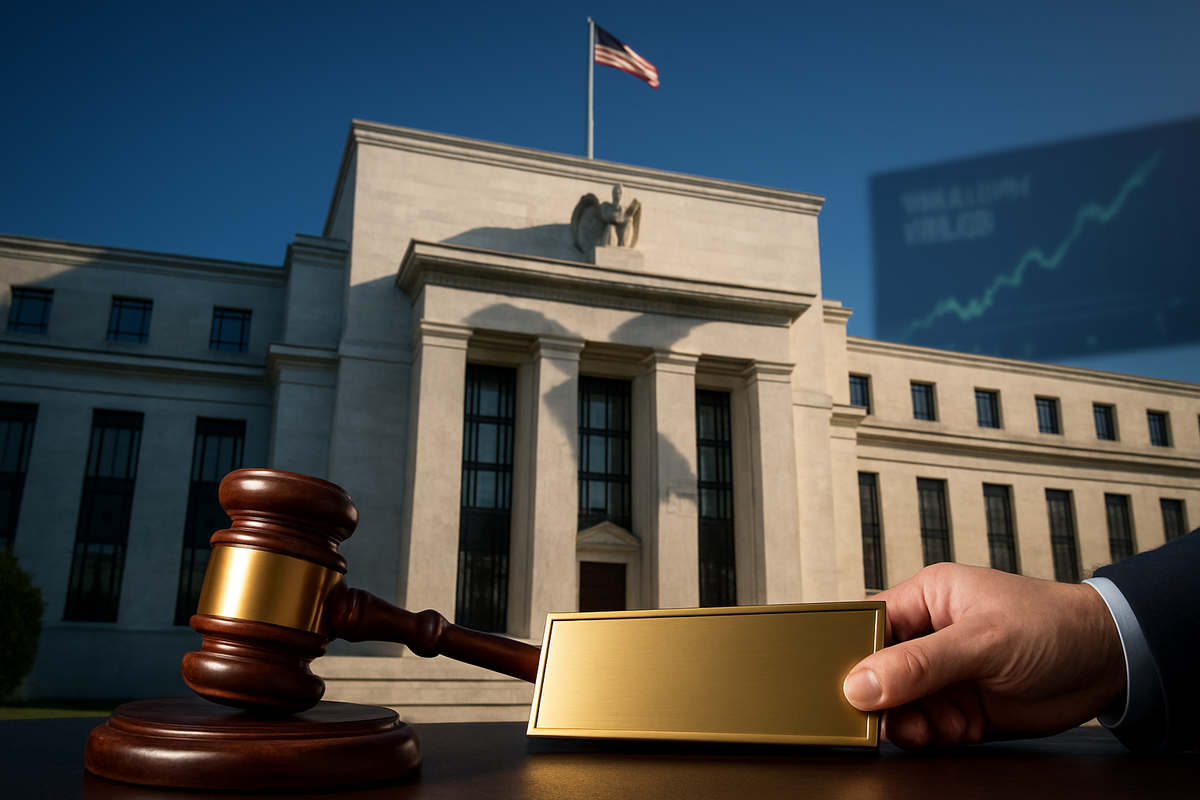
In a move that signals a seismic shift in U.S. monetary policy, President Donald Trump has formally nominated Kevin Warsh to serve as the next Chair of the Federal Reserve. The announcement, made in late January 2026, sets the stage for a transition of power at the world’s most influential central bank as Jerome Powell’s second four-year term approaches its conclusion on May 15, 2026. The selection of Warsh, a former Fed Governor and critic of long-standing "easy money" policies, suggests a pivot toward a more hawkish, rules-based approach to governing the American economy.
The immediate implications of this nomination are profound. By naming a successor months before Powell's departure, the administration aims to minimize market uncertainty during the transition. However, Warsh’s reputation as a policy "hawk"—an official who prioritizes controlling inflation over stimulating growth—has already sent ripples through the fixed-income and equity markets. Investors are now recalibrating their expectations for the path of interest rates, anticipating a Fed that may be less inclined to rescue markets during downturns and more focused on long-term price stability.
A Return to the "Rules-Based" Doctrine
Kevin Warsh, currently a fellow at the Hoover Institution and a former executive at Morgan Stanley (NYSE: MS), is no stranger to the inner workings of the Eccles Building. Having served as the youngest Fed Governor in history from 2006 to 2011, Warsh was a key architect of the response to the 2008 financial crisis. Despite his involvement in those emergency measures, he later became a vocal critic of the Federal Reserve's reliance on quantitative easing (QE) and what he termed "groupthink" among central bankers. His nomination follows a period of intense speculation that saw other high-profile figures, such as Scott Bessent, considered for the role.
The timeline leading to this moment has been marked by a growing divergence between the Trump administration’s economic goals and the Fed's "data-dependent" strategy under Powell. Throughout late 2025, inflation remained a stubborn hurdle, leading to friction over the pace of rate cuts. Warsh’s appointment is widely viewed as an attempt to install a leader who favors market-based signals—such as gold prices and commodity trends—over lagging academic indicators like the Phillips Curve. Initial market reactions were swift: Treasury yields ticked upward as the "Warsh Premium" was priced in, reflecting expectations of a tighter monetary stance.
Winners and Losers in a Warsh-Led Economy
The transition to a Warsh-led Federal Reserve creates a distinct set of winners and losers across the corporate landscape. The banking sector stands out as the primary beneficiary. Large financial institutions like JPMorgan Chase & Co. (NYSE: JPM), Bank of America Corp. (NYSE: BAC), and The Goldman Sachs Group, Inc. (NYSE: GS) typically thrive in environments with higher interest rates, which allow them to expand their net interest margins. Furthermore, Warsh’s history suggests a preference for "tailored regulation," which could lead to a rollback of stringent capital requirements such as the Basel III Endgame, providing these banks with more flexibility to return capital to shareholders.
Conversely, growth-oriented sectors and interest-rate-sensitive industries face significant headwinds. Technology giants like Apple Inc. (NASDAQ: AAPL) and Microsoft Corp. (NASDAQ: MSFT), whose high valuations are often justified by discounting future cash flows at lower interest rates, may see downward pressure on their multiples if Warsh maintains a restrictive policy. Similarly, the real estate sector, represented by major players like Prologis, Inc. (NYSE: PLD), could struggle as higher borrowing costs dampen demand for commercial and residential development. The "easy money" era that fueled the tech boom of the early 2020s appears to be firmly in the rearview mirror.
Broader Industry Trends and Historical Context
Warsh’s nomination fits into a broader global trend of reassessing central bank independence and the limits of monetary intervention. For the past decade, central banks have been the primary drivers of market liquidity; Warsh represents a return to a more disciplined, "rules-based" framework similar to the era of Paul Volcker. This shift could trigger a "ripple effect" among international partners, forcing the European Central Bank and the Bank of Japan to adjust their own policies to prevent excessive currency volatility against a strengthening U.S. Dollar.
Historically, the transition between Fed Chairs has often coincided with market volatility. When Paul Volcker took the helm in 1979, he famously broke the back of inflation with aggressive rate hikes that led to a painful but necessary recession. While the current economic environment is not as dire as the late 70s, Warsh’s skepticism of the Fed’s balance sheet expansion suggests he may prioritize "normalizing" the Fed's role in the economy, even if it leads to short-term market corrections. This "tough medicine" philosophy marks a clear departure from the pragmatic, consensus-driven leadership style of Jerome Powell.
The Path to Confirmation and Strategic Pivots
Looking ahead, the next few months will be dominated by Warsh’s confirmation hearings before the Senate Banking Committee. While the Republican-controlled Senate is expected to support the nominee, Democrats are likely to grill Warsh on his views regarding the Fed’s dual mandate—specifically how his hawkish stance might impact employment levels among vulnerable populations. Investors should prepare for a period of heightened rhetoric regarding the independence of the Fed, as Warsh will have to balance his alignment with Trump’s pro-growth agenda against the necessity of maintaining the institution’s credibility.
In the short term, corporations may need to pivot their capital allocation strategies. With the prospect of "higher-for-longer" rates becoming more certain, companies may accelerate debt refinancing before Warsh takes the gavel in May. We may also see a shift in investor preference toward "value" stocks and companies with strong balance sheets that do not rely on cheap credit to fund operations. The strategic advantage will likely shift to firms that can maintain profitability in a high-cost-of-capital environment.
Summary and Final Thoughts
The nomination of Kevin Warsh represents more than just a change in leadership; it is a fundamental re-evaluation of the Federal Reserve's relationship with the financial markets. Key takeaways include a likely shift toward higher interest rates, a focus on deregulation for the banking sector, and a move away from unconventional monetary tools like QE. While this may cause short-term turbulence for tech and real estate, it aims to provide a more stable, inflation-resistant foundation for the long term.
As we move toward May 2026, investors should keep a close watch on the yield curve and the U.S. Dollar index. The "Warsh Fed" will likely be more transparent but less predictable than the Powell Fed, as it moves away from "forward guidance" and back toward responding to real-time market signals. The coming months will determine whether this pivot can achieve a sustainable equilibrium or if the "tough medicine" of the Warsh era will test the resilience of the American consumer and the global financial system.
This content is intended for informational purposes only and is not financial advice.