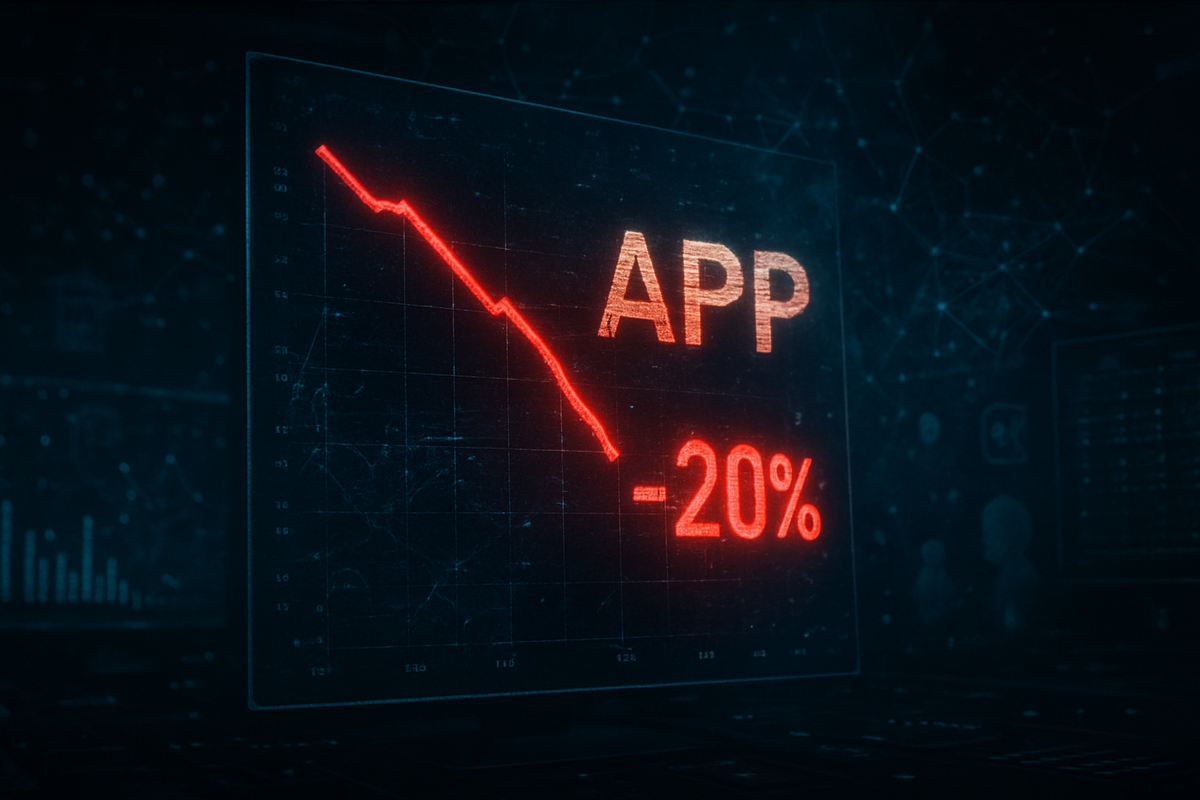
In a stunning reversal for one of 2025’s top market performers, AppLovin (NASDAQ: APP) saw its shares crater by 20% following its fourth-quarter earnings report on February 11, 2026. Despite posting "beat-and-raise" results that exceeded Wall Street’s expectations for both revenue and earnings, the Palo Alto-based software company became a victim of its own high-flying success. Investors, increasingly wary of a "growth normalization" narrative, sent the stock tumbling as concerns over intensifying AI-driven competition and an ongoing regulatory probe overshadowed record-breaking profit margins.
The sell-off has wiped billions from AppLovin’s market capitalization, marking a nearly 40% decline from its all-time highs reached in late 2025. This dramatic move highlights the fragility of high-beta AI software stocks in a market that is no longer satisfied with simple earnings beats. As the dust settles, the industry is left questioning whether the "moat" built by AppLovin’s AXON 2.0 engine is deep enough to withstand a new wave of disruptive technologies and a tightening regulatory environment.
The Perfect Storm: Growth Deceleration Meets Emerging Threats
The catalyst for the plunge was the company’s February 11 earnings release. For the fourth quarter of 2025, AppLovin reported revenue of $1.66 billion—a 66% year-over-year increase—and a record adjusted EBITDA margin of 84.4%. However, the market’s focus quickly shifted to the first-quarter 2026 guidance. While AppLovin projected revenue between $1.745 billion and $1.775 billion, the implied sequential growth of just 5% to 7% signaled a significant cooling off from the hyper-growth seen throughout 2024 and 2025. Analysts noted that for a stock trading at a price-to-sales ratio exceeding 30x, any hint of "averaging out" was bound to trigger a revaluation.
Beyond the numbers, the week leading up to the earnings report was fraught with anxiety. On February 4, a new competitor named CloudX—founded by the original creator of MoPub—officially launched its AI-native supply-side platform. CloudX’s "monetization as code" approach is seen as a direct threat to AppLovin’s MAX mediation platform. Simultaneously, Alphabet Inc. (NASDAQ: GOOGL) unveiled "Project Genie," a generative AI tool that could commoditize game development, potentially flooding the market with content and diluting the value of AppLovin’s discovery tools.
The timeline of the collapse was further accelerated by lingering reputational damage from a January short-seller report by CapitalWatch. Although the firm retracted its most sensational claims of financial impropriety just days before the earnings call, the initial shock had already weakened investor resolve. Furthermore, the Securities and Exchange Commission (SEC) is reportedly intensifying its investigation into "identifier bridging" practices—a technique AppLovin uses to track users across apps—raising the specter of significant legal and operational hurdles in the coming year.
Winners and Losers in the Ad-Tech Shakeout
The primary "winner" emerging from this volatility appears to be the new guard of AI-native startups like CloudX and its partners, including Magnite (NASDAQ: MGNI). These companies are positioning themselves as more transparent and technologically agile alternatives to the "black box" algorithms that have dominated the last five years. By focusing on agent-led advertising, these disruptors are betting that the next phase of the mobile economy will rely on open-source efficiency rather than proprietary data moats. Meta Platforms (NASDAQ: META) also stands to gain, as it has reportedly become more aggressive in bidding for in-game traffic, successfully reclaiming market share it lost following Apple’s 2021 privacy changes.
On the losing side, Unity Software (NYSE: U) was caught in the blast radius. Just a day before AppLovin’s report, Unity shares plummeted 26% after the company issued muted guidance and admitted to technical struggles with its own ad engine. The dual collapse of Unity and AppLovin has created a "sector contagion," leading investors to flee the mobile gaming tech space en masse. Other high-multiple software players like The Trade Desk (NASDAQ: TTD) have also felt the heat, as the market begins to question the long-term durability of high-margin AI software when faced with potential regulatory crackdowns on data collection.
Retail investors who bought into AppLovin during its meteoric rise in 2025 are currently facing the steepest losses. However, institutional "value hunters" may see this as an entry point, given that the company still generates massive free cash flow—nearly $4 billion in 2025. The disparity between those betting on continued disruption and those focusing on current cash flow has created a deeply bifurcated sentiment around the stock.
A Wider Significance: The End of the AI 'Black Box' Era?
The AppLovin sell-off is a microcosm of a broader shift in the technology sector. For years, investors rewarded "black box" AI solutions that delivered high returns without requiring a deep understanding of the underlying data mechanics. However, the rise of regulatory scrutiny—specifically the SEC’s interest in "identifier bridging"—suggests that the era of aggressive data stitching may be coming to a close. This event serves as a warning that platform-dependent companies are always one policy change or one regulatory probe away from a massive valuation reset.
Historically, this event mirrors the "post-ATT" (App Tracking Transparency) shock of 2021, when Meta and other social media giants lost billions in market value overnight. The difference in 2026 is that the disruption is coming from within the AI field itself. The launch of CloudX and Google’s Project Genie represents a second wave of AI—one that prioritizes generative creation and automated mediation over traditional user targeting. This suggests that the "moats" built on 2023-2024 AI models are already being disrupted by 2026-era agentic workflows.
Furthermore, the "sell-the-news" reaction to AppLovin’s strong earnings highlights a shift in market psychology. In a high-interest-rate environment where capital is no longer "free," investors are demanding more than just growth; they are demanding sustainable, long-term defensibility. When a company like AppLovin, which arguably has the best margins in the software world, sees its stock crushed after a beat-and-raise, it signals that the market is beginning to prioritize "tail risks" (like SEC probes and AI displacement) over current-quarter performance.
What Comes Next: Strategic Pivots and Market Hurdles
In the short term, AppLovin must address the SEC investigation and provide a clear roadmap for how it will maintain its edge without relying on controversial data-stitching techniques. Management will likely need to accelerate their own "agentic" AI transitions to compete with CloudX, potentially sacrificing some of their industry-leading margins to reinvest in R&D. A strategic pivot toward more transparent, first-party data solutions may be necessary to appease both regulators and privacy-conscious advertisers.
Longer-term, the company faces a fundamental question: can it remain the "king of mobile gaming" in a world where AI makes game creation effortless? If Google’s Project Genie succeeds in democratizing game development, the volume of apps could explode, making AppLovin’s curation and discovery tools more valuable—or, conversely, making the entire ecosystem so fragmented that no single platform can dominate. AppLovin may seek to diversify further into connected TV (CTV) or enterprise AI software to reduce its reliance on the volatile mobile gaming sector.
Potential scenarios for 2026 include a period of "dead money" for the stock as it consolidates and waits for regulatory clarity. However, if the company can prove that its AXON engine can adapt to an agent-led world, a significant recovery could occur by year-end. Investors should watch for any announcements regarding partnerships with major platforms or a resolution to the SEC probe as key indicators of a potential turnaround.
Final Takeaways: A Reality Check for Ad-Tech
The 20% plunge in AppLovin shares serves as a stark reminder that even the most efficient "money-printing machines" are not immune to market sentiment shifts and technological disruption. The key takeaway for investors is that in the 2026 market, a "beat-and-raise" is only as good as the guidance that follows it. Decelerating growth, even at a high level, is being punished severely as the market recalibrates its expectations for the AI software sector.
Moving forward, the ad-tech space will likely remain highly volatile as it grapples with the dual forces of AI innovation and regulatory tightening. The "moats" of yesterday are being tested by the "agents" of tomorrow. Investors should keep a close eye on the SEC’s findings and the adoption rates of new competitors like CloudX over the coming months.
Ultimately, while AppLovin remains a highly profitable and formidable player in the digital landscape, its recent "fall from grace" underscores a new reality: in the age of rapid AI evolution, no lead is safe, and no valuation is permanent. The coming months will determine if this was merely a healthy correction or the beginning of a larger structural decline for the former darling of the ad-tech world.
This content is intended for informational purposes only and is not financial advice