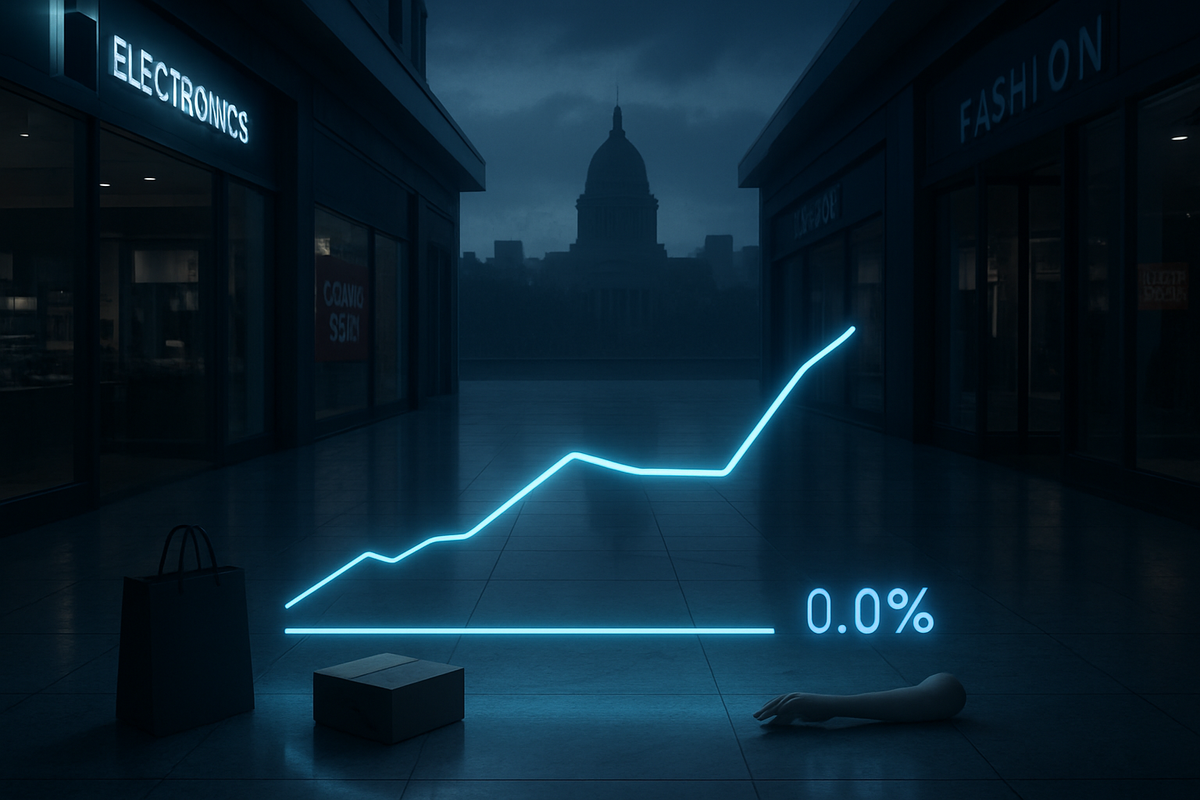
The American consumer, long the indomitable engine of the global economy, appears to have hit a sudden roadblock. Fresh data released by the Commerce Department on February 10, 2026—following a delay caused by a 43-day government shutdown—revealed that retail sales were flat (0.0%) in December 2025. This stagnation defied the 0.4% growth that economists had widely predicted, marking a sharp reversal from the robust 0.6% gain recorded in November and signaling a cooling of the holiday spirit.
The flat reading is more than just a statistical miss; it serves as a harbinger of a potential slowdown in economic growth as the nation moves into the first quarter of 2026. With inflationary pressures lingering and the labor market showing early signs of softening, the stalled sales data suggests that households are finally tightening their belts. This shift in behavior is already rippling through the financial markets, forcing investors to re-evaluate their expectations for corporate earnings and Federal Reserve policy in the coming months.
A Post-Holiday Chill: Analyzing the December Stagnation
The release of the December retail report was met with an audible gasp from Wall Street, not only because of the missed estimates but because of the breadth of the decline. While total sales were flat, eight out of thirteen major retail categories posted month-over-month decreases. Discretionary spending, the lifeblood of retail growth, was the primary casualty. Electronics and appliances saw a 0.4% dip, while clothing and accessories fell by a more substantial 0.7%. Even the normally resilient furniture and home furnishings sector suffered a steep 0.9% drop, indicating that consumers are delaying big-ticket purchases and home improvements.
The timeline leading up to this moment was characterized by a false sense of security. In November 2025, a 0.6% surge in retail sales led many to believe that the economy would cruise into the new year with significant momentum. However, the data suggests that much of that November activity may have been "pulled forward" by aggressive early holiday discounting, leaving December’s registers cold. The primary stakeholders—ranging from the Commerce Department to major retail lobby groups—now find themselves grappling with a "soft handover" to 2026 that looks increasingly fragile.
Market reaction was immediate and defensive. Bond yields initially slipped as investors bet on a more dovish Federal Reserve, while equity futures for major retailers saw significant volatility. The "control-group" sales figure, which strips out volatile items like gasoline and automobiles and is used directly to calculate GDP, actually fell by 0.1%. This prompted major banking institutions to immediately downwardly revise their Q1 2026 growth forecasts, with some analysts warning of a "no-growth landing" for the start of the year.
Winners and Losers in a Tightened Economy
In an environment of flat consumer spending, the retail landscape has split into a clear divide of winners and losers. Walmart Inc. (NYSE: WMT) has emerged as the definitive champion of this cycle, recently hitting a historic $1 trillion market capitalization. As middle-class families face a squeeze on their disposable income, Walmart has benefited from a "trade-down" effect, capturing market share as shoppers prioritize groceries and essential household goods over discretionary luxuries. The company’s ability to use its massive scale to keep prices low has turned it into a primary destination for a budget-conscious public.
Conversely, Target Corporation (NYSE: TGT) has found itself on the losing side of this shift. Historically more dependent on discretionary categories like home decor and apparel, Target’s sales mix has left it vulnerable to the current spending freeze. The company has already warned investors of "meaningful profit pressure" for the first half of 2026, as it struggles to move inventory that consumers are no longer willing to splurge on. Similarly, department store stalwarts like Macy’s Inc. (NYSE: M) reported a 0.3% decline in sales, forcing them into aggressive cost-cutting and inventory liquidations to protect shrinking margins.
Even the giants of e-commerce are not immune to the slowdown. Amazon.com, Inc. (NASDAQ: AMZN) reported only a modest 0.1% growth in its non-store category for December, a far cry from the double-digit growth rates of previous years. While still a dominant force, the cooling of Amazon's growth suggests that even the convenience of online shopping is hitting a ceiling of consumer exhaustion. Meanwhile, Costco Wholesale Corporation (NASDAQ: COST) remains a resilient outlier due to its membership model and bulk-value proposition, though its shares faced a temporary sell-off as investors questioned whether its high valuation could be sustained in a flat-demand environment.
Policy Pivots and the Ghost of Stagflation
The stagnation in retail sales fits into a broader, more concerning trend: a decline in consumer confidence that has hit its lowest level in over a decade. The Conference Board reported that its sentiment index plummeted from 94.2 in December to 84.5 in January 2026. Consumers cited a "triple threat" of high tariffs, persistent inflation, and a softening labor market as reasons for their sudden caution. This shift in sentiment is a significant blow to an economy where consumer spending accounts for roughly two-thirds of GDP.
This data has placed the Federal Reserve in a precarious position. During its January 2026 meeting, the Federal Open Market Committee (FOMC) held interest rates steady at 3.5%–3.75%, pausing a brief easing cycle that began in late 2025. While some Fed officials, such as Raphael Bostic, have expressed concern about persistent inflation, the flat retail data has intensified market pressure for a pivot. Historically, such a sharp drop in consumer activity preceded the recessions of 2001 and 2008, and the current flat-line reading is reviving fears of "stagflation"—a scenario of stagnant growth coupled with stubbornly high prices.
The ripple effects are also being felt by international partners. As US demand for imported electronics and clothing wanes, global supply chains—already strained by geopolitical tensions—are bracing for a reduction in order volumes. This could lead to a feedback loop where reduced demand from American consumers slows manufacturing growth in exporting nations, further dampening the global economic outlook for the remainder of 2026.
What Comes Next: Strategic Pivots and Market Scenarios
In the short term, retailers will likely respond to this spending stall with a "race to the bottom" on pricing. Expect to see aggressive promotional activity throughout the first quarter of 2026 as companies attempt to clear excess winter inventory. This will be a double-edged sword: while it may temporarily boost sales volumes, it will inevitably erode profit margins. Investors should pay close attention to the upcoming Q4 earnings calls, where executives are expected to offer conservative guidance and announce further cost-saving measures, including potential store closures or layoffs in the department store sector.
Long-term, the focus will shift toward the "value" and "essential" sectors. Companies that can demonstrate a clear value proposition—offering lower prices for high-volume items—will be the primary beneficiaries of a prolonged consumer pullback. There is also a potential for a strategic pivot toward service-based offerings or private-label brands, which often carry higher margins than third-party discretionary goods. If the Federal Reserve chooses to cut interest rates in April 2026, as markets now predict, we may see a slight rebound in consumer confidence; however, the scars of 2025’s inflationary spike may keep the public cautious for some time.
Summary and Outlook for Investors
The flat December retail sales report serves as a stark reminder that the post-pandemic consumer boom has finally reached its limit. With actual growth at 0.0% against a 0.4% expectation, the disconnect between economic forecasts and consumer reality is significant. The key takeaway is the widening gap between value-oriented retailers like Walmart and discretionary-heavy stores like Target. The former is well-positioned to navigate a downturn, while the latter faces a challenging road ahead.
Moving forward, the market will be hyper-focused on the Federal Reserve's next move and the subsequent monthly retail reports for January and February. For investors, the coming months will require a defensive posture. Keep a close watch on the "control-group" metrics and consumer sentiment data; if these continue to trend downward, the risk of a technical recession in early 2026 will increase substantially. In this new era of stalled spending, selectivity and a focus on essential services will be the hallmark of a successful portfolio strategy.
This content is intended for informational purposes only and is not financial advice.