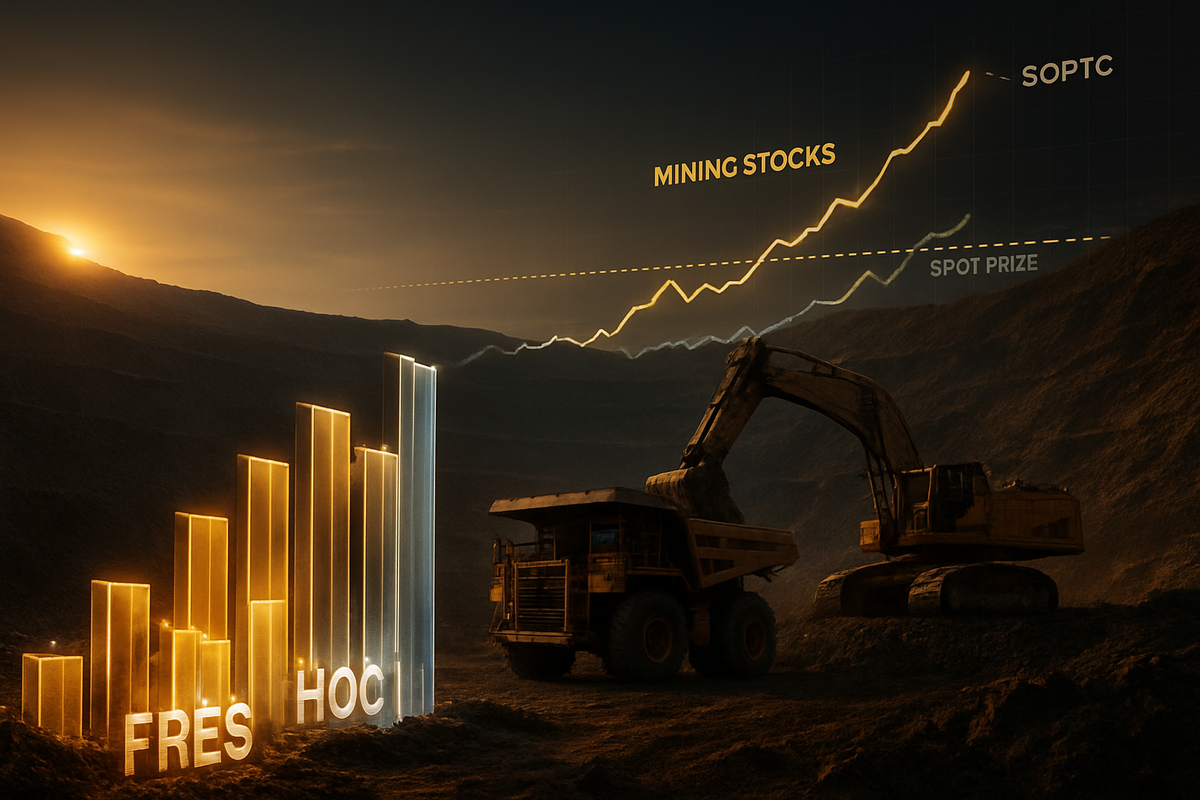
As of February 12, 2026, the global precious metals market is witnessing a historic realignment. For years, investors lamented the "disconnect" between surging gold and silver spot prices and the seemingly stagnant share prices of the companies that pull these metals from the ground. However, following a blockbuster 2025, the narrative has shifted from one of frustration to one of high-octane "catch-up." Mining equities, led by giants like Fresnillo PLC and mid-tier players like Hochschild Mining, have finally moved into a high-leverage phase, significantly outperforming the underlying commodities they track.
This dramatic reversal marks a turning point for the sector, which spent much of 2024 struggling under the weight of "sticky" inflationary pressures and rising All-In Sustaining Costs (AISC). Today, with gold prices stabilizing at record highs and silver hovering near $60 an ounce, the mining industry is reaping the rewards of massive margin expansion. The MarketVector Global Gold Miners Index (MVGDXTR), the benchmark for the sector, now reflects a valuation landscape that suggests the "lag" is officially a thing of the past, though new risks regarding cost discipline and production grades are beginning to emerge.
The Great Reversal: From Laggards to Leaders
The timeline leading to this moment began in early 2024, a period characterized by a puzzling divergence. While gold spot prices were smashing through the $2,400 per ounce ceiling, mining stocks remained tethered to the floor. The primary culprit was a "margin squeeze": although revenue was rising, the costs of labor, diesel, and electricity were rising just as fast, preventing the higher metal prices from trickling down to the bottom line. Investors preferred the safety of physical gold ETFs over the operational risks of mining companies.
However, the tide turned in the latter half of 2024 and into 2025. Once gold crossed the psychological $2,500 threshold and silver broke $30, the "unit profit" per ounce began to expand exponentially. In 2025 alone, while gold delivered a staggering 65% gain, the VanEck Gold Miners ETF (NYSE Arca: GDX), which tracks the MarketVector Global Gold Miners Index, converted that into a 155% upside. This parabolic move was the "catch-up mode" in its purest form—a period where mining equities leverage their fixed-cost bases to deliver outsized returns during the peak of a bull market.
Winners and Losers in the Mining Renaissance
Within this broad rally, performance has been bifurcated based on operational efficiency and jurisdictional stability. Fresnillo PLC (LSE: FRES) has emerged as one of the primary victors. As the world’s largest primary silver producer, Fresnillo saw its share price nearly treble in the twelve months leading up to October 2025, fueled by silver’s ascent to a historic $64 per ounce. Despite some concerns over declining gold grades at its Herradura mine in early 2026, the company’s strong balance sheet and a forecast dividend yield of 3% have kept it in favor with institutional heavyweights like J.P. Morgan.
Conversely, Hochschild Mining (LSE: HOC) presents a more complex story of the risks inherent in the "catch-up" phase. While the stock saw its price increase fivefold from 2021 lows by early 2026, it has been plagued by operational volatility. In August 2025, the company suffered a 16% single-day share price collapse after cutting production guidance in Brazil due to heavy rainfall and contractor disputes. By January 2026, analysts began cooling on the stock, citing a sharp rise in projected AISC to over $2,150 per gold-equivalent ounce, highlighting that even in a bull market, operational execution remains paramount.
Valuation Shifts and Industry Significance
A structural milestone for the sector occurred on September 19, 2025, when the flagship GDX ETF officially transitioned to tracking the MarketVector Global Gold Miners Index. This move was designed to focus on "free-float" market capitalization, providing a more accurate representation of the liquidity available to global investors. Currently, the index trades at a forward P/E ratio of 13x to 24x, a significant jump from the depressed levels seen in early 2024.
The wider significance of this shift lies in the "Operating Leverage" story. By the fourth quarter of 2025, with gold averaging $4,150 per ounce and industry-wide AISC stabilizing around $1,525 per ounce, miners were operating at profit margins exceeding 170%. This unprecedented profitability has allowed major players like Barrick Gold (NYSE: GOLD) and Newmont Corporation (NYSE: NEM) to aggressively reduce debt and fund new exploration, fundamentally altering the sector's risk profile compared to previous cycles.
The Road Ahead: 2026 and Beyond
As we move further into 2026, the primary challenge for the sector will be managing the "mean reversion" risk. With the Price-to-Book (P/B) ratio for the MarketVector index sitting near 3.0x, some analysts warn that a cooling in precious metals prices could trigger a sharp correction in mining equities. The "catch-up" is complete, and the market is now in a "maintenance" phase where companies must prove they can sustain these margins even if commodity prices plateau.
Short-term opportunities may emerge from a shift in capital allocation. Having repaired their balance sheets in 2025, many miners are expected to pivot toward more aggressive dividend payouts and share buybacks in the coming months. However, investors must keep a close eye on rising government royalties—often tied to realized metal prices—which are starting to creep into AISC calculations, potentially capping the next leg of the rally.
Conclusion: A New Era for Mining Equities
The transformation of the mining sector between 2024 and 2026 serves as a masterclass in market cycles. The "catch-up mode" that defined 2025 has successfully closed the valuation gap, rewarding patient investors who looked past the initial lag. The sector has transitioned from a fringe play hindered by inflation to a central pillar of the global equity market, characterized by record-breaking margins and significant free cash flow.
Moving forward, the focus for investors should shift from macro commodity trends to micro operational performance. While the rising tide lifted all boats in 2025, the 2026 landscape will be more selective. Watch for companies that can maintain cost discipline in the face of rising royalties and those that can successfully navigate the jurisdictional challenges that tripped up players like Hochschild. The mining "gold rush" on the stock exchange may have matured, but its impact on the market will be felt for years to come.
This content is intended for informational purposes only and is not financial advice.