The economic landscape of February 2026 has reached a definitive turning point, as the long-promised "AI dividend" finally manifests in hard macroeconomic data. After years of skepticism regarding the "Solow Paradox"—the idea that computerization was visible everywhere except in productivity statistics—new reports from the Bureau of Labor Statistics and the Department of Commerce confirm that the U.S. economy is undergoing its most significant structural shift since the late 1990s.
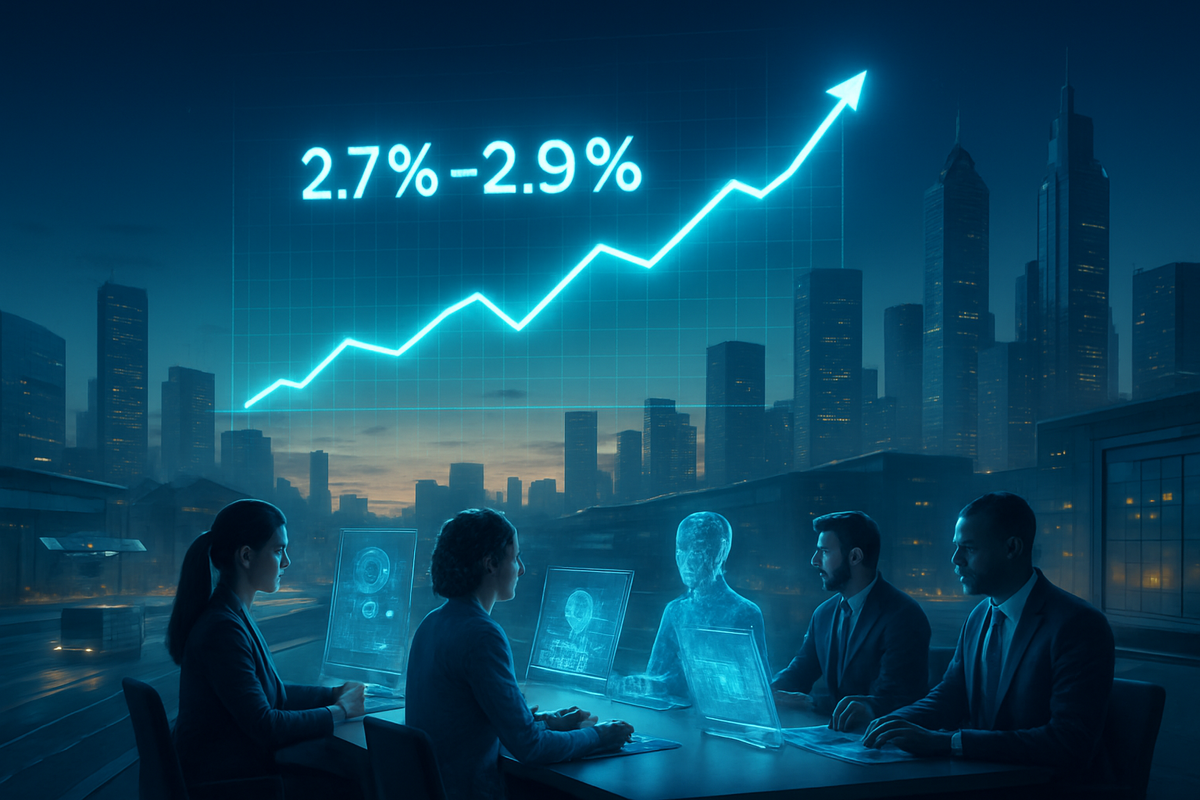
Gross Domestic Product (GDP) for the 2025 fiscal year has been revised upward, with 2026 projections now firmly settled in the 2.7% to 2.9% range. This growth occurs at a time when traditional economic models predicted a slowdown due to aging demographics and persistent labor shortages. Instead, the "Second Productivity Revolution" has decoupled output from headcount, allowing the economy to expand even as the available labor pool tightens.
The Dawn of the 'Age of Proof'
The transition from AI experimentation to full-scale economic impact began in earnest during the latter half of 2024 and accelerated through 2025. While early generative AI was criticized as a "fancy autocomplete," the deployment of autonomous "agentic" AI—software capable of executing multi-step business processes without constant human intervention—has fundamentally altered corporate cost structures. By late 2025, nonfarm business productivity surged by 4.9%, a figure reminiscent of the post-WWII golden age.
Key to this surge was the rapid adoption of AI by "traditional" sectors beyond the tech bubble. In the manufacturing sector, "Physical AI" and digital twin technology, championed by firms like Honeywell (NASDAQ: HON), have reduced production deployment times by as much as 40%. Simultaneously, in the service sector, the integration of AI agents has allowed firms to maintain operations with significantly fewer middle managers, leading to a "low-hire, low-fire" environment where vacancies are simply left unfilled in favor of automated solutions.
The timeline of this shift was punctuated by the "2025 Autonomous Breakthrough," where major enterprise software providers shifted from offering "chatbots" to "autonomous business units." This allowed corporations to absorb the impact of sticky labor costs—wages that remained high due to worker scarcity—without sacrificing profitability. By early 2026, corporate margins for the S&P 500 reached an estimated 13.9%, far exceeding the 11.5% historical average.
Winners of the Efficiency Era
The primary beneficiaries of this shift have been the "Power Implementers"—companies that successfully re-engineered their core workflows around AI. In the financial sector, JPMorgan Chase & Co. (NYSE: JPM) and Morgan Stanley (NYSE: MS) have set a new standard, with the latter using AI-augmented wealth management tools to support over 16,000 advisors, effectively doubling their capacity to handle complex client portfolios. These firms are seeing EBITDA margins significantly higher than their peers who lagged in technological adoption.
On the infrastructure side, the "sellers" of this revolution continue to thrive. NVIDIA (NASDAQ: NVDA) and Taiwan Semiconductor Manufacturing Co. (NYSE: TSM) remain the backbone of the movement, providing the processing power necessary for the "agentic" shift. Meanwhile, hyperscalers like Microsoft (NASDAQ: MSFT) and Alphabet (NASDAQ: GOOGL) have successfully transitioned from selling cloud storage to selling "intelligence-as-a-service," capturing a larger share of corporate IT budgets as AI becomes the primary driver of operational efficiency.
However, the 2026 market is also identifying clear losers. Companies with rigid labor agreements or legacy IT infrastructures that cannot integrate with modern AI agents are finding their margins squeezed. Brick-and-mortar retailers that failed to implement AI-driven inventory and logistics optimizations, unlike giants such as Amazon (NASDAQ: AMZN) and Walmart (NYSE: WMT), are struggling to maintain price competitiveness in a market where efficiency is now the primary differentiator.
A New Macroeconomic Paradigm
The wider significance of this productivity boom cannot be overstated. It represents a definitive departure from the 1990s internet boom. While the 90s was an era of "possibility"—characterized by speculative startups and debt-fueled growth—2026 is the era of "profitability." Today’s growth is driven by established, cash-rich giants using their massive free cash flow to fund nearly $700 billion in annual AI capital expenditures. This self-funding mechanism makes the current cycle far more resilient to interest rate fluctuations than previous tech cycles.
Furthermore, AI is acting as a "deflationary shield." In a world where labor costs are "sticky" and demographics are unfavorable, AI-driven efficiency prevents a wage-price spiral. By automating routine tasks, companies can afford higher wages for their remaining "AI-skilled" workers—who are seeing a 56% wage premium—without passing those costs on to consumers in the form of higher prices. This has allowed the Federal Reserve to maintain a "Goldilocks" environment of sustainable growth and stable inflation.
Regulatory bodies are also pivoting. As productivity gains become central to GDP growth, policy discussions are shifting from "AI safety" to "AI transition management." Governments are increasingly focused on how to retrain displaced workers while ensuring that the productivity windfall is not concentrated entirely in the hands of a few "hyperscalers." The historical precedent here is the transition from agrarian to industrial economies, though the current shift is occurring at nearly ten times the speed.
The Road to Physical AI
Looking ahead to the remainder of 2026 and into 2027, the market is bracing for the "Second Wave": the integration of AI into physical robotics and the broader supply chain. While the current gains are largely digital and administrative, the next frontier involves the widespread deployment of autonomous logistics. Companies like FedEx (NYSE: FDX) and United Parcel Service (NYSE: UPS) are already testing AI-driven route optimization and robotic sorting systems that aim for predictive accuracy of over 90%.
The long-term challenge for the market will be the "Intelligence Saturation" point. As AI becomes a utility rather than a competitive advantage, the premium currently enjoyed by early adopters may begin to fade. Companies will need to find new ways to differentiate themselves beyond mere efficiency. This could lead to a strategic pivot toward "Human-Centric Value," where the quality of human interaction and creative output becomes the next premium service in an automated world.
The Bottom Line for 2026
The 2026 economic story is one of resilience through technology. The "Great Decoupling" has proven that productivity can thrive even when traditional labor dynamics are constrained. For investors, the takeaway is clear: the focus has shifted from who builds AI to who uses AI best. The 2.8% GDP growth we are seeing is not a fluke; it is the first fruit of a fundamentally more efficient global economy.
As we move forward, the market will likely reward those companies that can show a direct correlation between their AI investments and their "output per worker." The "Age of Proof" is here, and it is being written in the margins of corporate earnings reports. Investors should watch for the next round of quarterly labor data to see if the productivity surge sustains its momentum into the second half of the year.
This content is intended for informational purposes only and is not financial advice