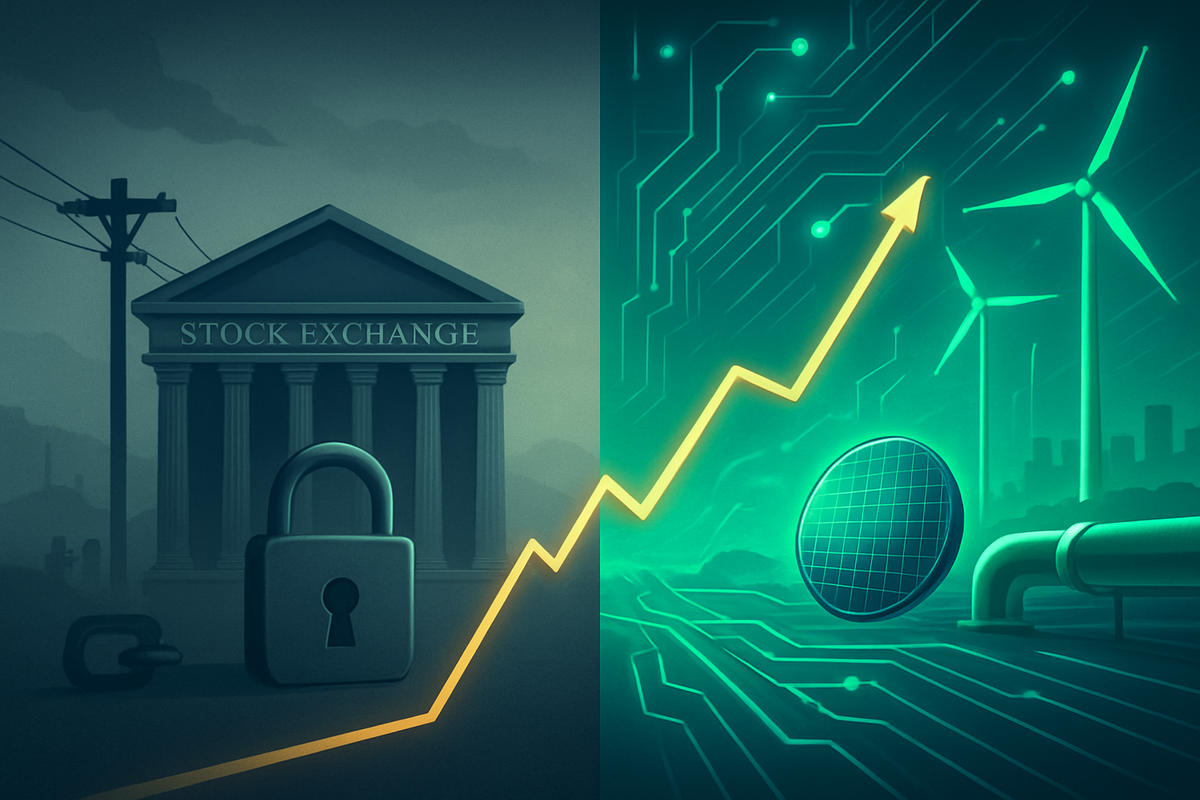
The opening weeks of 2026 have etched a stark portrait of a "two-speed" economy. As of February 12, 2026, the S&P 500 continues to hover near the historic 7,000-point milestone, but the celebratory headline masks a deep internal fracture. A handful of sectors—primarily high-octane Technology and a reimagined Energy sector—are pulling the weight of the entire index, while traditional pillars like Financials and Utilities have begun the year with a whimper. This bifurcation is no longer just a trend; it has become the defining characteristic of the Q1 2026 market.
The immediate implications for investors are sobering. The long-awaited "market broadening"—a scenario where small caps and defensive sectors participate in the rally—has failed to materialize. Instead, the market is doubling down on the "AI-Energy Nexus," a feedback loop where massive computing power demand is driving both chip sales and a desperate scramble for energy infrastructure. For the broader market, this lack of breadth suggests that the S&P 500’s valuation is increasingly dependent on a narrow corridor of secular growth, leaving it vulnerable to any shift in the "hard money" narrative emanating from Washington.
The Great Divide: Tech and Energy Surge While Others Stagnate
The story of January 2026 was written in silicon and power lines. The technology sector, led by a resurgent Nvidia (NASDAQ: NVDA), which maintains its crown as the world's most valuable company, surged as "hyperscale" capital expenditure hit a staggering projected run rate of $700 billion for the year. The transition from AI experimentation to full-scale enterprise deployment has silenced many skeptics. Investors in January 2026 were particularly emboldened by reports that AI-driven productivity gains were finally showing up in the bottom lines of software giants and semiconductor firms alike.
Parallel to the tech surge, the Energy sector emerged as an unlikely champion. Unlike the oil booms of the past, this rally was fueled by the "Electricity is the New Oil" thesis. While crude prices remained relatively stagnant in the $58 range, companies specializing in natural gas and power infrastructure saw massive inflows. The timeline leading to this surge began in late 2025, when it became clear that the global data center footprint would require a 20% increase in baseline power generation by 2027. This sparked a January buying spree in midstream players and power providers who are now viewed as essential "AI-adjacent" assets.
Conversely, the market's laggards have faced a brutal reality check. The "Warsh Shock"—named after the mid-January signals of a more aggressive, "hard money" stance from the Federal Reserve—sent shockwaves through rate-sensitive sectors. Utilities, typically seen as safe-haven dividend plays, were dumped as Treasury yields spiked, making their yields less attractive by comparison. Financials also took a hit, with the S&P 500 Financial Index underperforming as credit risk concerns and a volatile yield curve compressed margins for major lenders.
Winners and Losers in the AI-Energy Nexus
The clear winners of the January 2026 performance gap are the "Enablers." Microsoft (NASDAQ: MSFT) and Alphabet (NASDAQ: GOOGL) have seen their valuations swell as they successfully integrated AI agents into their core cloud offerings, providing tangible revenue growth that justified their high P/E ratios. In the hardware space, Nvidia and Amazon (NASDAQ: AMZN)—the latter now a dominant force in custom AI silicon—have become the go-to vehicles for institutional capital seeking growth at any price.
On the losing side, the Financial sector has faced a "perfect storm" of regulatory and macroeconomic headwinds. UnitedHealth Group (NYSE: UNH) and Humana (NYSE: HUM) weighed heavily on the sector in January following disappointing Medicare revenue forecasts and payment rate adjustments that sent insurance stocks into a tailspin. Furthermore, regional banks are struggling with the transition to a high-rate, low-liquidity environment, where the cost of deposits is eating into the profits typically expected during periods of high interest rates.
The Utility sector, while fundamentally sound in its long-term outlook for power demand, has been a short-term victim of its own success as a "bond proxy." Companies like NextEra Energy (NYSE: NEE) have seen their share prices pressured by the "hard money" policy shift, despite record-breaking requests for new data center connections. For investors, the lesson of early 2026 is clear: even a structural tailwind like AI power demand cannot always offset the gravity of rising interest rates.
Macroeconomic Crosswinds: The 'Warsh Shock' and Interest Rate Reality
This bifurcated performance fits into a broader industry trend where the "S&P 500" is increasingly a misnomer for an "S&P 10" or "S&P 20." The concentration risk at the top of the index has reached levels not seen since the late 1990s, but with a crucial difference: the leading companies are generating massive, real-world cash flows. However, the reliance on these few names has created a "fragile strength." If a company like Meta Platforms (NASDAQ: META) misses on its AI monetization targets, the ripple effects could derail the entire index.
Historically, periods of extreme market concentration often precede significant volatility. The current situation echoes the 2023 "Magnificent Seven" rally, but with the added complication of a more hawkish Federal Reserve. The nomination of Kevin Warsh as Fed Chair has signaled a departure from the "lower for longer" hopes of 2024. This "hard money" pivot is designed to combat sticky inflation, but it also creates a policy environment that favors cash-rich tech giants over debt-heavy utilities and cyclical financials, further widening the gap between the haves and the have-nots.
Looking Ahead: Will the Market Finally Broaden in Q1?
As we move deeper into Q1 2026, the primary question for the market is whether the "rest" of the S&P 500 can catch up. Short-term, the outlook for broadening remains bleak. With the Fed signaling that "hard money" is the new standard, the cost of capital will likely remain high, continuing to penalize the Financials and Industrials that rely on cheap borrowing for expansion. The strategic pivot for many companies will be to find an "AI angle" to re-rate their stock—a move that is becoming increasingly difficult as investors demand proof of revenue rather than just "AI-washing" in earnings calls.
Market opportunities may emerge in the "Value Tech" or "Infrastructure" niches. If Utilities can decouple from their bond-like behavior and trade on their utility-as-growth-infrastructure merits, they could see a significant rebound later in the quarter. However, the more likely scenario is a continued consolidation of power. We may see a "survival of the fattest" where the companies with the largest balance sheets use their capital to acquire smaller competitors who are struggling under the weight of high interest rates, potentially leading to a new wave of M&A activity in the tech and energy sectors.
A High-Stakes Balancing Act for 2026
The performance of the S&P 500 in January 2026 has provided a definitive answer to the question of market breadth: it is currently non-existent. The index is being propelled by an unprecedented synergy between the digital and physical worlds—AI and Energy—while the traditional economic engines of finance and public utilities remain stuck in low gear. For the market to maintain its upward trajectory toward the end of Q1, these two leading sectors will have to deliver "flawless" earnings to satisfy their bloated valuations.
For investors, the coming months require a defensive yet opportunistic stance. While it is tempting to chase the winners in Tech and Energy, the high concentration levels suggest that the risk of a sharp "mean reversion" is rising. Moving forward, the most important indicators to watch will be the "Warsh Fed's" interest rate decisions and the Q1 earnings reports from the big banks, which will serve as a bellwether for the health of the broader consumer economy. In 2026, the gap between the market leaders and the laggards isn't just a statistical quirk—it’s a roadmap for the new economic order.
This content is intended for informational purposes only and is not financial advice.