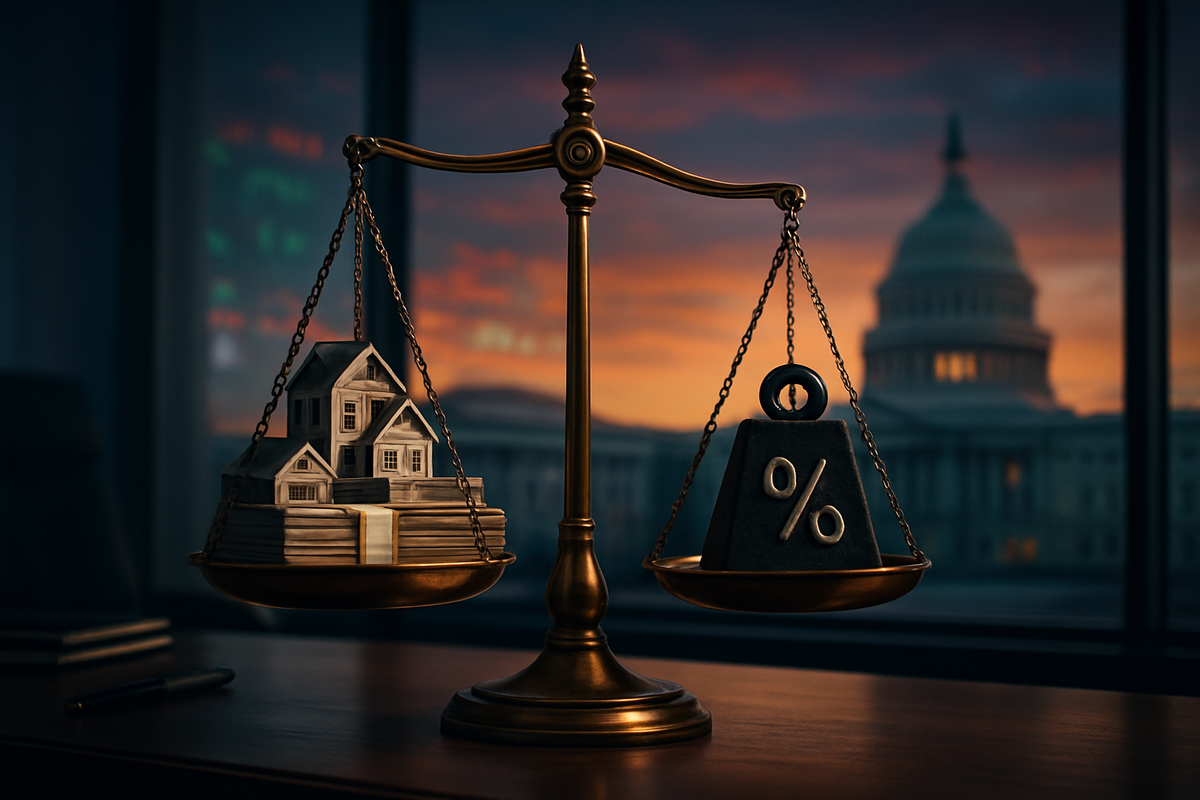
Following the release of a robust January jobs report that exceeded all Wall Street expectations, President Donald Trump has reignited his aggressive campaign against current Federal Reserve policy, calling for the United States to implement the “lowest interest rates in the world.” The President’s remarks, punctuated by a celebratory “Great jobs numbers!” post on social media, have placed his hand-picked Fed Chair nominee, Kevin Warsh, in an increasingly delicate position. While the administration views the strong labor data as a victory for its deregulation and tariff-heavy agenda, the figures have simultaneously gutted market expectations for a significant rate cut in the coming months.
The tension between the White House and the central bank has reached a fever pitch as the administration argues that the U.S. economy can sustain ultra-low interest rates—comparable to those in Japan or Switzerland—without triggering a resurgence of inflation. However, with the 10-year Treasury yield climbing to 4.19% in response to the jobs data, the bond market appears to be signaling a different reality: an economy that is growing too fast to justify the aggressive easing the President demands. This disconnect is setting the stage for a historic showdown over the future of American monetary policy and the independence of the Federal Reserve.
Resilient Labor Data Meets Political Pressure
The January 2026 employment report, released yesterday by the Bureau of Labor Statistics, showed the U.S. economy added 130,000 jobs, nearly doubling the consensus forecast of 70,000. The unemployment rate ticked down to 4.3%, while wage growth remained stubborn at a 3.7% annual pace. For President Trump, these figures are a validation of his "America First" economic platform. Almost immediately following the release, the President took to the airwaves to demand that the Fed pivot toward a "1% or lower" interest rate environment, claiming that every basis point reduction saves the federal government $600 billion in debt servicing costs.
This demand comes at a chaotic time for the Federal Reserve. The nomination of Kevin Warsh to replace Jerome Powell is currently stalled in the Senate, caught in a political quagmire led by Senator Thom Tillis and others who are demanding a full investigation into the Fed’s recent internal spending and Powell's previous testimonies. This "leadership limbo" has left the central bank in a state of paralysis, even as the President publicly critiques the outgoing Powell—whom he recently dubbed “Jerome ‘Too Late’ Powell”—for failing to slash rates during what Trump characterizes as a period of "unnecessary" economic friction.
Initial market reactions to the jobs report were swift and corrective. Before the data hit the tape, traders had priced in a nearly 50% chance of a rate cut at the March FOMC meeting. By the end of the trading day yesterday, those odds plummeted to just 6%. The disconnect is stark: the President is demanding the lowest rates in the developed world at a time when the labor market is showing the kind of resilience that usually prompts central bankers to lean toward higher-for-longer policy to prevent overheating.
Winners and Losers in the Low-Rate Crusade
The President's push for rock-bottom rates has created a clear divide in the corporate world. Among the primary beneficiaries are the nation's homebuilders and real estate giants. Companies like PulteGroup (NYSE: PHM) and Zillow Group (NASDAQ: Z) stand to gain immensely if the administration succeeds in forcing mortgage rates down. A 1% benchmark rate would likely trigger a massive wave of refinancing and new home purchases, boosting the bottom lines of residential developers and tech-enabled real estate marketplaces alike.
Conversely, the banking sector faces a more complex outcome. While a lower-rate environment traditionally boosts loan volume and merger-and-acquisition activity, it also squeezes Net Interest Margins (NIMs)—the difference between what a bank earns on loans and what it pays on deposits. Industry titans like JPMorgan Chase (NYSE: JPM), Bank of America (NYSE: BAC), and Goldman Sachs (NYSE: GS) are currently navigating this volatility. A sudden, politically-driven drop in rates could hurt their profitability in the short term, though a potential boom in investment banking fees could provide a significant offset.
In the technology sector, the prospect of lower rates remains a massive tailwind for growth-oriented stocks. Valuations for companies like Microsoft (NASDAQ: MSFT) and Nvidia (NVDA) are highly sensitive to interest rates, as lower rates increase the present value of future cash flows. However, these companies also thrive on economic stability. If the President’s pressure on the Fed is perceived as an assault on the bank’s independence, the resulting market instability could lead to a "risk-off" environment that hurts even the strongest balance sheets in Silicon Valley.
Breaking the 'Warsh Rule': Policy vs. Independence
The current situation is a significant departure from historical precedent. Never before has a President so explicitly tied a strong jobs report to a demand for lower rates. Typically, "great jobs numbers" are seen as a reason for the Fed to hold steady or even tighten. By calling for "the lowest rates in the world" amidst a labor boom, the Trump administration is effectively attempting to rewrite the rules of monetary policy. This move challenges the long-standing "Warsh Rule" of thumb—named after the nominee himself during his previous stint at the Fed—which emphasized that the central bank must remain a credible, data-dependent institution to keep inflation expectations anchored.
This event fits into a broader global trend of increasing political influence over central banks. From Turkey to Brazil, the world has seen the inflationary consequences of politicians dictating interest rate policy. In the U.S., the ripple effects could be profound. If the Fed yields to political pressure and cuts rates into a strong economy, it risks a "second wave" of inflation similar to the 1970s. This would likely force competitors in the Eurozone and Asia to adjust their own monetary stances to prevent their currencies from devaluing too rapidly against a potentially volatile dollar.
Regulatory implications are also looming. The ongoing Senate standoff over Warsh’s confirmation suggests that the Fed may become a "shadow" arm of the executive branch if the administration successfully installs its preferred leadership. This has led to concerns among institutional investors about the long-term credibility of the U.S. dollar as the world's reserve currency. Historical comparisons to the Nixon era, where Arthur Burns was pressured to keep rates low ahead of an election, are being whispered across trading floors from New York to London.
The Path Forward: March Meeting and Confirmation Hurdles
In the short term, all eyes are on the Federal Reserve's March meeting. It will be the first major test of the bank's resolve since the January jobs report and the President’s subsequent "lowest rates" mandate. If the Fed ignores the President and holds rates steady, expect a fresh round of social media broadsides and potentially more aggressive moves to bypass the Senate to install Warsh via a recess appointment. Conversely, a surprise rate cut would likely be viewed by the markets as a total capitulation to political pressure, potentially sending bond yields even higher as inflation fears take hold.
Long-term, the strategic pivot for corporations will involve preparing for a "high-growth, high-volatility" era. Companies may need to hedge more aggressively against currency fluctuations and potential shifts in the Fed's dual mandate. The market opportunity lies in identifying sectors that can thrive in a "stimulated" economy even if inflation begins to creep back up—such as commodities and infrastructure. However, the challenge remains the threat of a sudden policy reversal if the economy eventually overheats to the point where even a politically-aligned Fed is forced to hike rates aggressively.
A Market at a Crossroads
The events of early 2026 have fundamentally altered the relationship between the White House and the Federal Reserve. The January jobs report, while ostensibly good news for the American worker, has become a weapon in a larger battle over the control of the nation’s money supply. President Trump’s demand for the "lowest rates in the world" ignores traditional economic guardrails, prioritizing immediate growth and debt relief over long-term price stability. This creates a high-stakes environment for Kevin Warsh, who may find that his biggest challenge isn't the economy itself, but the expectations of the man who nominated him.
Moving forward, the market is likely to remain in a state of heightened sensitivity. Investors should watch the 10-year Treasury yield as a real-time barometer of the Fed's perceived independence. Any sign that the central bank is losing its ability to act autonomously will likely result in increased market premium for U.S. debt. For now, the "Great jobs numbers" are a blessing for the administration but a massive headache for a Federal Reserve that is trying to navigate between the Scylla of a hot labor market and the Charybdis of a President who refuses to take "no" for an answer.
This content is intended for informational purposes only and is not financial advice