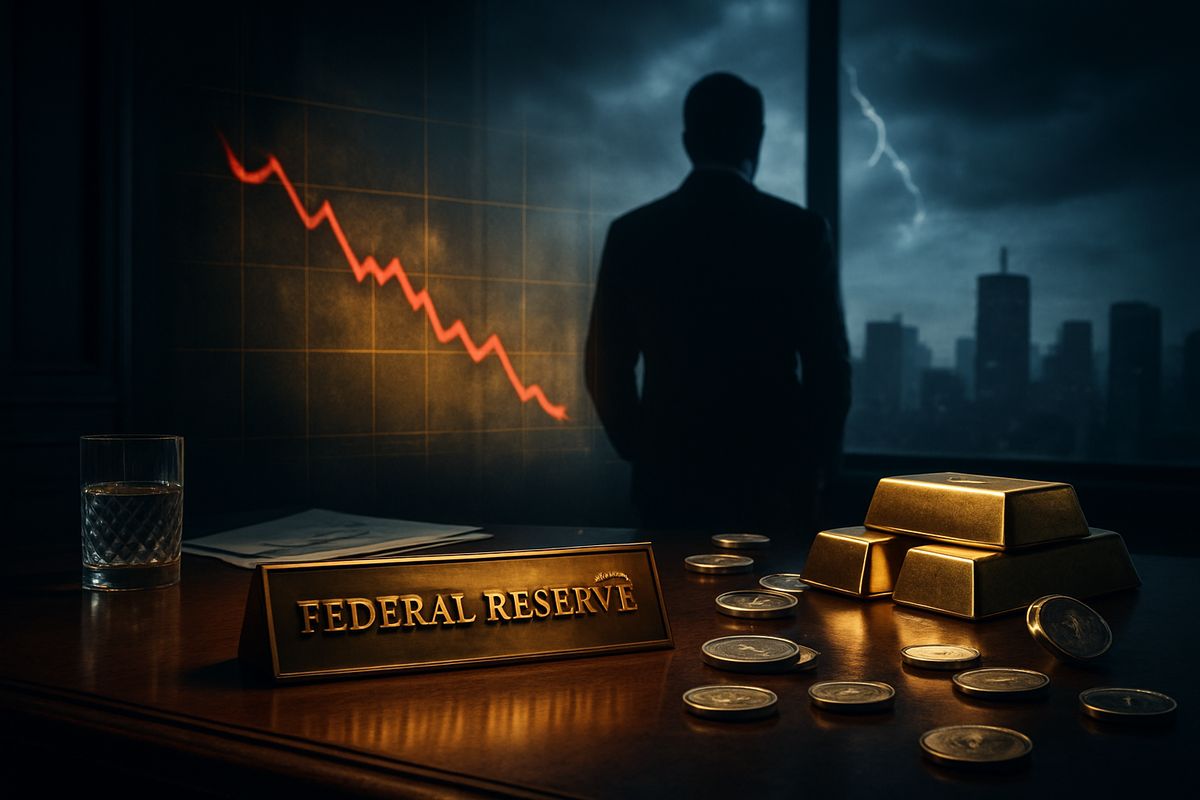
The nomination of Kevin Warsh as the next Chairman of the Federal Reserve on January 30, 2026, sent a seismic shockwave through the global commodities markets, ending a multi-year parabolic run for precious metals in a single afternoon. Within hours of the White House announcement, gold prices plummeted by more than 11%, while silver—the perennial high-beta play—witnessed a staggering 31% collapse, its most violent single-day retreat in over four decades. This "Warsh Shock" was fueled by a sudden, aggressive pivot back to the U.S. dollar, as traders interpreted the pick as a signal that the era of "political" monetary accommodation was over, replaced by a hawk committed to fiscal discipline and a stronger greenback.
However, as the dust settles on February 12, 2026, the underlying narrative for the precious metals market remains stubbornly resilient. While the immediate reaction was one of massive profit-taking, the structural pillars of the gold bull market—record-breaking sovereign debt, persistent inflation, and a global trend toward de-dollarization—have not been dismantled. For many institutional investors, the January correction was a necessary "release valve" for an overheated market, rather than the start of a long-term bear cycle.
The path to the January 30th nomination began in late 2024, when speculation first surfaced that Kevin Warsh, a former Fed Governor with deep institutional ties, was the preferred candidate to succeed the outgoing leadership. Throughout 2025, gold prices surged from $2,700 to an all-time high of $5,600 per ounce, driven largely by fears that a "political" appointee might weaponize the Fed to monetize the ballooning U.S. deficit. When the formal announcement of Warsh was made, it represented a "regime change" in market psychology. Warsh, known for his hawkish stance on inflation and his vocal defense of Fed independence, effectively removed the "independence risk premium" that had been baked into gold prices for eighteen months.
The market reaction was instantaneous and brutal. As the U.S. Dollar Index (DXY) staged its largest intraday gain in years, gold futures (NYSE Arca: GLD) saw massive liquidations. The metal fell from its $5,600 peak to settle near $4,745 per ounce. Silver (NYSE Arca: SLV) was hit even harder, with a "flash crash" style movement that saw prices dive from over $110 to roughly $78 per ounce. Traders who had been riding the 2025 momentum were caught in a liquidity trap, as stop-loss orders were triggered in a cascading waterfall across the COMEX and London OTC markets.
Key stakeholders, including central bank reserve managers and sovereign wealth funds, were forced to recalibrate. For the past three years, central banks in the "Global South" had been adding over 1,000 tonnes of gold annually to their reserves. The Warsh nomination initially checked this momentum, as the prospect of a more aggressive quantitative tightening (QT) program under a Warsh-led Fed suggested that the dollar’s reign as the primary reserve currency might be defended more vigorously than previously expected.
The initial carnage was felt most acutely by the major mining equities. Newmont Corporation (NYSE: NEM), the world's largest gold producer, saw its shares slide from a January peak of $132 to a low of $112 in the days following the announcement. Similarly, Barrick Gold Corp. (NYSE: GOLD) and Agnico Eagle Mines (NYSE: AEM) faced heavy selling pressure as the "easy money" exited the sector. However, the sell-off has created a curious divergence: while the spot price of gold fell, the miners' profitability remains at historic highs. With All-In Sustaining Costs (AISC) for companies like Agnico Eagle still averaging between $1,400 and $1,900 per ounce, even a "corrected" gold price of $4,800 leaves these companies with unprecedented margins.
In the silver space, the volatility was even more pronounced. First Majestic Silver (NYSE: AG) and Pan American Silver (NASDAQ: PAAS) saw their market caps trimmed by nearly a third in the week following the Warsh news. Yet, the loss for these companies appears to be temporary and primarily paper-based. By early February, institutional dip-buyers began rotating back into the sector, noting that the VanEck Gold Miners ETF (NYSE Arca: GDX) was trading at a significant discount to its net asset value. Analysts argue that the miners are in a "catch-up" phase, as their equity valuations had never fully reflected the $5,000+ gold prices seen in late 2025.
The "losers" in this scenario are primarily the retail momentum traders and over-leveraged hedge funds that entered the gold market above the $5,000 mark. Conversely, the "winners" appear to be the diversified mining giants who have used the 2025 windfall to clean up their balance sheets and increase dividends. By February 12, 2026, companies like Agnico Eagle have already begun to recover, with shares trading back near $217 as investors realize that a $4,800 gold price still supports record-breaking free cash flow and dividend hikes.
Beyond the immediate market mechanics, the "Warsh Shock" highlights a broader tension in the global financial system. Warsh is widely viewed as a "market-friendly hawk" who will prioritize price stability. However, his appointment does not solve the underlying fiscal crisis facing the United States. As of early 2026, global sectoral debt has ballooned to $340 trillion. Even a hawkish Federal Reserve cannot easily ignore the interest-rate sensitivity of the U.S. government’s own debt obligations. This fiscal "trap" is precisely why many analysts believe the gold bull market remains fundamentally intact.
The historical precedent for this moment is often compared to the early 1980s under Paul Volcker. While Volcker successfully broke inflation with double-digit interest rates, the 2026 context is vastly different due to the sheer scale of the national debt-to-GDP ratio. If Warsh raises rates too aggressively to defend the dollar, he risks triggering a sovereign debt crisis or a deep recession—both of which have historically been bullish for gold. Furthermore, the trend of de-dollarization among the BRICS+ nations continues unabated. These countries are not buying gold because they dislike the Fed Chair; they are buying it as a hedge against the weaponization of the dollar and the instability of the Western financial system.
Regulatory and policy implications will also be a major theme in the coming months. Warsh has expressed support for deregulatory measures and AI-driven productivity gains as "disinflationary forces." If these policies fail to materialize or if inflation remains "sticky" in the 3.2% to 3.5% range—as it has throughout 2025—the Fed will find itself between a rock and a hard place. In such a scenario, the "flight to hard assets" will likely resume with even greater fervor.
In the short term, the precious metals market is expected to remain in a consolidation phase as it digests the "Warsh Regime" change. We are likely to see gold trade in a wide range between $4,500 and $5,000 per ounce as the market awaits the new Chairman’s first few Federal Open Market Committee (FOMC) meetings. The critical question for investors is whether Warsh will follow through on his reputation for aggressive balance sheet reduction. If the Fed remains "all talk and no action" on quantitative tightening, gold could easily reclaim its all-time highs by the end of 2026.
Strategically, mining companies are already adapting. Rather than chasing growth at any cost, the focus has shifted to "value over volume." Investors should watch for increased merger and acquisition activity in the mid-tier mining sector, as larger players like Newmont and Barrick use their cash reserves to acquire smaller rivals at the now-discounted valuations. Additionally, the silver market remains a potential powder keg; while the Jan 30th drop was severe, the industrial demand for silver in green energy and AI hardware continues to outstrip mine supply, suggesting a supply-demand deficit that no Fed Chair can fix with interest rates alone.
The nomination of Kevin Warsh has undoubtedly changed the "flavor" of the 2026 market, shifting the focus from a panicked flight from the dollar to a more calculated assessment of value. The key takeaway for investors is that while the "panic premium" has been sucked out of the gold price, the "fundamental premium" remains. The massive profit-taking event in late January was a technical correction in a structural bull market, providing a much-needed entry point for those who missed the 2025 rally.
Moving forward, the market will be hyper-sensitive to any signs of friction between the Warsh-led Fed and the Treasury Department. Any indication that fiscal spending is outstripping the Fed's ability to contain inflation will be the catalyst for the next leg up in precious metals. Investors should keep a close eye on the U.S. Dollar Index and real interest rates; as long as the latter remain near zero or negative in real terms, the case for gold as a primary reserve asset remains unassailable. The "Warsh Shock" may have been a cold shower for the market, but the fire under precious metals is far from extinguished.
This content is intended for informational purposes only and is not financial advice.