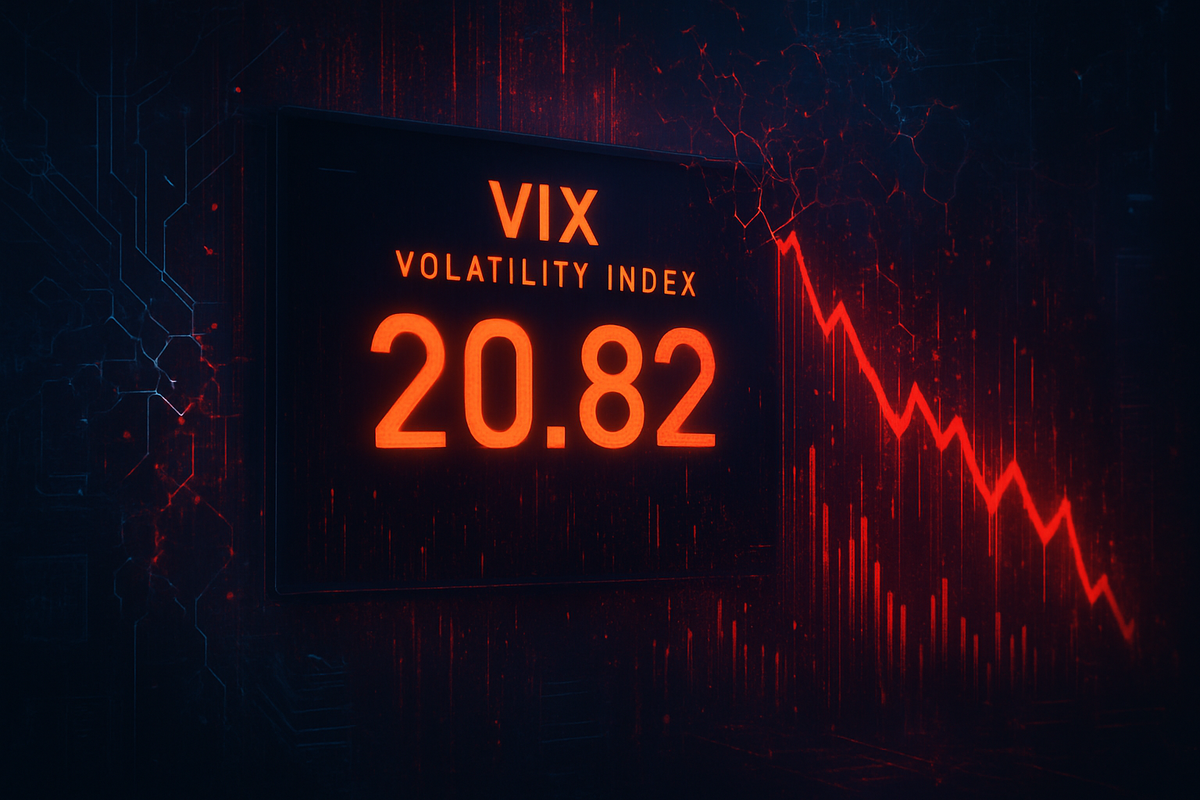
The "fear gauge" returned with a vengeance on February 13, 2026, as the CBOE Volatility Index (VIX) surged nearly 18% to settle at 20.82. This sharp spike marks a significant departure from the relative calm that had characterized much of the early winter trading season, signaling a profound shift in investor sentiment toward the technology sector. The catalyst for this sudden turbulence appears to be a toxic cocktail of "capex fatigue" and mounting fears that the massive multi-billion-dollar investments in artificial intelligence (AI) may not yield the explosive returns once promised.
As the Nasdaq Composite and S&P 500 reeled from the volatility, market participants were forced to confront a sobering reality: the "AI premium" that fueled the historic bull market of 2024 and 2025 is under intense scrutiny. With the VIX breaking past the psychological 20-point threshold, the immediate implications are clear—investors are paying up for downside protection, and the era of "buying every dip" in tech may be giving way to a more defensive, risk-averse posture.
The Catalyst: From Innovation to Investigation
The spike on February 13 was not an isolated incident but rather the culmination of several weeks of building pressure within the semiconductor and cloud computing industries. The morning began with a wave of selling pressure following a series of research notes from major investment banks questioning the long-term sustainability of the "compute arms race." By midday, the VIX had climbed from its opening level of 17.65 to over 20, as institutional traders moved aggressively into put options to hedge their portfolios against further tech-led declines.
This volatility mirrors the "DeepSeek Shock" of early 2025, when the emergence of highly efficient, low-cost AI models first challenged the dominance of the high-end GPU market. Throughout late 2025 and into early 2026, the market has become increasingly sensitive to any sign that the "moat" of massive capital expenditure (capex) is being bridged by software efficiencies. The February 13 rout was further exacerbated by rumors of impending regulatory hurdles in the European Union, where the phased implementation of the EU AI Act has begun to bite into the profit margins of major developers.
Key stakeholders, including hedge fund managers and retail "day traders" alike, were caught off guard by the velocity of the move. For the first time since the brief "Volmageddon" events of years past, the rapid unwinding of leveraged tech positions created a feedback loop that pushed the VIX to its highest level since the tariff-induced jitters of mid-2025. The initial market reaction saw a broad rotation out of high-beta growth stocks and into traditional "safe havens" like Treasury bonds and gold, as the broader indices struggled to find a floor.
Winners and Losers in the Volatility Storm
The primary victims of this spike were the "Hyperscalers" and hardware giants that have been the darlings of the AI era. NVIDIA (NASDAQ: NVDA) saw its shares stumble as investors questioned whether the demand for its H-series and B-series chips could withstand a slowdown in corporate AI spending. Similarly, Microsoft (NASDAQ: MSFT) and Alphabet (NASDAQ: GOOGL) faced selling pressure due to "capex fatigue," with analysts pointing to their projected 2026 infrastructure spending—estimated to exceed $380 billion combined—as a potential drag on free cash flow if AI software revenue fails to accelerate.
On the flip side, defensive stalwarts like Apple (NASDAQ: AAPL) appeared relatively resilient. Having maintained a more conservative infrastructure spending profile while focusing on consumer-facing "Apple Intelligence," the Cupertino giant has increasingly been viewed as a defensive play within the tech space. Furthermore, the energy sector continues to be a surprising winner in this high-volatility environment. Companies providing the massive power requirements for AI data centers, such as Constellation Energy (NASDAQ: CEG) and Vistra Corp (NYSE: VST), saw increased interest as investors realized that regardless of which AI model wins, the need for electricity remains a constant.
Small-cap stocks and "Value" plays also found some support during the rotation. As the "Magnificent Seven" lost their luster, the median S&P 500 stock began to outperform the tech-heavy benchmarks. This "broadening" of the market suggests that while the AI giants are being repriced, the rest of the economy—less sensitive to GPU supply chains and LLM training costs—may provide a refuge for capital.
A New Era of Market Maturity
This event fits into a broader industry trend dubbed the "AI Maturity Phase." Following the unbridled optimism of 2023 and the massive build-out of 2024, 2025 and early 2026 have been defined by a shift from "imagining" AI's potential to "measuring" its actual impact on the bottom line. The current VIX spike is a classic "reset" event, reminiscent of the 2000 Dot-com burst, where the market began to distinguish between companies with sustainable AI business models and those merely riding the wave of hype.
The regulatory landscape is also a significant driver of this volatility. With the EU AI Act now forcing transparency regarding proprietary training data, and the U.S. government oscillating between deregulation and national security-based AI curbs, the legal risks have become too large for investors to ignore. This regulatory uncertainty has a ripple effect on global partners and competitors, particularly in the semiconductor supply chain in Taiwan and South Korea, where export controls continue to disrupt traditional trade flows.
Historical precedents, such as the 2018 "Volmageddon" and the 1998 Long-Term Capital Management collapse, serve as a reminder that volatility can remain elevated for extended periods once the market's "regime" changes. Unlike the brief spikes of 2024, the current move above 20 suggests that the market may be entering a period of sustained price discovery for AI valuations, where every earnings report is a high-stakes referendum on the technology's future.
Looking Ahead: The Path to Stability
In the short term, market participants should expect continued turbulence as the VIX likely tests the 25-30 range before stabilizing. The next major catalyst will be the Q1 2026 earnings season, where companies will be under immense pressure to show tangible AI-driven revenue growth to justify their massive capital outlays. Strategic pivots are already underway; expect to see more "Big Tech" firms announcing stock buybacks or dividend increases as a way to appease shareholders who are growing weary of the "spend now, earn later" AI narrative.
Long-term, this spike could serve as a healthy "cleansing" of the market. By shaking out speculative froth and forcing a more disciplined approach to AI investment, the industry may move toward a more sustainable growth trajectory. However, the emergence of low-cost, open-source alternatives continues to threaten the high-margin "moats" of the incumbents. A potential scenario could involve a "commoditization" of AI hardware and software, leading to a permanent reset in the valuations of the sector's current leaders.
Market opportunities may emerge in "Edge AI" and specialized applications where the ROI is easier to quantify, such as in healthcare or industrial automation. Investors will need to adapt by moving away from broad "AI themes" and instead focusing on specific companies that can demonstrate operational efficiency and cost control in an era of high energy prices and tightening regulation.
Final Thoughts: The Return of the Fear Gauge
The 18% jump in the VIX to 20.82 on February 13, 2026, is more than just a daily fluctuation; it is a signal that the AI-driven market cycle has reached a critical juncture. The key takeaways are clear: the market's patience for "future promises" is wearing thin, regulatory and energy-related bottlenecks are real, and the "magnificent" growth of the past three years is facing its toughest test yet. Moving forward, the market will likely remain in a "show me the money" mode, where fundamentals will matter far more than buzzwords.
Investors should closely watch the VIX for signs of "contagion" into other asset classes and monitor the "capex-to-revenue" ratios of the leading tech firms. The coming months will determine whether this spike was a temporary jitters or the beginning of a prolonged valuation reset. As the AI landscape matures, the winners will be those who can navigate the transition from experimental innovation to profitable, sustainable utility.
This content is intended for informational purposes only and is not financial advice.