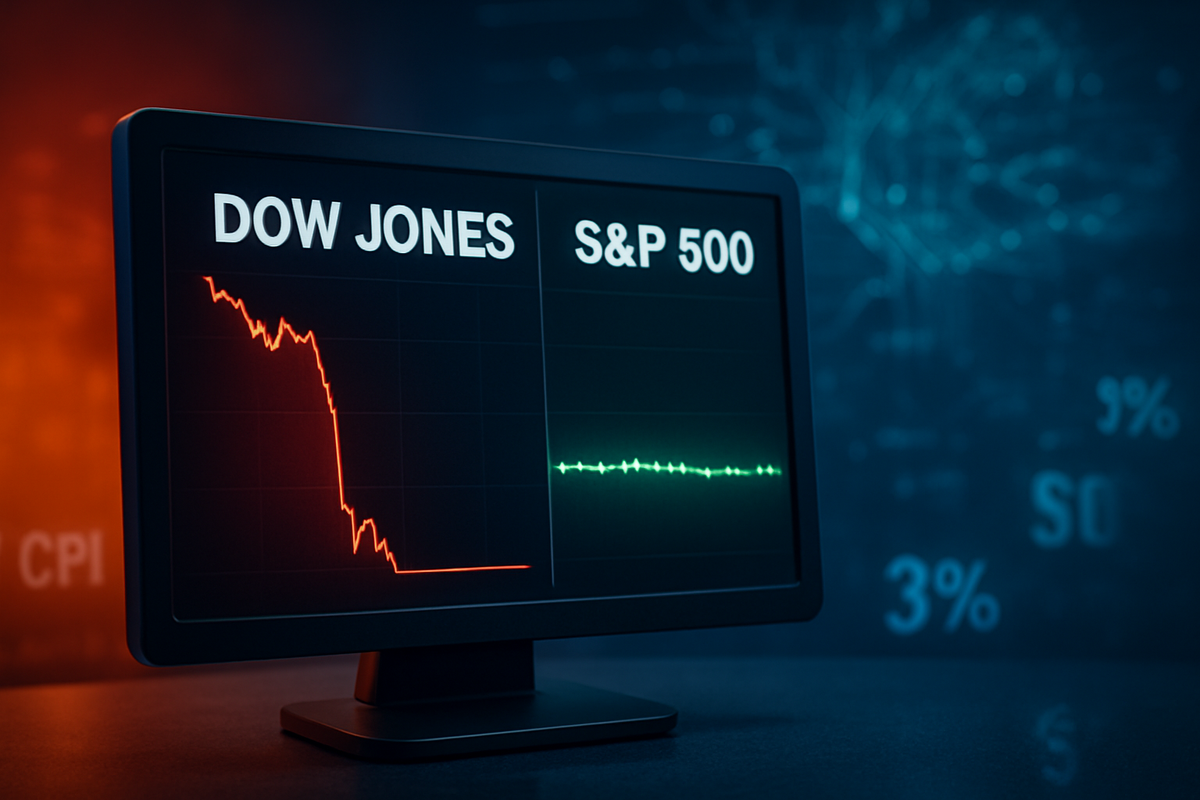
NEW YORK – After a harrowing session that saw the Dow Jones Industrial Average surrender its hard-won 50,000 milestone, Wall Street found a fragile floor on Friday, February 13, 2026. An encouraging inflation update provided the necessary cooling effect to a market that had been boiling over with anxiety just 24 hours prior, allowing the major indices to catch their breath despite a continuing exodus from high-growth technology stocks.
The S&P 500 (NYSE: SPY) and the Dow Jones Industrial Average (NYSE: DIA) both finished the day virtually unchanged, a stark contrast to the aggressive selling that characterized Thursday’s "risk-off" rout. While the Nasdaq Composite (NASDAQ: QQQ) continued to lag—weighed down by a fundamental reassessment of Artificial Intelligence (AI) valuations—the broader market’s ability to hold steady suggests that the "soft landing" narrative remains intact for now.
A Tale of Two Sessions: From Thursday’s Rout to Friday’s Relief
The market’s stabilization followed a brutal session on February 12, which many analysts have dubbed the "Thursday Tech Tantrum." The sell-off was ignited by a disappointing earnings report from Cisco Systems (NASDAQ: CSCO), which plummeted 12.3% after signaling a significant slowdown in AI-related infrastructure spending. This "canary in the coal mine" moment triggered a cascading effect across the technology sector, fueled further by hawkish comments from Federal Reserve officials who warned that sticky services inflation might delay long-anticipated interest rate cuts.
By the time the closing bell rang on Thursday, the Dow had slipped below the psychological 50,000 mark, and the S&P 500 had breached key technical support levels. However, the mood shifted at 8:30 AM on Friday with the release of the January Consumer Price Index (CPI) report. The data showed that annual inflation slowed to 2.4%, coming in cooler than the 2.5% consensus forecast. This unexpected dip in pricing pressure provided the "green light" investors needed to halt the panic selling.
The Bureau of Labor Statistics reported that while housing costs remained firm, a sharp decline in used vehicle prices and a stabilization in energy costs helped pull the headline figure lower. For a market gripped by the fear of "higher for longer" rates, the CPI update served as a vital circuit breaker, reassuring traders that the Federal Reserve still has room to maneuver as the spring FOMC meeting approaches.
Winners and Losers: The Great Defensive Rotation
The diverging paths of the Dow and the Nasdaq on Friday highlighted a massive rotation into defensive and value-oriented sectors. Financial giants and consumer staples were the primary beneficiaries of the "flight to quality." JPMorgan Chase & Co. (NYSE: JPM) saw its shares climb 1.4% as the cooling inflation data reduced the risk of a recessionary spike in defaults. Similarly, Procter & Gamble (NYSE: PG) rose 1.1%, as investors sought the safety of reliable dividends amidst the volatility of the tech sector.
Conversely, the technology sector remained a landscape of scorched earth. Nvidia (NASDAQ: NVDA), the poster child of the 2024-2025 AI rally, slipped another 2.1% as investors continued to question the timeline for tangible returns on massive AI capital expenditures. The skepticism was echoed in the performance of Palantir Technologies (NYSE: PLTR), which faced additional pressure following high-profile bearish calls from institutional short-sellers who argued that the AI bubble has entered its "terminal phase."
Logistics firms also bore the brunt of the week’s volatility. C.H. Robinson (NASDAQ: CHRW) fell nearly 15% over the two-day period, as fears intensified that AI-driven automation in the freight industry would disrupt legacy business models faster than expected. This "AI Disillusionment" has created a sharp divide in the market: companies that produce essential goods and services are being rewarded, while those trading on future AI promises are being re-priced with extreme prejudice.
The Broader Context: Geopolitics and the "Last Mile" of Inflation
The events of February 13 do not exist in a vacuum. The market’s current fragility is partly due to a backdrop of significant geopolitical uncertainty. The expiration of the New START treaty earlier this month has left a void in global arms control, creating a "geopolitical overhang" that has kept the VIX volatility index elevated. Furthermore, a spike in Brent crude prices to $70 per barrel in early February had many fearing a return of the 1970s-style stagflation—a fear that Friday’s CPI report has partially dispelled.
Historically, the "last mile" of inflation—the journey from 3% down to the Fed’s 2% target—has always been the most volatile. The early 2026 market resembles the mid-cycle adjustments seen in the late 1990s, where a narrow focus on tech eventually gave way to a broader, more diversified market. The "50,000 Dow" milestone reached earlier this month was a testament to the resilience of the American industrial and financial base, even as the "Magnificent Seven" tech giants lose their luster.
Regulatory scrutiny is also playing a role. As the Department of Justice continues its aggressive antitrust push against big tech, the premium once afforded to companies like Alphabet (NASDAQ: GOOGL) and Amazon (NASDAQ: AMZN) is being chipped away. Investors are now prioritizing "inflation-protected value"—companies with strong pricing power and low debt—over the speculative growth that defined the previous two years.
The Road Ahead: Navigating the "Risk-Off" Fog
Looking forward, the market is entering a period of "data-dependent discovery." The Federal Reserve is now widely expected to maintain its current pause through the end of the first quarter, with the possibility of a 25-basis-point cut in June if the cooling trend in CPI continues. However, any reversal in the downward inflation trend could reignite the selling pressure seen on February 12.
Strategic pivots are already underway in the institutional world. Hedge funds are increasingly moving toward "market-neutral" strategies, hedging their tech exposure with long positions in traditional energy and healthcare. For retail investors, the challenge will be resisting the urge to "buy the dip" in tech stocks that may still have significant valuation corrections ahead. The emergence of a "two-tier" market—where the Dow remains robust while the Nasdaq struggles—requires a more surgical approach to portfolio construction.
The next major catalyst will be the retail sales report due out later this month, which will provide a clearer picture of whether the American consumer is finally starting to buckle under the weight of cumulative inflation. If consumer spending remains resilient, the S&P 500 could see a slow climb back toward its 7,000 target.
Summary of Market Realities
The stabilization on February 13, 2026, marks a critical junction for Wall Street. The "inflation relief" provided by the January CPI data has prevented a full-scale panic, but it has not cured the underlying "AI fatigue" that is dragging down the tech sector. The key takeaway for the month of February is that the era of "easy money" and unchecked tech optimism has been replaced by a more disciplined, value-focused environment.
As we move toward the spring, investors should keep a close eye on the 10-year Treasury yield and the stability of the 50,000 level on the Dow. These will be the primary barometers of market health. While the "Friday the 13th" curse failed to materialize this time, the volatility of the past 48 hours serves as a potent reminder that in the 2026 economy, the margin for error remains razor-thin.
This content is intended for informational purposes only and is not financial advice.