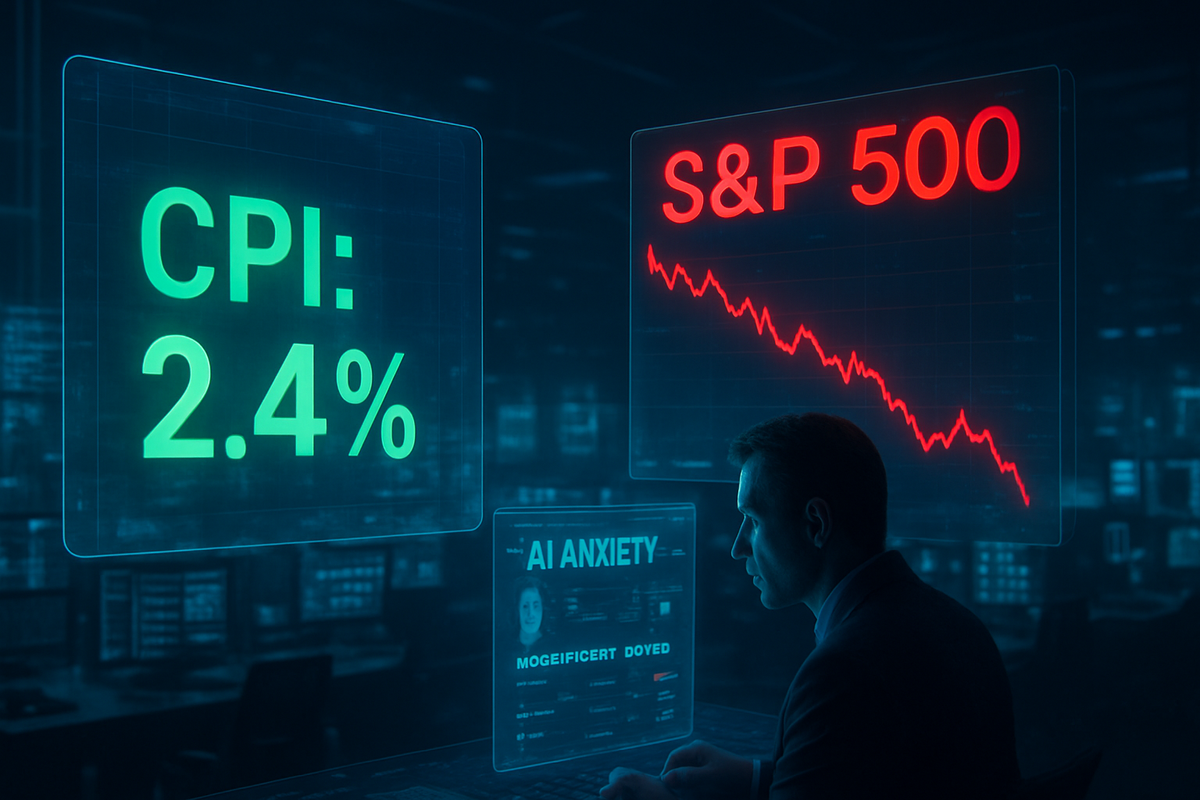
The financial markets are currently witnessing a rare and unsettling disconnect. On Friday, February 13, 2026, the S&P 500 (INDEXSP: .INX) is struggling to maintain a marginal morning gain, despite a fresh consumer price index (CPI) report that showed inflation cooling significantly faster than economists had anticipated. The benchmark index is currently trading near 6,832.76, leaving it on track for a distinct weekly loss following a bruising 1.6% sell-off during the Thursday session.
While the "goldilocks" inflation data—showing headline CPI at a multi-year low of 2.4%—would typically trigger a broad market rally, the current climate is dominated by structural shifts and a growing sense of "AI anxiety." Investors are increasingly looking past the macroeconomic stability of the Federal Reserve's target range to confront microeconomic fears regarding the return on investment for artificial intelligence and the sustainability of record-high tech valuations.
The Week of Disconnect: CPI Meets Market Skepticism
The week leading up to Friday the 13th was characterized by a tug-of-war between optimistic economic data and pessimistic technical signals. The primary catalyst for the week’s volatility was the release of the January 2026 CPI report on Friday morning. Headline inflation rose just 2.4% year-over-year, beating the 2.5% forecast and marking a steady decline from December’s 2.7%. Core CPI, which excludes volatile food and energy prices, matched expectations at 2.5%, its slowest annual pace since early 2021. This data should have signaled a clear path for the Federal Reserve to consider rate cuts, but the market's reaction remained tepid.
The downward momentum actually crystallized on Thursday, February 12, when a sharp rotation out of growth stocks sent the S&P 500 tumbling. The index hit a wall at the 7,000-point psychological resistance level earlier in the month and has since struggled to regain its footing. Adding to the unease is the transition period within the Federal Reserve itself; with Kevin Warsh recently nominated for a top leadership role, investors are weighing how a potential shift in central bank philosophy might affect the "higher-for-longer" yield environment, even as inflation data suggests the battle has been won.
The timeline of the week shows that early gains were eroded by a "sell the news" mentality. After a strong start to the year in 2025, the 2026 market has hit a period of consolidation. By the time the positive CPI data hit the wires on Friday morning, much of the optimism had already been drained by a spike in the CBOE Volatility Index (INDEXCBOE: VIX), which surged 18% on Thursday to settle near 21.00. This spike indicates that professional traders are increasingly hedging against a deeper correction, regardless of the cooling price environment.
Winners and Losers: The AI Hype Meets Reality
The most significant drag on the S&P 500 this week has been the technology sector, particularly companies previously buoyed by the artificial intelligence boom. Cisco Systems, Inc. (NASDAQ: CSCO) saw its shares crater by 12.3% as concerns grew over the pace of enterprise AI adoption and the cannibalization of traditional networking hardware. Even more dramatic was the slide of AppLovin Corp (NASDAQ: APP), which fell 19.7% amid fears that AI-driven shifts in the software ecosystem are disrupting established advertising and monetization models faster than new revenue can be generated.
The "Magnificent Seven" cohort, which led the market for much of 2024 and 2025, has faced a collective 6.2% decline year-to-date. Investors are now questioning the massive capital expenditures these giants have funneled into AI data centers. While the S&P 500's market-cap-weighted index is hurting, the equal-weighted version of the index has shown more resilience, reflecting a healthy, if painful, rotation.
Conversely, the "value" sectors of the market have emerged as unexpected sanctuaries. The Energy sector is up roughly 21% year-to-date, benefiting from geopolitical stability and a focus on dividend-paying reliability. Utilities have also seen a resurgence as a defensive play against tech volatility. These sectors are providing a floor for the market, preventing the S&P 500 from breaching deeper support levels near 6,731. However, the sheer weight of the tech giants means that until the "AI anxiety" subsides, the broader index will continue to face headwinds.
Historical Precedents and the Shifting Tech Landscape
The current market behavior echoes the "dot-com" digestion period of the early 2000s, where high-quality earnings were often ignored in favor of re-evaluating long-term growth narratives. For the past two years, AI was viewed purely as a productivity booster; in early 2026, it is increasingly being viewed as a disruptive force that may require years of "creative destruction" before it yields consistent bottom-line results. This shift in sentiment has fundamentally changed how the market reacts to traditional economic "wins" like low inflation.
This event also highlights a growing divergence between the labor market and the stock market. Earlier in the week, Non-Farm Payroll (NFP) data remained robust, suggesting that the U.S. consumer is still strong. Typically, a strong consumer plus low inflation equals a surging stock market. However, the 10-year Treasury yield has remained stubbornly high, stabilizing near 4.11%. This suggests that bond markets are pricing in a Federal Reserve that is less concerned with inflation and more focused on the long-term structural changes in the economy, including the fiscal implications of the Warsh nomination.
Furthermore, the technical breakdown of the 6,871 pivot zone suggests that the "easy money" phase of the post-2023 rally has concluded. The S&P 500 is now navigating a "show-me" market, where positive macro data is a prerequisite for stability rather than a catalyst for new all-time highs. This mirrors the 2011 period where markets consolidated for months despite improving fundamentals, as investors waited for clarity on leadership and global policy shifts.
What Comes Next: Critical Levels and Strategic Pivots
Looking ahead, the next several weeks will be defined by whether the S&P 500 can hold the 6,830 support level on a weekly closing basis. A breach of this mark would likely trigger further automated selling, potentially dragging the index down to its 100-day Simple Moving Average (SMA). Traders will be watching for a stabilization in the VIX; a move back below 18 would suggest that the current "AI panic" is a temporary flush-out rather than the start of a bear market.
The upcoming Federal Open Market Committee (FOMC) meetings will be more critical than usual. While the CPI data suggests the Fed could cut rates, the question is whether they will given the strength of the labor market and the recent leadership transitions. Investors should watch for a strategic pivot in corporate guidance during the next earnings cycle. Companies that can demonstrate tangible, margin-expanding results from AI—rather than just "AI-potential"—are likely to lead the next leg of the market.
In the short term, the rotation toward Energy and Utilities is expected to persist. Portfolio managers are likely to continue trimming over-concentrated tech positions in favor of these "old economy" stocks that offer better valuation support. For individual investors, the challenge will be resisting the urge to "buy the dip" in tech too early, at least until the S&P 500 proves it can reclaim its 20-day moving average and clear the 6,945 resistance zone.
Summary of Key Takeaways and Market Outlook
The S&P 500's struggle on February 13, 2026, serves as a stark reminder that the "inflation story" is no longer the primary driver of equity valuations. Despite headline CPI cooling to 2.4%, the market remains haunted by technical resistance at 7,000 and a fundamental re-evaluation of the AI revolution. The 1.6% drop on Thursday and the subsequent tepid reaction to positive data indicate a defensive shift in investor sentiment, as evidenced by the spike in the VIX and the rebounding bearishness in the AAII investor survey.
Moving forward, the market is likely to remain in a volatile consolidation phase. The "Magnificent Seven" era is maturing into a more fragmented landscape where sector rotation is the dominant theme. Investors should keep a close eye on Treasury yields and the 6,830 technical support floor. While the broader economy remains on solid footing with low inflation and steady jobs growth, the stock market is currently undergoing a necessary repricing of risk and innovation.
In the coming months, the focus will shift from "when will the Fed cut?" to "which companies can actually survive the AI transition?" The transition from hype to utility is rarely a smooth process, and the current weekly loss for the S&P 500 is simply the latest chapter in that ongoing adjustment.
This content is intended for informational purposes only and is not financial advice.