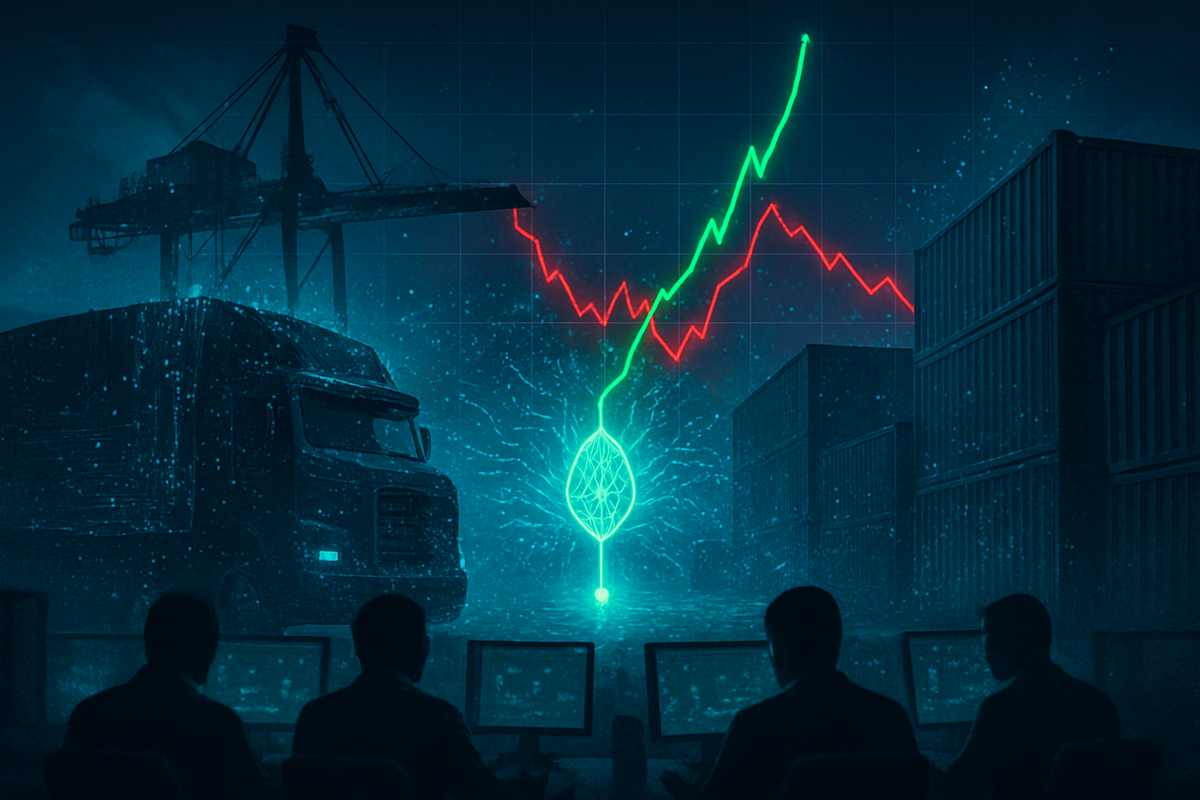
The financial markets in early February 2026 have been gripped by a phenomenon now dubbed the "Penny Stock Scare Trade." At the center of this storm is Algorhythm Holdings (NASDAQ: ALGO), a micro-cap company with a market capitalization previously under $5 million, which saw its shares surge over 30% in a single session on February 12, 2026. While a jump in a penny stock is often dismissed as retail speculation, this particular move sent shockwaves through the broader $23 billion logistics sector, triggering a massive valuation rout among industry stalwarts.
The immediate implications are profound. As ALGO shares gained an additional 20% in pre-market trading on February 13, 2026, the fear of AI-driven disruption caused billions of dollars in market value to evaporate from established logistics giants. This "valuation disconnect"—where a tiny player dictates the narrative of an entire industry—highlights the extreme sensitivity of today's investors to "AI angst" and the potential for software-driven automation to commoditize traditional freight and brokerage services.
The Catalyst: AI Optimization and the SemiCab Launch
The spark for this market-wide volatility was Algorhythm Holdings’ announcement regarding the full-scale deployment of its SemiCab platform. Marketed as an AI-enabled predictive optimization engine, the company claims the platform can allow carriers to scale their freight volumes by as much as 300% to 400% without the need for additional headcount. Furthermore, the technology aims to reduce "empty freight miles"—a persistent inefficiency in the trucking world—by over 70%.
On February 12, the stock's 30% surge to approximately $1.30 per share caught the attention of both algorithmic traders and retail investors. By the morning of February 13, the momentum continued, pushing the stock higher as traders bet on the platform’s ability to dismantle the traditional brokerage model. The timeline suggests a rapid realization among institutional desks that if Algorhythm’s claims hold any merit, the high-margin intermediary roles occupied by legacy firms could be permanently compromised.
Winners and Losers: A Tale of Two Valuations
The primary "winner" in this scenario, at least in terms of share price appreciation, is Algorhythm Holdings (NASDAQ: ALGO). However, the gains in this micro-cap space have come at the direct expense of the industry's heavyweights. C.H. Robinson Worldwide, Inc. (NASDAQ: CHRW), a titan in the logistics space with a market cap of approximately $23 billion, saw its stock price plunge by 14.5% as the news broke.
The carnage did not stop there. Landstar System, Inc. (NASDAQ: LSTR) plummeted 15.6%, while RXO, Inc. (NYSE: RXO) and Expeditors International of Washington, Inc. (NASDAQ: EXPD) shed 13.2% of their value. These companies, which rely on extensive human networks and proprietary data, are suddenly being viewed through a lens of obsolescence. For these established players, the "Scare Trade" represents a crisis of confidence: can their massive physical moats withstand a lean, AI-first competitor?
The Significance of the "AI Scare Trade"
This event fits into a broader trend of "AI angst" that has permeated the market throughout February 2026. The "Penny Stock Scare Trade" is a unique byproduct of this environment, where small, speculative companies release disruptive news that "scares" institutional investors out of expensive, "old economy" positions. This is not the first time the market has seen such a reaction; the tech rout earlier this month—which saw major software players like Atlassian (NASDAQ: TEAM) and Salesforce (NYSE: CRM) take double-digit hits—set the stage for a heightened sensitivity to AI disruption.
Analysts from firms like Jefferies have warned that the market reaction may be disconnected from physical reality. While Algorhythm’s software may be revolutionary, the logistics sector is famously reliant on physical assets, long-standing relationships, and complex regulatory compliance. The historical precedent for such moves often involves a "valuation reset" followed by a slow recovery as investors realize that software cannot replace physical infrastructure overnight. However, the surge in the VIX (Volatility Index) by over 5.5% this month suggests that investors are currently more interested in capital preservation than in betting on the durability of legacy business models.
Looking Ahead: The Future of Freight
In the short term, the logistics sector is likely to remain highly volatile as established firms scramble to demonstrate their own AI credentials. We may see a wave of "defensive" acquisitions, where larger players like C.H. Robinson or J.B. Hunt Transport Services, Inc. (NASDAQ: JBHT) seek to acquire smaller AI firms to bolster their technological capabilities and calm investor fears. Strategic pivots toward "autonomous brokerage" will likely become a recurring theme in upcoming earnings calls.
Longer term, the "Scare Trade" serves as a warning shot. If Algorhythm Holdings can prove that its SemiCab platform delivers on its 70% reduction in empty miles, the industry will have no choice but to adopt similar technologies or face consolidation. The challenge for ALGO will be scaling its operations beyond the "penny stock" phase and proving it can handle the volume of a multi-billion dollar sector without the infrastructure its competitors have built over decades.
Summary and Market Outlook
The "Penny Stock Scare Trade" of February 2026 has provided a stark reminder of how speculative technology news can destabilize an entire sector. Algorhythm Holdings' 30% jump may seem like a minor blip in the context of the broader market, but its impact on the $23 billion logistics industry is a testament to the current era of AI-driven volatility.
Investors should watch for two things in the coming months: first, whether Algorhythm can sustain its momentum and secure significant enterprise contracts; and second, how legacy logistics firms respond to the threat of commoditization. While the initial "scare" may subside, the underlying pressure to innovate or be disrupted is now the dominant narrative for the transportation and logistics market. For now, the message to investors is clear: in a market fueled by AI speculation, even the smallest players can move the largest needles.
This content is intended for informational purposes only and is not financial advice.