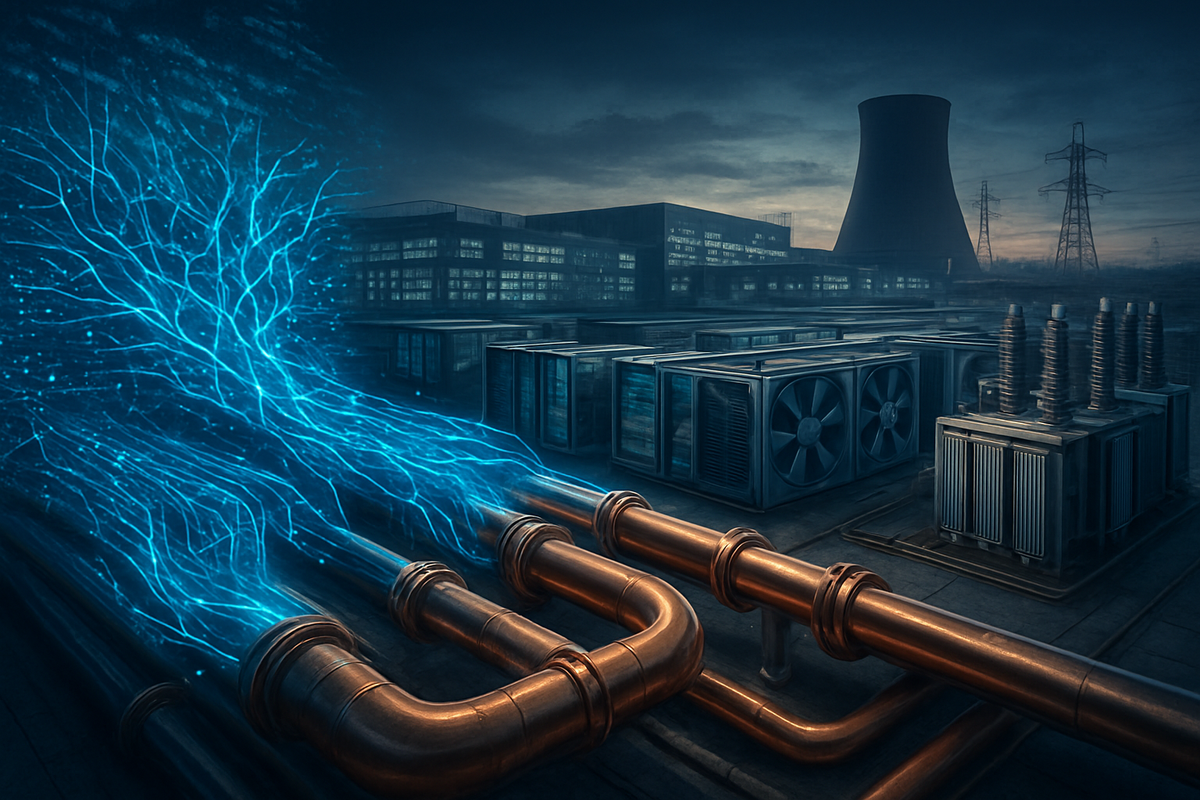
The speculative fervor that once propelled artificial intelligence (AI) software to dizzying heights has met its match: the laws of physics. In early 2026, a profound rotation is sweeping through global markets as investors pivot from "disembodied" software applications to the "Physical Bottleneck" of AI—the massive infrastructure of chips, data centers, and power grids required to sustain the next generation of autonomous agents. This shift marks the dawn of the "Infrastructure Era of AI," where the premium is no longer on the most clever algorithm, but on the ability to secure electricity and cooling in an increasingly gridlocked world.
The immediate implications are stark. While software-as-a-service (SaaS) giants face an existential "SaaS Reckoning" fueled by fears that autonomous AI will cannibalize their seat-based licensing models, the "industrial plumbers" of the AI revolution are seeing their valuations soar. The "Big Five" hyperscalers—Amazon (NASDAQ: AMZN), Alphabet (NASDAQ: GOOGL), Microsoft (NASDAQ: MSFT), Meta (NASDAQ: META), and Oracle (NYSE: ORCL)—have collectively signaled a staggering $660–$700 billion in capital expenditure for 2026, a near-doubling from the previous year. This capital is not going into marketing or app development; it is being poured into concrete, copper, and nuclear reactors.
The Infrastructure Pivot: From Code to Kilowatts
The transition began in late 2025, as the market realized that the bottleneck for AI scaling had shifted from model capability to "Speed to Power." By February 2026, the timeline of events leading to this moment has crystallized. The catalyst was a series of reports from the International Energy Agency (IEA) highlighting that global electricity demand, driven by data centers, is now outdistancing economic growth for the first time in three decades. Interconnection queues for new data centers in primary hubs like Northern Virginia now stretch three to five years, creating a literal physical wall for tech expansion.
Key players in this shift include the "Big Five" hyperscalers, who have entered into a desperate arms race for land and energy. In early February, Amazon sent shockwaves through the market with a $200 billion capex bombshell, confirming that the race for physical space is accelerating rather than peaking. Simultaneously, Anthropic released "Claude Cowork," an autonomous AI system that demonstrated the ability to build and deploy software without human intervention. This triggered a massive sell-off in traditional software, as investors realized that the per-seat licensing model—long the backbone of the tech sector—might soon be obsolete.
Market reactions have been swift and decisive. The iShares Expanded Tech-Software ETF (BATS: IGV) has plunged roughly 30% from its late-2025 highs, while physical infrastructure indices have hit record levels. Analysts at major investment banks are now re-rating companies not by their user growth, but by their "Megawatts under Management."
The Winners and Losers of the Physical Era
The clear beneficiaries of this rotation are the companies providing the "physical heartbeat" of AI. Vertiv Holdings (NYSE: VRT) has emerged as a titan in this new landscape. In its recent Q4 report, Vertiv announced a "blowout" performance with 252% organic order growth and a $15 billion backlog, sending its stock to all-time highs above $236. As rack densities for chips like Nvidia (NASDAQ: NVDA) Blackwell architecture exceed 100kW, Vertiv’s dominance in liquid cooling has made it an indispensable partner for the chip giant.
Utilities and alternative energy providers have become the unlikely darlings of the tech trade. Constellation Energy (NASDAQ: CEG) continues to ride the momentum of its landmark deal to restart the Three Mile Island nuclear plant, positioning it as a vanguard of the nuclear-AI alliance. Meanwhile, Bloom Energy (NYSE: BE) has seen its stock skyrocket 489% over the past year, as its "behind-the-meter" fuel cell solutions allow data centers to bypass the grid entirely. Other winners include Quanta Services (NYSE: PWR), which is leading the charge in grid hardening, and Vistra Corp (NYSE: VST), which recently secured major nuclear power purchase agreements with Meta.
On the losing side are the traditional SaaS heavyweights. Salesforce (NYSE: CRM) and Adobe (NASDAQ: ADBE) have struggled to convince investors that their business models can survive an era where AI "agents" perform the tasks once handled by human workers using their software. The fear is that as AI becomes more autonomous, the need for human-facing interfaces—and the expensive licenses that accompany them—will diminish. Hedge funds reportedly made $24 billion shorting software stocks in early 2026, betting that the "Agentic Revolution" will favor those who own the infrastructure over those who own the interface.
Broader Significance and the Energy Crisis
The shift from software to infrastructure is more than just a market trend; it is a fundamental reordering of the global economy. This event mirrors the telecom fiber boom of the late 1990s, but with a critical difference: while the fiber boom led to a glut of unused capacity, the AI infrastructure boom is meeting an insatiable demand for compute that the current electrical grid simply cannot support. The regulatory implications are significant, as governments grapple with the massive energy consumption of data centers.
This trend has created a ripple effect across all sectors. Nvidia (NASDAQ: NVDA), while maintaining its $5 trillion valuation, is no longer judged solely on its chip performance but on its "Performance per Watt," as power efficiency becomes the primary metric for data center operators. Networking companies like Broadcom (NASDAQ: AVGO) are thriving as the bottleneck shifts to inter-rack connectivity, and optical specialists like Lumentum (NASDAQ: LITE) are seeing record demand as 60% of their revenue now stems from AI infrastructure.
Historically, this pivot reflects the "Gilded Age" of the 19th century, where the fortunes were made not by the miners (the software developers), but by the railroads and steel mills (the infrastructure) that enabled them. In 2026, electricity is the new steel, and the data center is the new railroad.
Looking Ahead: The Nuclear-AI Alliance
In the short term, the market will likely remain focused on "Speed to Power." Companies that can provide immediate, off-grid energy solutions or accelerated cooling technology will continue to command a premium. We expect to see more "Big Tech" investments directly into energy generation, potentially leading to hyperscalers owning and operating their own modular nuclear reactors (SMRs) by the end of the decade.
Long-term, the challenge will be the "Physical Limit." As the most accessible power and land are snapped up, the cost of scaling AI will increase, potentially leading to a consolidation of the industry. Only companies with the deepest pockets and the most robust physical supply chains will be able to compete. Strategic pivots are already underway; we may see software companies attempt to "re-industrialize" by acquiring energy assets or building specialized hardware to maintain their relevance.
Final Assessment: Atoms over Bits
The shift from AI software to physical infrastructure marks a turning point in the digital age. The era of "unlimited scaling" via code has been replaced by the reality of physical constraints. For investors, the takeaway is clear: the most valuable assets in the AI revolution are no longer just the algorithms, but the pipes, wires, and reactors that make them possible.
Moving forward, the market will likely be defined by the "Physical Bottleneck." Investors should watch for further developments in the nuclear-AI alliance, the evolution of liquid cooling technologies, and the impact of rising energy costs on AI training budgets. As we move through 2026, the companies that can bridge the gap between digital ambition and physical reality will be the ones that define the next decade of technology.
This content is intended for informational purposes only and is not financial advice.