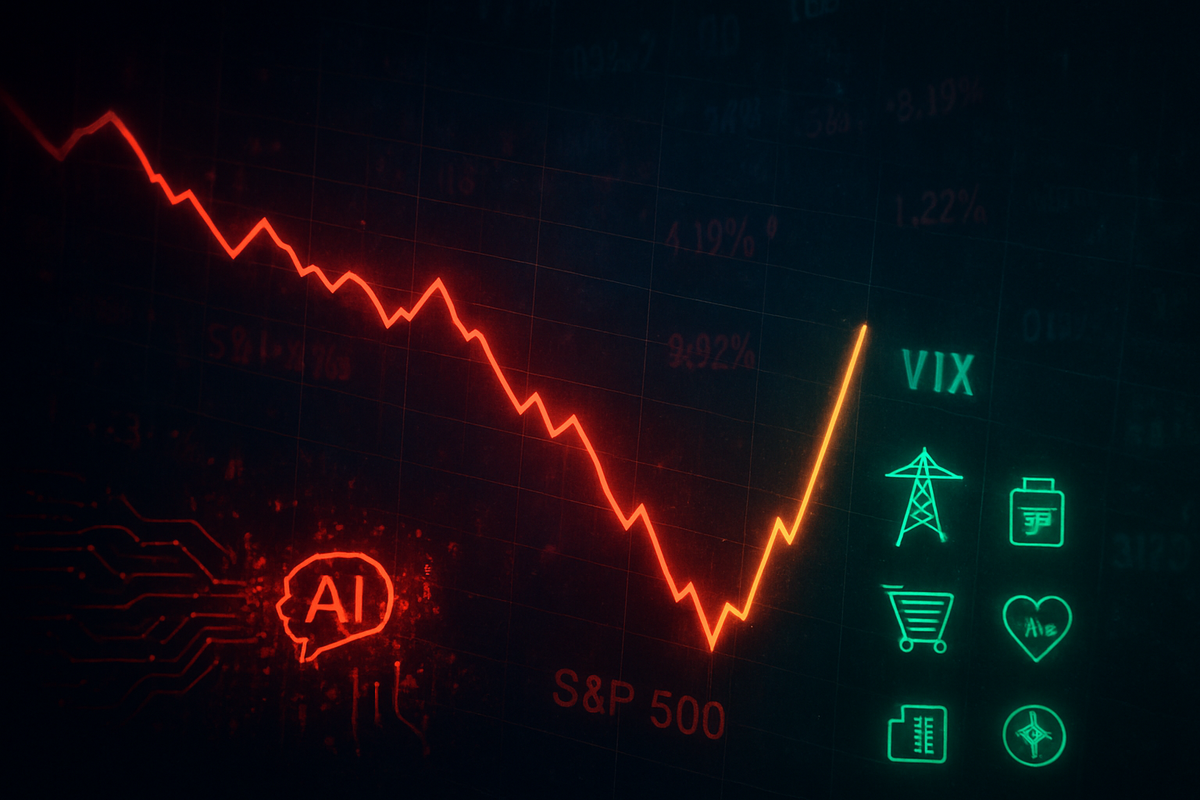
The U.S. equity markets faced a grueling three-session losing streak ending Friday, February 13, 2026, as a wave of "AI capex fatigue" and disappointing corporate guidance sent investors scurrying for safety. The selling pressure, which began as a mild pullback on Wednesday, accelerated into a full-scale rout on Thursday, wiping out billions in market capitalization and pushing the CBOE Volatility Index (VIX) up by nearly 18%. By the close of trading on Friday, the tech-heavy indexes remained bruised, despite a cooler-than-expected inflation report that failed to ignite the typical "Goldilocks" rally.
This three-day slide marks a significant shift in market psychology, transitioning from a relentless pursuit of growth to a defensive posture focused on capital preservation. The S&P 500 and the Nasdaq Composite both breached critical technical support levels, specifically their 50-day moving averages, triggering automated sell programs that exacerbated the decline. As the dust settles on this volatile week, the narrative of 2026 appears to be shifting toward the sustainability of artificial intelligence investments and the potential for a more hawkish Federal Reserve.
The Anatomy of a Sell-Off: From AI Euphoria to Earnings Reality
The market's descent began quietly on Wednesday, February 11, with indices finishing slightly in the red as investors awaited key earnings reports. However, the tone shifted dramatically on Thursday, February 12, following a stark warning from Cisco Systems (NASDAQ: CSCO). The networking giant plummeted 12.3% after issuing weak full-year guidance, which served as a canary in the coal mine for enterprise technology spending. This spark ignited a broader bonfire in the technology sector, as investors began questioning whether the massive $650 billion in planned capital expenditures by AI "hyperscalers" would yield the returns promised in late 2025.
By mid-afternoon on Thursday, the VIX had spiked 17.96%, surging from 17.65 to settle above the psychologically critical 20-point mark at 20.82. The Nasdaq Composite led the declines, falling 2.04% in its worst single-session performance of the year. The selling was not confined to tech; financial institutions and communication services were also caught in the crosshairs. Rumors of a more hawkish shift at the Federal Reserve, following the potential nomination of Kevin Warsh to a key post, added to the unease, leading institutional traders to aggressively purchase downside protection via put options.
On Friday, February 13, the release of the Consumer Price Index (CPI) showed inflation cooling to 2.4%, below the 2.5% forecast. In a standard market environment, this would have sparked a relief rally. Instead, the market treated it as a "sell the news" event. While the S&P 500 and Nasdaq managed to eke out marginal gains of 0.12% and 0.15% respectively, the Dow Jones Industrial Average remained in the red, closing down 0.08%. The inability to stage a meaningful recovery on Friday suggests that the underlying structural concerns regarding growth and valuations remain unresolved.
Winners and Losers: The Great Sector Migration
The most striking feature of this three-day window was the aggressive rotation out of the "Magnificent Seven" and into defensive bastions. Technology leaders like Apple (NASDAQ: AAPL) saw a 5% drop on Thursday alone, fueled by concerns over delayed AI features and mounting antitrust pressure in Europe. Nvidia (NASDAQ: NVDA) and Dell Technologies (NYSE: DELL), the darlings of the AI hardware boom, faced heavy liquidation as investors locked in profits, with Dell falling 9%. In the communication space, Meta Platforms (NASDAQ: META) and Alphabet (NASDAQ: GOOGL) were not spared, contributing to a massive $450 billion wipeout in market value for the top tech firms in a single session.
Financial stocks also faced headwinds as investors weighed the impact of AI disruption on wealth management and the possibility that the benefit of high interest rates had finally peaked. Banking giant JPMorgan Chase (NYSE: JPM) saw its shares retreat as the broader financial sector fell 2.0% during the Thursday rout. Other notable laggards included transportation and logistics firms, with C.H. Robinson (NASDAQ: CHRW) tumbling 14.5% and real estate giant CBRE Group (NYSE: CBRE) dropping 8.8%, reflecting fears of a broader cooling in industrial activity.
Conversely, defensive sectors emerged as the week's clear winners. The Utilities sector (XLU) led the charge, gaining roughly 1.5% as investors prioritized stable dividends over high-octane growth. NextEra Energy (NYSE: NEE) saw significant inflows as a safe-haven play. Consumer Staples also performed admirably; Walmart (NYSE: WMT) and Procter & Gamble (NYSE: PG) acted as "havens," with Walmart’s price-to-earnings ratio stretching into the 40s—a level usually reserved for growth stocks. Healthcare mainstays like Johnson & Johnson (NYSE: JNJ) also saw steady demand, as the sector gained 0.6% while the rest of the market floundered.
Strategic Shifts and the AI Reality Check
The events of February 11-13 highlight a broader industry trend that analysts are calling "AI Capex Fatigue." For the past eighteen months, the market has rewarded companies for spending billions on GPUs and data centers. However, this week’s sell-off suggests that the honeymoon phase is over, and investors are now demanding evidence of monetization and Return on Investment (ROI). This shift has profound implications for the entire tech ecosystem, potentially slowing the pace of infrastructure orders for semiconductor and hardware providers while forcing software companies to prove their AI value proposition.
Beyond technology, the market's reaction to the cooling CPI data and the Warsh nomination rumors suggests a heightened sensitivity to Federal Reserve policy. The "higher-for-longer" narrative is being replaced by a "slower-to-cut" anxiety. Historically, when the VIX breaks the 20-level during a period of sector rotation, it often precedes a period of consolidation or a multi-month correction. Comparisons are already being drawn to the tech volatility of late 2018 and the post-pandemic correction of 2022, where high-valuation names were systematically re-rated.
Regulatory pressures are also beginning to weigh on market sentiment. Renewed protectionist rhetoric regarding trade tariffs and the implementation of the EU AI Act have added a layer of geopolitical risk that was largely ignored during the early-year rally. For competitors and partners of the "Magnificent Seven," the current volatility may provide an opening to gain market share, but it also increases the cost of capital for startups and smaller firms that rely on a buoyant venture capital and IPO environment.
The Road Ahead: Support Levels and Strategic Pivots
Looking forward, the immediate question for investors is whether the major indices can reclaim their 50-day moving averages in the coming week. A failure to do so could lead to a test of the 200-day moving average, representing a much deeper correction. Short-term, expect continued volatility as institutional players rebalance their portfolios to reflect a more defensive bias. The upcoming Federal Reserve meeting will be the next major catalyst, as any clarity on interest rate trajectories could either soothe or inflame the current market jitters.
Strategic pivots are already underway. Many asset managers are adopting a "barbell" strategy—balancing high-growth AI exposures with deep-value defensive plays in utilities and healthcare. The emergence of Walmart as a growth-alternative suggests that "quality" is becoming the most sought-after factor in the market. Investors should also watch the 10-year Treasury yield, which plummeted to 4.06% on Friday; a further flight to bonds could signal deeper concerns about economic growth rather than just sector rebalancing.
Market opportunities may emerge in the wake of this sell-off, particularly for companies with strong balance sheets and sustainable cash flows that were unfairly dragged down in the tech rout. However, the "buy the dip" mentality that characterized much of 2025 is being replaced by a more disciplined "show me the money" approach. The next few weeks will be a trial by fire for the AI narrative and a test of the market’s underlying resilience.
Final Takeaways: A New Regime of Volatility
The three-day sell-off ending February 13, 2026, serves as a stark reminder that the market does not move in a straight line. The 18% spike in the VIX and the aggressive rotation out of tech and financials into defensive sectors signal that the era of easy gains driven solely by AI hype may be drawing to a close. While the cooling CPI data provides some macroeconomic comfort, it was not enough to overcome the structural anxieties regarding corporate spending and valuation levels.
Moving forward, investors should remain cautious and watch for signs of stabilization in the tech sector. Key indicators to monitor include the sustainability of the 50-day moving average for the S&P 500 and the quarterly earnings of remaining AI-linked firms. The lasting impact of this week may be the re-establishment of a "risk-off" floor, where fundamental metrics like P/E ratios and free cash flow yield regain their importance over speculative growth potential.
In conclusion, while the market is currently in a defensive crouch, this period of volatility could provide the necessary correction to prune overvalued segments and pave the way for a more sustainable, if slower, upward trajectory. For now, the watchwords are diversification and discipline.
This content is intended for informational purposes only and is not financial advice.