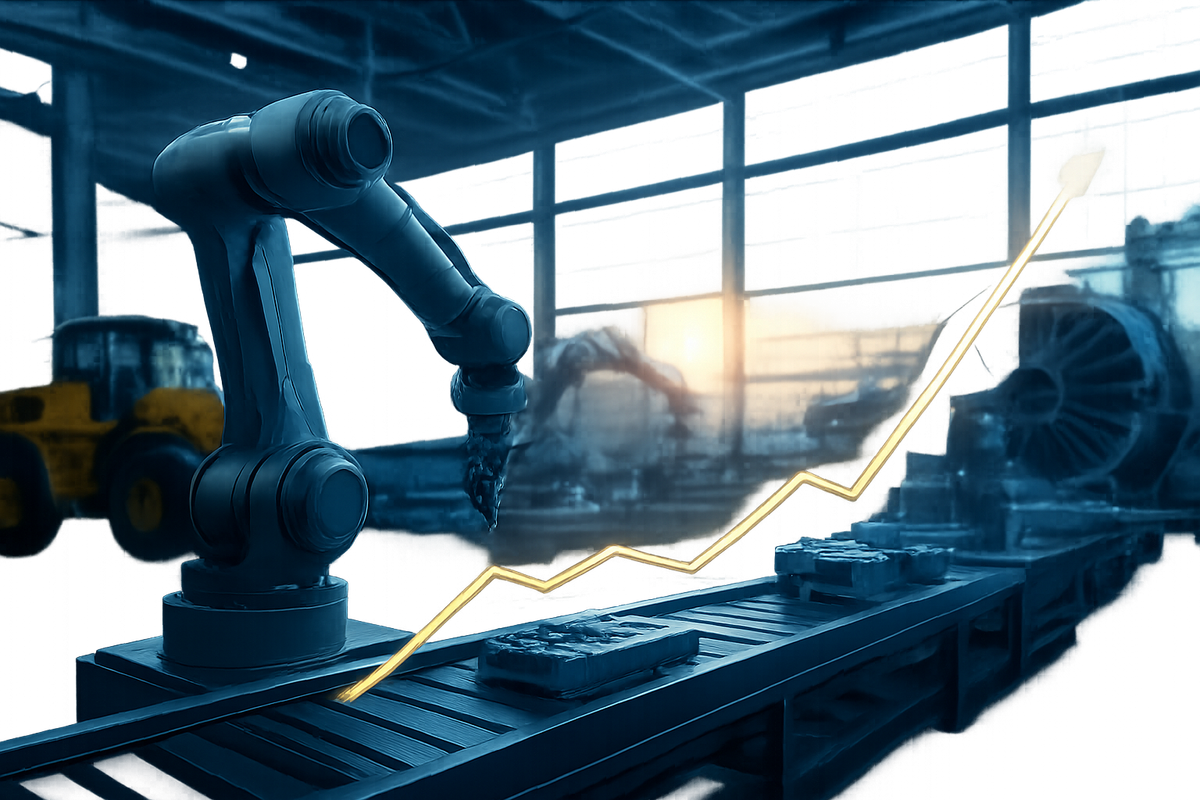
NEW YORK — In a resounding signal that the American industrial heartland has finally shaken off its post-pandemic lethargy, the U.S. manufacturing sector roared back into expansion territory in January 2026. The Institute for Supply Management (ISM) reported on February 2nd that its Manufacturing PMI rose to 52.6 last month, marking the first time the index has crossed the crucial 50-point threshold of growth since late 2024. This unexpected surge, fueled by a dramatic spike in new orders and ramped-up production schedules, suggests that the "rolling recession" that plagued the sector for much of 2025 has officially bottomed out.
The 52.6 reading caught many Wall Street analysts by surprise, as consensus estimates had pegged the index at a more modest 49.8. The immediate implications for the broader economy are significant: a strengthening manufacturing base typically precedes broader GDP growth and suggests that the Federal Reserve’s long-awaited "soft landing" may be transitioning into a "re-acceleration" phase. With factory gates swinging open and order books filling up, the report has ignited a rally in industrial equities and provided a much-needed boost to economic sentiment at the start of the new year.
A Turnaround in the Making: Breaking Down the January Surge
The January report was characterized by broad-based strength across nearly all sub-indices, but none were more impactful than the New Orders index, which jumped to 54.2, and the Production index, which climbed to 53.5. This reversal follows a grueling 2025 where high financing costs and inventory destocking kept the manufacturing sector in a persistent state of contraction. Timothy Fiore, Chair of the ISM Manufacturing Business Survey Committee, noted that the "collective sigh of relief" from purchasing managers was palpable, as the "New Orders" component—the lifeblood of future activity—reached its highest level in nearly two years.
The timeline leading to this pivot was paved with volatility. Throughout 2025, the index hovered between 47 and 49, as manufacturers grappled with the tail end of the "just-in-case" inventory glut and a cautious capital expenditure environment. However, the tide began to turn in the final quarter of 2025 as the Federal Reserve initiated a series of tactical rate cuts, lowering the cost of equipment financing. By early January, the combination of lower rates and a surge in domestic demand—particularly in the aerospace and semiconductor sectors—pushed the needle into expansionary territory. Initial market reactions were swift, with the Dow Jones Industrial Average gaining over 400 points on the news as investors pivoted toward cyclical growth stocks.
The Winners and Losers of the Industrial Rebound
The return to expansion is a major boon for heavy machinery giants and industrial conglomerates that have spent the last year trimming costs and managing lean inventories. Caterpillar Inc. (NYSE: CAT) saw its shares jump nearly 4% in pre-market trading, as the company is viewed as the primary beneficiary of the renewed demand for construction and mining equipment. Similarly, Deere & Company (NYSE: DE) stands to gain as the stabilization of the industrial sector often trickles down into increased confidence for agricultural and construction equipment purchasers.
Honeywell International Inc. (NASDAQ: HON) and GE Vernova (NYSE: GEV) are also positioned as primary "winners" in this new cycle. Honeywell's focus on industrial automation and building technologies aligns perfectly with the "Agentic AI" shift currently sweeping through modern factories. Meanwhile, GE Vernova is seeing a spike in orders for power generation and grid equipment as the massive new "mega-fabs" in Texas and Arizona begin their final commissioning phases. Conversely, the "losers" in this report may be found in industries sensitive to rising input costs. The Prices Index within the ISM report also nudged higher to 53.1, suggesting that companies like 3M Company (NYSE: MMM) or Dow Inc. (NYSE: DOW) may face renewed margin pressure if raw material costs (particularly chemicals and aluminum) continue to climb alongside demand.
Policy Tailwinds and the AI Transformation
The wider significance of the January 52.6 reading cannot be overstated, as it validates several major policy and technological shifts. A significant driver of the surge is the "One Big Beautiful Bill Act" (OBBBA) passed in mid-2025, which introduced a 35% tax credit for advanced manufacturing facilities and reinstated 100% bonus depreciation for equipment. These fiscal incentives effectively "unlocked" billions in sidelined capital, leading to the surge in new orders seen in January. Furthermore, the "reshoring" trend is no longer just a talking point; the operational launch of Samsung’s Taylor, Texas facility and the expansion of TSMC (NYSE: TSM) in Arizona have created a massive local supply chain ecosystem that is now showing up in the headline ISM data.
Beyond policy, 2026 is emerging as the year of "Agentic AI" on the factory floor. Unlike the generative AI hype of 2024, the current cycle is defined by autonomous AI agents that manage real-time production scheduling and predictive maintenance. This technological maturity has allowed manufacturers to increase production (the 53.5 reading) without a corresponding spike in labor shortages, as AI-driven efficiency gains allow for higher throughput with existing headcounts. This mirrors the productivity boom of the late 1990s, suggesting that the U.S. could be entering a sustained period of non-inflationary industrial growth.
The Road Ahead: Sustainability vs. Inflation
Looking forward, the primary question for investors is whether this expansion is a "one-off" burst of pent-up demand or the start of a multi-year bull cycle. In the short term, the "pre-ordering frenzy" sparked by late-2025 tariff uncertainties may keep the index elevated through the first quarter. However, for the trend to be sustainable, we must see a stabilization in the Employment index, which lagged slightly behind at 50.1 in the January report. If manufacturers begin to hire aggressively again, it could signal a long-term commitment to capacity expansion.
Potential challenges include the risk of "overheating." If the ISM index climbs too rapidly toward the 60-point mark, it could reignite inflationary pressures, forcing the Federal Reserve to pause its rate-cutting cycle or even consider a "hawkish pivot." Strategic adaptations will be required; companies that invested in flexible, AI-driven supply chains will likely outperform those stuck in traditional, rigid manufacturing models. Investors should watch the February and March reports closely for "follow-through"—if the New Orders index remains above 54, the case for a new industrial super-cycle will be nearly impossible to ignore.
Summary and Market Outlook
The January 2026 ISM Manufacturing Index of 52.6 marks a definitive turning point for the U.S. economy. After a year of stagnation, the industrial sector is once again a growth engine, propelled by favorable tax policies, the maturation of AI-integrated factories, and a critical mass of domestic semiconductor and energy projects coming online. The surge in new orders suggests that the "re-industrialization" of America is moving from the construction phase into the production phase.
Moving forward, the market is likely to reward "quality cyclicals"—companies with strong pricing power and exposure to the high-tech manufacturing boom. While the threat of rising input prices remains a shadow on the horizon, the overall narrative is one of resilience and renewal. For investors, the coming months will be about monitoring the durability of this demand. If the industrial renaissance of 2026 holds its momentum, it may well define the economic landscape for the remainder of the decade.
This content is intended for informational purposes only and is not financial advice.