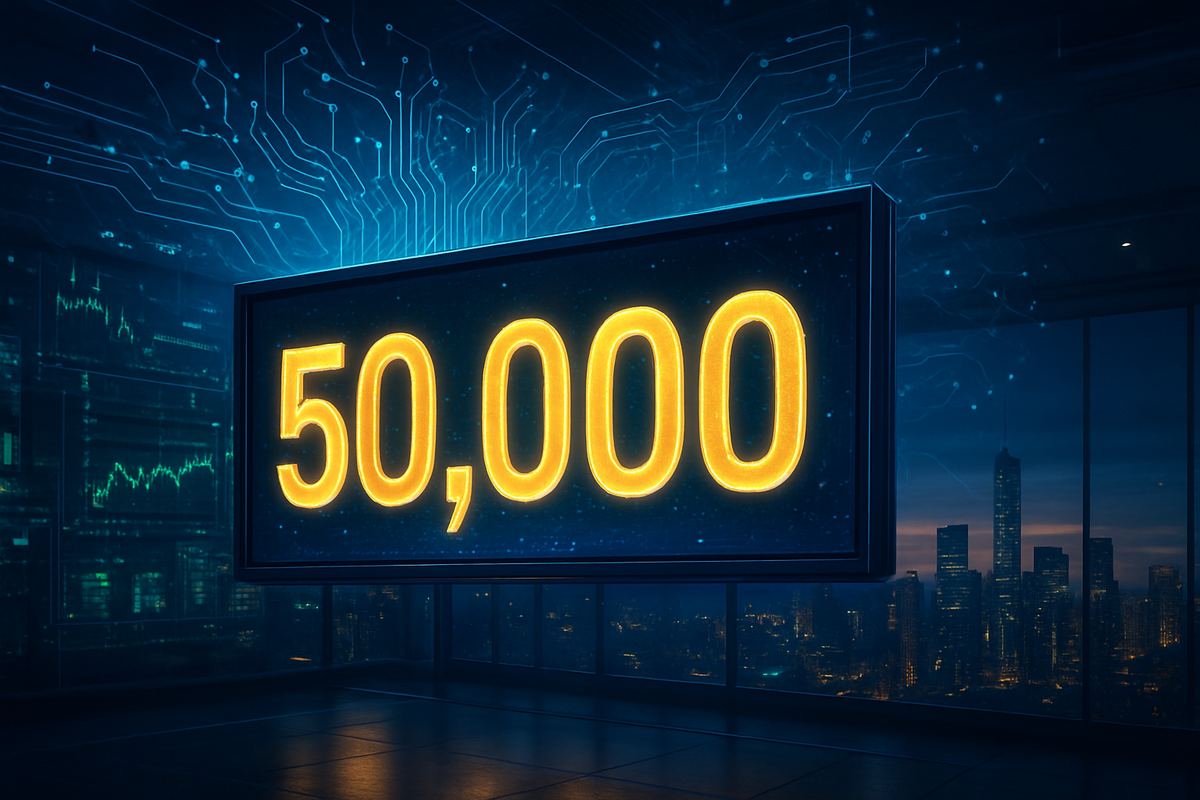
The American financial landscape entered a new era this month as the Dow Jones Industrial Average crossed the psychological and symbolic 50,000 milestone for the first time in history. On February 6, 2026, the blue-chip index shattered its previous ceilings, closing at 50,120.45 in a session characterized by aggressive buying and a jubilant atmosphere on the floor of the New York Stock Exchange. This historic achievement, coming less than two years after the 40,000 mark was first breached in May 2024, signals a profound structural shift in the U.S. economy, driven largely by the unrelenting demand for artificial intelligence and a resilient "soft landing" for the broader macroeconomy.
The immediate implications of "Dow 50k" are far-reaching for U.S. investors, many of whom had braced for a recession that never materialized in 2025. Instead, the index’s 25% climb over the last 21 months has been fueled by a "virtuous cycle" of AI infrastructure spending. As of today, February 16, 2026, the market remains in a period of consolidation following the breakout, with analysts suggesting that 50,000 has transformed from a formidable resistance level into a new psychological floor for the equity markets.
A Perfect Storm: The Path to 50,000
The journey to 50,000 was catalyzed by a pivotal decision in late 2024. On November 8, 2024, S&P Dow Jones Indices replaced the long-struggling Intel (NASDAQ: INTC) with the undisputed champion of the AI era, Nvidia (NVDA: NASDAQ). This move "re-wired" the price-weighted average, directly linking the Dow’s performance to the explosive growth of the semiconductor industry. Throughout 2025, while traditional industrial components faced a high-rate environment, Nvidia’s relentless climb—driven by record-breaking revenues and the successful rollout of its "Blackwell" and "Rubin" architectures—provided the necessary torque to pull the 30-stock average higher.
The timeline leading to this moment was marked by a steady "melt-up" in late 2025. Following a series of strategic interest rate cuts by the Federal Reserve, which brought the federal funds rate into the 3.5%–3.75% range by early 2026, liquidity flooded back into large-cap equities. Investors who had previously sat on the sidelines in money market funds began rotating back into the Dow’s heavyweights. By the time 2026 opened, the index was sitting at 48,500, needing only a spark to reach the 50k finish line. That spark arrived in the form of blowout guidance from tech leaders and a surprisingly robust January jobs report, proving that the U.S. consumer remained healthy despite years of inflationary pressure.
The day of the crossing, February 6, saw an intraday surge led by a 7.2% jump in Nvidia shares. Key stakeholders, including institutional asset managers and retail "FOMO" (fear of missing out) buyers, converged to push the index over the line in the final hour of trading. Initial market reactions have been overwhelmingly positive, though some contrarian voices warn of overextended valuations in the "AI or bust" narrative.
The Winners and Losers of the New Regime
The primary beneficiary of this rally is undoubtedly Nvidia (NVDA: NASDAQ). Now a $4.5 trillion behemoth, Nvidia has become the "gravitational center" of the global market. Its inclusion in the Dow proved to be the single most important factor in the index's recent 10,000-point gain. Similarly, while not a member of the Dow 30, Broadcom (AVGO: NASDAQ) has played a critical supporting role. Broadcom's record $64 billion revenue in 2025 and its massive $73 billion AI backlog have served as a barometer for the health of the entire tech ecosystem. As Broadcom’s custom AI accelerators (XPUs) became the industry standard for hyperscalers like Microsoft (MSFT: NASDAQ) and Meta (META: NASDAQ), its performance provided a "halo effect" that boosted the sentiment of the entire Dow.
Traditional Dow components have also found themselves in a "win" column, albeit through adaptation. JPMorgan Chase (JPM: NYSE) and Goldman Sachs (GS: NYSE) reported significant margin expansion in early 2026, credited to the deep integration of AI-driven automation in their trading and back-office operations. Meanwhile, industrial giants like Caterpillar (CAT: NYSE) have leveraged AI to optimize global supply chains, allowing them to maintain profitability even as global shipping costs fluctuated.
Conversely, the "losers" of this era are those who failed to pivot. Intel (INTC: NASDAQ), since its removal from the index, has struggled to regain its footing, trailing far behind its peers in the foundry and AI chip race. Similarly, legacy consumer staples that have been slow to adopt predictive AI for inventory management have seen their weight in the index diminish, as growth-oriented tech continues to dominate the price-weighted calculation.
Wider Significance: AI Integration and Economic Precedents
This milestone is more than just a round number; it represents the formal "AI-fication" of the American industrial complex. Historically, the Dow has evolved to reflect the dominant economic engine of the time—from railroads and oil in the early 20th century to computing and finance in the late 90s. The climb to 50,000 confirms that AI is no longer a speculative "tech" theme but the fundamental utility driving modern productivity. The ripple effect is being felt among competitors and partners alike, as companies now face a "comply or die" ultimatum regarding AI adoption.
The event also draws comparisons to the "Dot-com" boom of the late 1990s, when the Dow crossed 10,000. However, analysts are quick to point out a key difference: the current rally is backed by massive, tangible cash flows and "sold out" product lines. Unlike the pre-revenue valuations of 1999, the leaders of 2026 are printing record profits. From a regulatory standpoint, the 50,000 milestone is likely to invite increased scrutiny from Washington. With a handful of companies wielding such immense influence over the national index, discussions regarding antitrust and "AI sovereignty" are expected to intensify in the coming months.
What Comes Next: The Road to 60,000
Looking ahead, the market faces a "digestion period." Short-term, a correction or a period of sideways trading is typical after such a monumental psychological breakthrough. Investors should prepare for potential volatility in mid-2026 as "capex anxiety" may resurface. The market will eventually demand to see even greater returns on the hundreds of billions being spent by hyperscalers on AI infrastructure. If those returns—in the form of software revenue and productivity gains—do not materialize by late 2026, the Dow may find it difficult to maintain its 50,000 handle.
Strategic pivots are already underway. Many companies are shifting from "AI experimentation" to "AI execution." The next leg of the rally will likely depend on the "secondary wave" of AI—where the industries that use AI (healthcare, energy, and logistics) begin to outperform the industries that build AI. Market opportunities are emerging in the energy sector, specifically for companies providing the massive power requirements for AI data centers, a trend that may see new energy-focused components added to the Dow by 2027.
Final Assessment: A New Benchmark for Success
The Dow Jones Industrial Average hitting 50,000 is a testament to the enduring dynamism of the U.S. economy and its ability to reinvent itself through technological breakthroughs. The takeaway for investors is clear: the integration of AI into the core of American business is the primary driver of value in this decade. While the "AI rally" was initially concentrated in a few semiconductor stocks, it has now broadened to include the banks, manufacturers, and retailers that comprise the Dow 30.
Moving forward, the market appears robust, supported by a favorable interest rate environment and strong corporate earnings. However, the concentration of power in names like Nvidia and Microsoft means that the index is more sensitive to tech-specific shocks than ever before. In the coming months, investors should closely watch the quarterly capital expenditure reports of the "Magnificent Seven" and the progress of AI regulation. While 50,000 is a historic peak, in the eyes of the most bullish analysts, it may simply be the base camp for the eventual climb to 60,000.
This content is intended for informational purposes only and is not financial advice