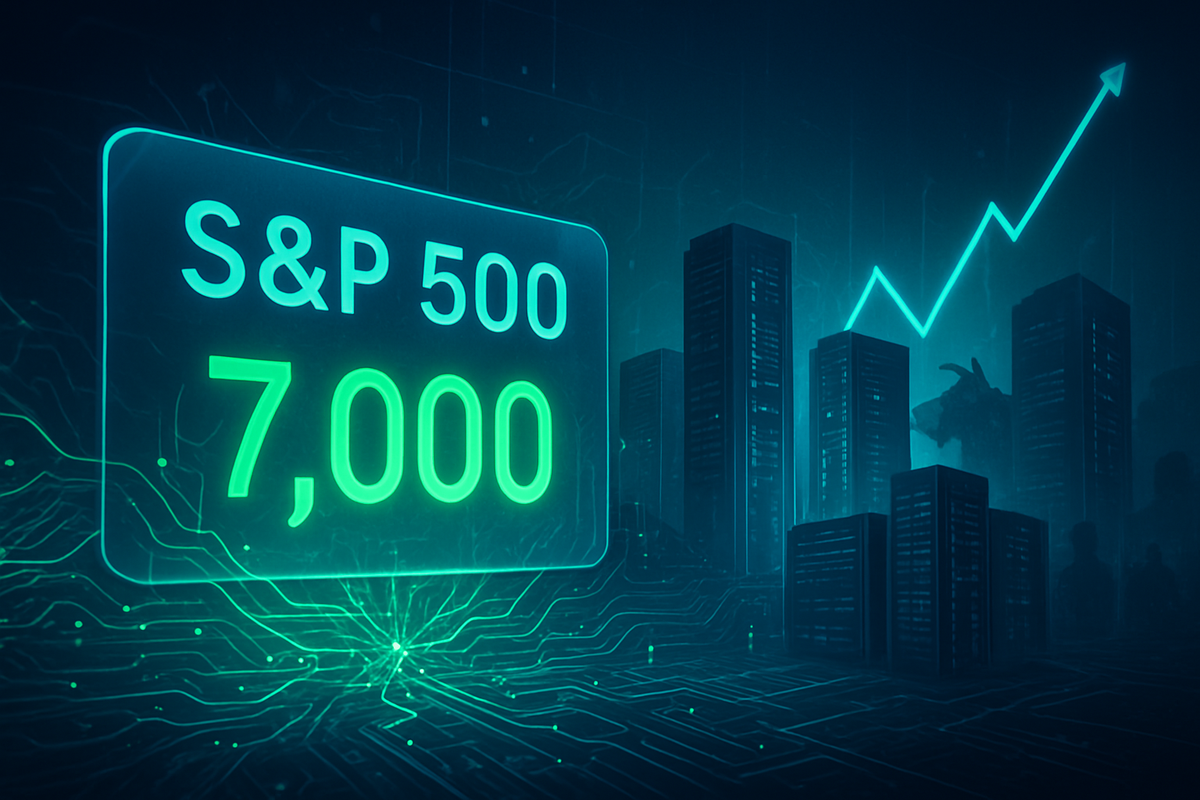
NEW YORK — The narrative surrounding the "AI trade" has taken a decisive turn as of February 18, 2026. After a tumultuous start to the month that saw the S&P 500 retreat from its historic 7,000-point milestone, a wave of dip-buyers has flooded back into the technology sector. The resurgence comes as investors pivot from fears of runaway capital expenditures to a more nuanced appreciation of the burgeoning "Return on Investment" (ROI) being realized across the enterprise landscape.
The bounce-back signals a critical maturation of the market's most dominant theme. While the early weeks of February were defined by "capex fatigue"—a collective anxiety over the staggering $700 billion collectively earmarked for AI infrastructure by big tech this year—the mid-month recovery suggests that the market is finally looking past the price tag. With enterprise backlogs swelling and "agentic AI" moving from pilot programs to full production, the S&P 500 (INDEXSP:.INX) is once again finding its footing, treating the recent correction as a localized "reality check" rather than the popping of a bubble.
The 'SaaSpocalypse' and the Road to Recovery
The volatility that defined early 2026 reached a fever pitch on January 28, when the S&P 500 briefly touched an intraday high of 7,002.28. The celebration was short-lived. A "SaaSpocalypse" followed, triggered by the dual release of advanced agentic AI tools from Anthropic and Alibaba Group Holding Ltd. (NYSE: BABA), which demonstrated the ability to automate complex professional workflows that were previously the bread and butter of traditional Software-as-a-Service (SaaS) providers.
The anxiety was further compounded by the launch of DeepSeek V4, a model from China that claimed to achieve parity with top-tier U.S. models at a fraction of the cost. This sparked a sharp sell-off in the software and services sub-sector, which plummeted 17% in just ten trading days. However, by the second week of February, the tide began to turn. Institutional heavyweights like J.P. Morgan Chase & Co. (NYSE: JPM) and Morgan Stanley (NYSE: MS) issued notes suggesting the sell-off was overextended, citing the "unbreakable moats" of established software giants and the high switching costs that protect their enterprise contracts.
By February 14, the Relative Strength Index (RSI) for the broader tech sector had dipped to a record low of 18, a technical signal of extreme oversold conditions. This served as a "green light" for algorithmic and retail investors alike. As the S&P 500 stabilized near its December 2025 support levels, the focus shifted from the cost of building AI to the revenue generated by using it.
The Magnificent Seven: From Spending Spree to Profit Engine
The rebound has been most visible among the "Magnificent Seven," who are now tasked with justifying unprecedented capital outlays. NVIDIA Corp. (NASDAQ: NVDA), the primary beneficiary of the AI infrastructure build-out, saw its market cap swing wildly, losing nearly $600 billion in the early February dip before staged a fierce recovery this week. Analysts point to NVIDIA's forward P/E ratio, which has settled at a surprisingly reasonable 24x, as a sign that the company’s earnings growth is finally catching up to its valuation.
Microsoft Corp. (NASDAQ: MSFT) has emerged as a primary beacon for dip-buyers. Despite a projected capex of over $140 billion for 2026, the company recently disclosed a staggering $281 billion backlog in AI service contracts. This tangible proof of demand has effectively neutralized the "spending fear" among its shareholders. Similarly, Alphabet Inc. (NASDAQ: GOOGL) and Amazon.com Inc. (NASDAQ: AMZN) have seen their shares stabilize as cloud margins remain resilient despite massive investments in the Vera Rubin platform and custom silicon.
On the other end of the spectrum, Meta Platforms Inc. (NASDAQ: META) has transitioned from an "AI underdog" to a "production powerhouse." With a 2026 capex projection of $125 billion, Meta’s resilience is rooted in its ability to translate AI into immediate advertising efficiency. However, the "losers" of this period remain the mid-cap software firms that failed to integrate agentic AI quickly enough, facing a "survival of the fittest" environment as legacy seats are replaced by autonomous agents.
A Structural Shift: Industrialized AI and the 'S&P 493'
This recent bounce-back is not just a tech story; it represents a fundamental shift toward "Industrialized AI." The market is moving beyond the producers of chips and models to the "users" of AI. Broadening market participation is evidenced by the performance of the "S&P 493"—the stocks outside of the tech titans—which are seeing margin expansions as AI-driven automation trims back-office costs.
Historically, this mirrors the "post-buildout" phase of the internet in the early 2000s, but at an accelerated pace. Unlike the dot-com era, today’s leaders are highly profitable and have the cash flow to fund their own disruption. Regulatory implications are also looming, with the U.S. and EU focusing on the competitive advantages gained by "compute-rich" firms, but for now, the market is more concerned with efficiency than antitrust. The ripple effect is being felt in Financials and Healthcare, where AI implementation has led to a projected 50% reduction in IT operational costs for some firms.
The 2026 Horizon: What Lies Ahead
In the short term, the market will remain hypersensitive to quarterly "proof of ROI" reports. The strategic pivot required for most public companies in 2026 is the move from "AI experimentation" to "AI integration." Firms that cannot show a clear path to margin expansion through AI will likely be punished by a market that has lost its patience for vague promises.
We may see a scenario where the S&P 500 enters a "high-plateau" phase, where the index continues to climb but at a more measured pace as the low-hanging fruit of AI productivity is picked. The biggest challenge emerging is the "energy wall"—the potential for power shortages to cap the expansion of data centers—which could create a new bottleneck for the AI trade by late 2026.
Investor Takeaway: The New Normal
The mid-February recovery of 2026 marks a coming-of-age for the AI era. The return of dip-buyers suggests that the market has accepted high capex as the "ante" for staying competitive in a global economy. The key takeaway for investors is that the "AI trade" has evolved from a speculative bet on the future into a fundamental driver of current earnings and operational efficiency.
Moving forward, the S&P 500’s trajectory appears to be supported by a new floor at the 7,000 level. Investors should watch for the widening gap between AI "haves" and "have-nots," and pay close attention to the sustainability of cloud margins as the massive 2026 infrastructure projects come online. The "AI bubble" has not popped; it has simply hardened into the new foundation of the global markets.
This content is intended for informational purposes only and is not financial advice.