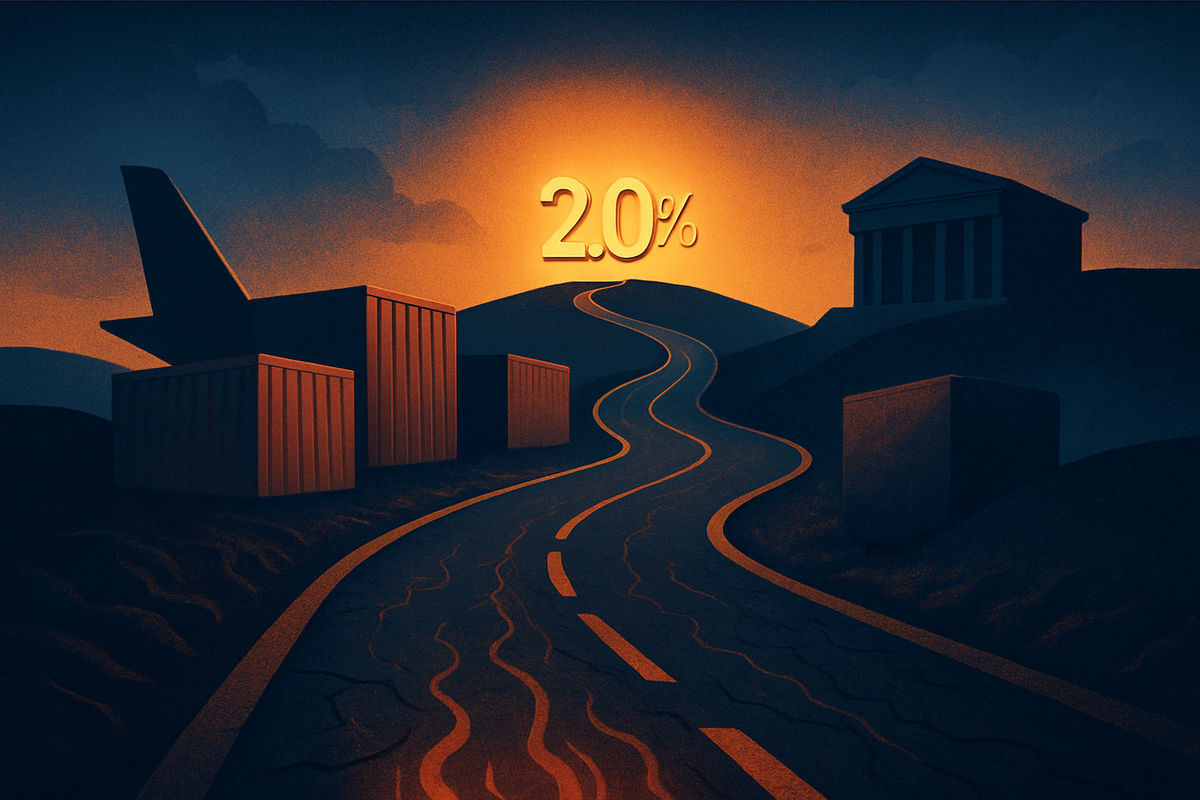
As of February 18, 2026, the Federal Reserve’s long-standing battle against inflation has hit a frustrating plateau. Despite years of aggressive monetary tightening and a brief flirtation with a 2% handle, recent Consumer Price Index (CPI) and Producer Price Index (PPI) data suggest that the "last mile" of disinflation is proving to be the most difficult. While headline inflation has cooled significantly from the peaks of previous years, the underlying "sticky" components of the economy—specifically services and wholesale costs—are signaling that the fight is far from over.
The immediate implications for the market are clear: the era of "easy" rate cuts has ended before it truly began. Investors who were betting on a rapid descent to a 2% neutral rate are now recalibrating for a "higher-for-longer" reality that could stretch well into the second half of the decade. With the Federal Open Market Committee (FOMC) maintaining a stance of "hawkish patience," the disconnect between cooling goods prices and surging service costs has created a volatile environment for both equities and fixed-income markets.
A Tale of Two Inflations: Breaking Down the February Data
The data released in early February 2026 painted a portrait of a bifurcated economy. Headline CPI rose 0.2% month-over-month, bringing the annual rate to 2.4%. While this is the lowest level since April 2025, the Core CPI—which strips out volatile food and energy costs—ticked up 0.3% for the month, holding firm at a 2.5% annual rate. Even more concerning was the Producer Price Index (PPI), which delivered a massive upside surprise in late January. Wholesale prices jumped 0.5% in a single month, pushing the year-over-year PPI to 3.0%. This surge suggests that inflationary pressures are still brewing at the start of the supply chain, largely driven by the residual effects of the "Liberation Day Tariffs" implemented throughout 2025.
The timeline leading to this moment is marked by a series of economic shocks. In the summer of 2025, a massive surge in PPI stalled the downward trend that many analysts thought would lead to a 2% CPI by year-end. This was followed by a 43-day government shutdown in late 2025, which created a "data blackout" and left the Fed flying blind during a critical policy pivot. By the time the data resumed in early 2026, it was clear that the "Supercore" inflation—services excluding shelter and energy—had re-accelerated. In January 2026 alone, Supercore inflation jumped 0.6%, fueled by a staggering 6.5% increase in airline fares and rising medical costs.
Key stakeholders, including Fed Governor Michael Barr, have signaled that the central bank is in no hurry to resume rate cuts. In a speech on February 17, 2026, Barr noted that it is "appropriate to hold rates steady for some time," citing the persistent risk of inflation settling at a 3% floor rather than returning to the 2% target. Market reaction has been swift, with Treasury yields climbing as traders price out the possibility of a rate cut in the first half of the year.
Winners and Losers in the Permanent 3% Economy
The persistence of sticky inflation has created a clear divide between corporate winners and losers. In the airline sector, carriers like Delta Air Lines (NYSE: DAL) and United Airlines Holdings (NASDAQ: UAL) have managed to pass on rising labor and fuel costs to consumers, as evidenced by the 6.5% jump in fares. However, this pricing power may eventually hit a ceiling if consumer discretionary spending weakens under the weight of sustained high interest rates.
On the losing side, large-scale retailers such as Walmart (NYSE: WMT) and Target (NYSE: TGT) are facing a double-edged sword. While they benefit from steady consumer demand for essentials, they are the primary targets of the "Liberation Day Tariffs." As importers, these companies initially absorbed the tariff costs in 2025 to maintain market share, but the recent PPI spike suggests they are now being forced to pass those costs on to shoppers, potentially dampening volume growth.
Financial institutions like JPMorgan Chase & Co. (NYSE: JPM) and Goldman Sachs Group (NYSE: GS) find themselves in a complex position. Higher-for-longer interest rates continue to bolster net interest margins, but the lack of a clear rate-cut trajectory has frozen the deal-making and mortgage markets. Conversely, energy giants like ExxonMobil (NYSE: XOM) and Chevron (NYSE: CVX) are seeing their influence on headline inflation wane. With energy prices falling 1.5% in January 2026, these companies are no longer the primary drivers of inflation, though they remain vulnerable to any geopolitical shifts that could send crude prices back toward $100 a barrel.
The Structural Shift: Beyond the 2% Target
The current inflationary environment is not just a statistical anomaly; it represents a structural shift in the global economy. The reliance on "volatile" categories like energy and apparel to drag down headline numbers masks a deeper trend: the "sticky-price" items—insurance, education, and healthcare—are entrenched at a 4.4% annualized growth rate. This suggests that the Fed’s 2% target, established in a world of hyper-globalization and cheap labor, may no longer be compatible with a 2026 economy defined by trade protectionism and labor shortages.
Historically, periods of "sticky" inflation have required prolonged periods of restricted monetary policy to break. The comparison to the late 1970s is often made, but the 2026 context is unique due to the "Liberation Day Tariffs" and the increasing cost of the green energy transition. The ripple effects are being felt globally, as partners and competitors alike struggle with a strong U.S. dollar and the export of American inflation. This has led to a fragmented regulatory landscape where central banks are no longer moving in lockstep, increasing the risk of policy errors.
What’s Next: The Powell Transition and the Warsh Factor
As the market looks ahead, the most significant catalyst will be the leadership transition at the Federal Reserve. Chairman Jerome Powell’s term is set to expire in May 2026, and the White House is reportedly considering Kevin Warsh as a potential successor. Warsh is widely viewed by the market as more "hawkish" or "neutral" than Powell, leading to expectations that the Fed may formally or informally adopt a higher inflation tolerance or, conversely, keep rates restrictive for a much longer duration to force inflation down to 2%.
In the short term, investors should expect a "sideways" market as the FOMC holds the federal funds rate steady at 3.50% to 3.75%. The potential for a strategic pivot is high; if the PPI continues to surge, the Fed may be forced to entertain the idea of a rate hike—a scenario that is currently not priced into the markets. The primary challenge will be navigating the "data blackout" scars from the 2025 shutdown, as the Fed remains hyper-sensitive to any new reports that suggest a resurgence in consumer spending.
Final Thoughts: The New Normal for Investors
The takeaway from the February 2026 inflation data is clear: the path to 2% is blocked by structural forces that interest rates alone may not be able to solve. The divergence between headline and core inflation has created a "mirage" of stability that hides the persistent rising costs in the service sector. For the market to move forward, there must be a realization that the "inflation floor" has likely shifted higher.
Investors should closely watch the "Supercore" metrics and PPI releases in the coming months. These will be the true bellwethers of whether the 2025 tariffs have been fully digested or if a second wave of inflation is imminent. As the Powell era draws to a close, the focus will shift from "when will they cut" to "how high is the new normal." In this environment, quality, pricing power, and balance sheet strength will be the only reliable shields for investors navigating the sticky last mile of the inflation marathon.
This content is intended for informational purposes only and is not financial advice.