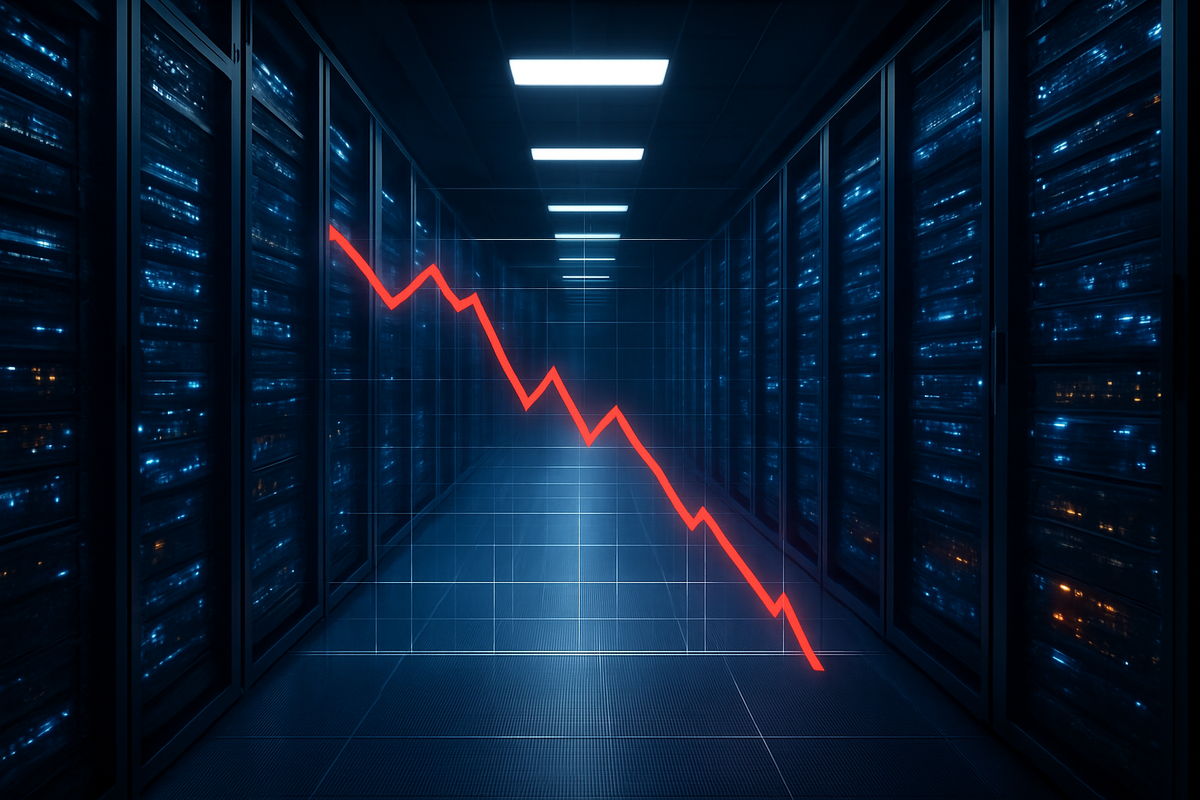
In a stark reminder of the market's unforgiving stance on future profitability, shares of Akamai Technologies (NASDAQ: AKAM) tumbled more than 9% on February 20, 2026. The sell-off came despite a fourth-quarter 2025 earnings report that surpassed analyst expectations on both the top and bottom lines. While the company demonstrated robust growth in its security and cloud computing segments, it was the conservative forward guidance for 2026—hampered by an aggressive and costly pivot toward artificial intelligence—that spooked investors.
The decline, which saw the stock drop to $99.38 in heavy trading, highlights a growing divergence in the cloud and cybersecurity sectors. As the industry enters a secondary phase of the AI revolution centered on "agentic" autonomous systems, the massive capital expenditures required to build out inference capacity are beginning to strain the balance sheets of legacy providers. For Akamai, the "AI tax" has arrived in the form of compressed margins and a sharp increase in equipment costs, overshadowing its operational successes.
The Cost of the AI Pivot: Q4 Beats Meet 2026 Reality
The volatility began immediately following the release of Akamai’s fiscal year 2025 year-end results. For the fourth quarter ending December 31, 2025, Akamai reported revenue of $1.095 billion, a 7.4% increase year-over-year, which handily beat the consensus estimate of $1.08 billion. Non-GAAP earnings per share (EPS) of $1.84 also cleared the $1.75 mark expected by Wall Street. Much of this growth was driven by the company’s "Cloud Infrastructure Services" segment, which surged 45% following the initial rollout of the Akamai Inference Cloud.
However, the celebratory mood was short-lived as management provided a sobering outlook for 2026. The company projected full-year EPS between $6.20 and $7.20, with a midpoint of $6.70—nearly 9% below the $7.29 analyst consensus. CEO Tom Leighton revealed that the company is bracing for a significant increase in capital expenditures (CapEx), which is expected to consume between 23% and 26% of total revenue in the coming year. This is nearly double the company's historical average of 14%, representing a multi-hundred-million-dollar bet on AI infrastructure.
Beyond internal strategic pivots, Akamai is also battling external inflationary pressures in the hardware market. Leighton noted during the earnings call that the cost of critical components, particularly high-performance memory chips required for AI servers, has "probably doubled" in recent months. To mitigate this, the company has baked a $200 million "inflation buffer" into its 2026 budget specifically for server and equipment procurement, a move that directly contributes to the projected non-GAAP operating margin compression from 30% down to roughly 26%.
A Tale of Two Clouds: Market Winners and Losers
The reaction to Akamai’s guidance was magnified by the contrasting performance of its primary competitors. While Akamai struggled with the heavy lifting of physical infrastructure build-outs, Cloudflare, Inc. (NYSE: NET) saw its shares surge by 16% during the same period. Cloudflare reported record annual contract values and a doubling of traffic related to "AI agents" in a single month, reinforcing the market's preference for its software-defined "connectivity cloud" model over Akamai’s more hardware-intensive approach.
Similarly, Fastly, Inc. (NYSE: FSLY) emerged as a notable winner, with its stock experiencing a massive rally after the company achieved its first full year of non-GAAP profitability. Fastly’s focus on "semantic caching" and high-compute edge orchestration has allowed it to capture high-margin AI traffic without the same level of capital intensity that Akamai is currently enduring. For investors, the message was clear: in the 2026 market, the ability to scale AI services without sacrificing margins is the ultimate differentiator.
Conversely, the broader content delivery network (CDN) sector continues to face headwinds. Traditional delivery revenue for Akamai fell another 2% this quarter, continuing a multi-year decline. Other legacy players that have been slow to pivot into security or high-performance cloud computing find themselves in a precarious position, as the "delivery" business becomes increasingly commoditized while the "intelligence" business becomes exponentially more expensive to enter.
The "Investment Year" Syndrome and Industry Trends
Akamai’s current predicament reflects a broader trend sweeping the technology sector in early 2026: the "Investment Year" fatigue. After several years of promising that AI would drive efficiency and higher margins, many enterprise tech companies are now admitting that the next phase of growth requires a massive, front-loaded investment in hardware. This has created a "show-me" environment where investors are no longer willing to give companies a pass on profitability in exchange for AI-themed narratives.
The situation also highlights the shifting landscape of edge computing. The industry is moving away from simply storing and moving data toward "Agentic AI," where autonomous agents perform complex tasks at the edge of the network. This requires significantly more localized compute power than traditional cloud services. Akamai’s decision to spend $250 million specifically on its Inference Cloud capacity is a strategic necessity to remain relevant in this space, even if it causes short-term pain for the stock.
Historically, this mirrors the transition seen in the mid-2010s when companies moved from on-premise hardware to the cloud. Those who invested early, like Amazon (NASDAQ: AMZN) and Microsoft (NASDAQ: MSFT), eventually reaped massive rewards, but often at the cost of years of margin pressure. Akamai is betting that by building its own specialized AI infrastructure now, it can eventually offer lower-latency and more secure AI services than its software-only rivals, potentially reclaiming its margin profile by 2027 or 2028.
Navigating the Path Forward: Strategic Pivots and Risks
Looking ahead, Akamai’s success will depend on its ability to convert its high capital expenditures into high-margin recurring revenue. The short-term challenge is clear: management must execute the build-out of the Akamai Inference Cloud without further cost overruns. If the global chip shortage and memory inflation continue to worsen through 2026, the company may be forced to either raise prices for its security customers—potentially driving them to competitors—or see further erosion of its bottom line.
Strategically, the company is doubling down on its "Zero Trust" and API security offerings, which remain the crown jewels of its portfolio. If Akamai can successfully bundle these security features with its new AI compute capabilities, it could create a "sticky" ecosystem that justifies the current spending spree. Analysts will be watching closely for any signs of "Agentic AI" adoption among Akamai’s enterprise client base in the second half of 2026, as this will be the primary indicator of whether the CapEx surge was a visionary move or a costly miscalculation.
Summary and Investor Outlook
The 9% drop in Akamai’s stock on February 20, 2026, serves as a cautionary tale for the tech sector. While the company is technically healthier than ever—boasting record revenues and a growing security business—it is being penalized for the sheer cost of staying competitive in the AI arms race. The market's reaction underscores a heightened sensitivity to forward guidance; in 2026, beating the previous quarter’s numbers is no longer enough if the future outlook suggests a retreat from peak profitability.
As we move forward, investors should keep a close eye on Akamai’s quarterly margin trends and any updates regarding the $200 million inflation buffer. The key question for the coming months will be whether Akamai can prove that its "Inference Cloud" can attract the kind of high-value AI workloads that justify an 11-point increase in capital intensity. For now, Akamai remains a company in transition—profitable and growing, but currently caught in the expensive shadow of its own future ambitions.
This content is intended for informational purposes only and is not financial advice.