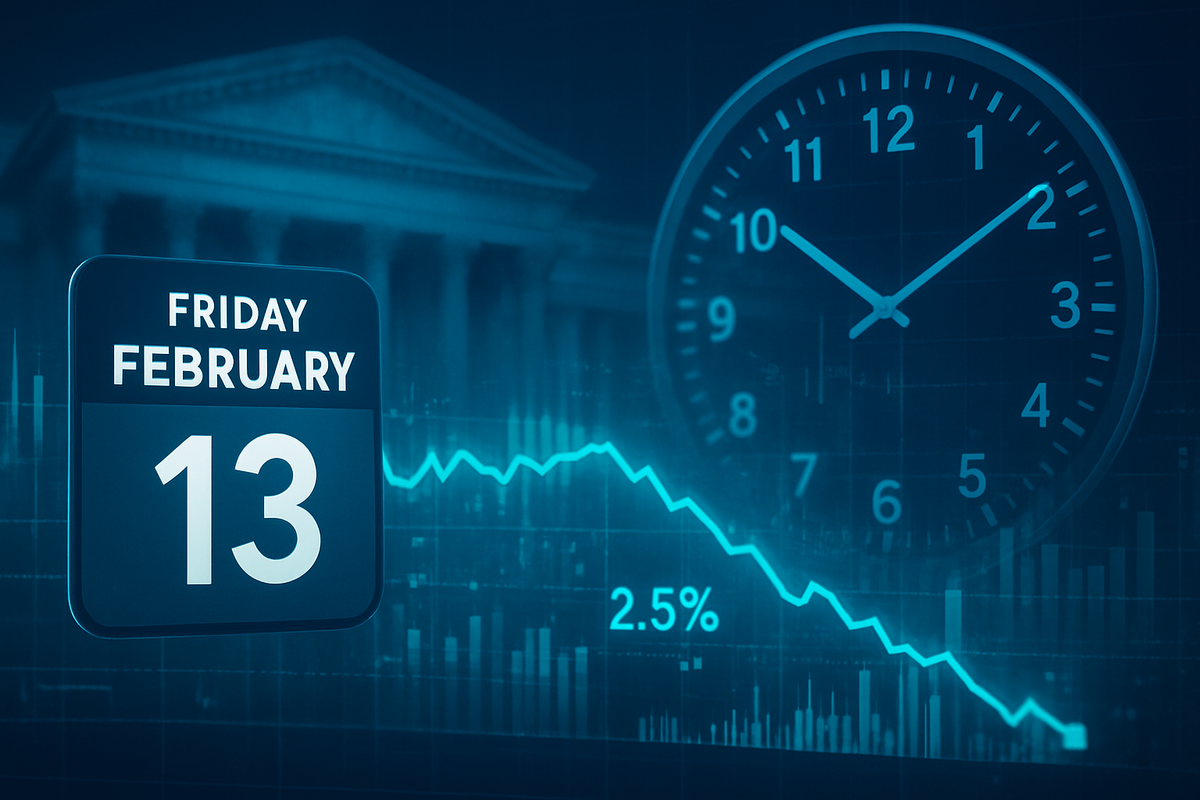
The financial world is bracing for a high-stakes data dump this Friday, as the Bureau of Labor Statistics prepares to release the January Consumer Price Index (CPI) following a disruptive four-day government shutdown. After a budget impasse temporarily silenced the nation’s primary economic engines at the end of January, the rescheduled report is now the most anticipated catalyst for a market searching for direction in a post-peak-inflation era.
Economists are coalescing around a forecast of a 2.5% year-over-year increase in headline inflation, a figure that would mark a significant cooling from late 2025. However, with the Federal Reserve currently holding interest rates at a restrictive 3.50%–3.75%, the Friday data will serve as the ultimate litmus test for whether the central bank can justify a pivot toward easing or if "sticky" service costs will force a higher-for-longer stance through the first half of 2026.
The Shutdown Stumble and the "January Effect"
The road to this Friday’s release was paved with political friction. A partial government shutdown, triggered on January 30, 2026, over Department of Homeland Security funding disputes, forced the Bureau of Labor Statistics (BLS) to suspend operations just as the final January price tallies were being processed. Although the lapse was short-lived—lasting only four days until a budget package was signed on February 3—it was enough to scramble the federal data calendar, pushing the CPI release from its original February 11 slot to Friday, February 13.
Despite the administrative hiccup, analysts at major institutions like The Goldman Sachs Group Inc. (NYSE: GS) and RBC Financial Group suggest the integrity of the data remains intact. The primary concern for traders is not the delay itself, but the "January effect"—a seasonal trend where corporations typically reset pricing contracts and implement annual hikes. While a 2.5% annual rate would represent progress, a hot month-over-month reading could suggest that the "last mile" of the inflation fight remains the most difficult.
Initial market reactions to the delay have been characterized by uncharacteristic quiet, as institutional investors move to the sidelines. The 10-year Treasury yield has hovered near 4.1%, reflecting a "wait-and-see" approach. Stakeholders are particularly focused on the "Core" CPI, which excludes volatile food and energy costs and is expected to mirror the headline trend, potentially landing between 2.5% and 2.6%.
Winners and Losers: The Sector Split
The impending data release creates a stark divide between sectors sensitive to interest rates and those that thrive on stability. Financial giants like JPMorgan Chase & Co. (NYSE: JPM) and Bank of America Corp. (NYSE: BAC) stand to benefit if the CPI print comes in near expectations. A steady, controlled descent in inflation allows these banks to better price loans and maintain healthy net interest margins without the threat of a sudden, aggressive rate hike cycle or a sharp, recessionary rate cut.
Conversely, the retail sector faces a more complex outlook. Giants such as Walmart Inc. (NYSE: WMT) and Target Corporation (NYSE: TGT) have been navigating a landscape where consumers are increasingly price-sensitive. A 2.5% inflation reading would signal a stabilization in input costs, but if the "Core" service inflation remains high, these retailers may struggle to pass on costs to a public that has already reached its spending limit. For Amazon.com Inc. (NASDAQ: AMZN), the stakes are equally high; any sign of persistent inflation could dampen consumer discretionary spending, which has been a key driver for the company’s retail margins in early 2026.
High-growth technology stocks, represented by bellwethers like Nvidia Corporation (NASDAQ: NVDA), remain the most sensitive to the Fed's reaction to the CPI. If Friday’s report surprises to the upside, the prospect of delayed rate cuts could put downward pressure on the high valuations currently enjoyed by the AI-led tech sector. For these companies, 2.5% is more than just a number; it is the green light required for the market to price in the "neutral" interest rate environment they crave.
The 2.5% Threshold and the Powell Transition
The significance of a 2.5% inflation reading extends far beyond a single data point; it represents the psychological and policy "comfort zone" for a Federal Reserve in transition. As the Fed enters 2026, it is grappling with an internal divide. During the January 28 FOMC meeting, the committee opted to hold rates steady, yet the decision was not unanimous. The dissent from some governors suggested a growing eagerness to cut rates to protect a cooling labor market, where unemployment has crept up to 4.4%.
This CPI release is also the first major test for the market's perception of the Fed’s future leadership. With Jerome Powell's term as Chair set to expire on May 15, 2026, and the nomination of Kevin Warsh as his successor, investors are looking for clues on how the central bank will handle the final descent to its 2% target. Warsh is historically perceived as more "hawkish" than Powell, leading some to fear that a CPI print even slightly above 2.5% could give the incoming leadership a reason to keep rates elevated well into the autumn.
Historically, periods of "disinflationary stalls"—where inflation hovers just above a central bank's target—have led to extended periods of market volatility. The current situation mirrors the mid-1990s, where a "soft landing" was achieved only through meticulous, data-dependent adjustments. If the Friday report confirms the 2.5% forecast, it will bolster the narrative that the U.S. economy has successfully avoided a hard landing despite the most aggressive tightening cycle in decades.
What Comes Next: The Path to the Terminal Rate
Following Friday’s release, the market will immediately pivot to the Fed's March meeting. A 2.5% print would likely cement a "pause" for the first quarter of 2026, as the Fed awaits more clarity on the labor market following the rescheduled jobs report. However, it would also set the stage for one or two 25-basis-point cuts in the second half of the year, potentially bringing the terminal rate down to a more neutral 3.00%–3.25% by December.
Short-term volatility is almost guaranteed. If the data misses the 2.5% target and comes in higher, we may see a strategic pivot from institutional investors away from small-cap stocks and back into "cash-rich" mega-cap tech. Conversely, a "cool" print below 2.5% could ignite a broad-market rally, as it would provide the Fed with the "greater confidence" it has publicly stated it needs to begin easing.
The Bottom Line for Investors
In summary, the delayed January CPI report is the most critical piece of the 2026 economic puzzle. The 2.5% forecast represents a delicate balance: low enough to suggest the inflation monster has been tamed, but high enough to keep the Federal Reserve from declaring a total victory. The government shutdown may have delayed the news, but it has only served to increase the magnitude of the market's eventual reaction.
As the Friday deadline approaches, investors should keep a close watch on the "Supercore" inflation figures—services excluding housing—as this will likely dictate the Fed's 2026 interest rate path more than the headline number itself. While the political theater of the shutdown has passed, its shadow remains over the data, reminding the markets that even in a cooling economy, the path to stability is rarely a straight line.
This content is intended for informational purposes only and is not financial advice