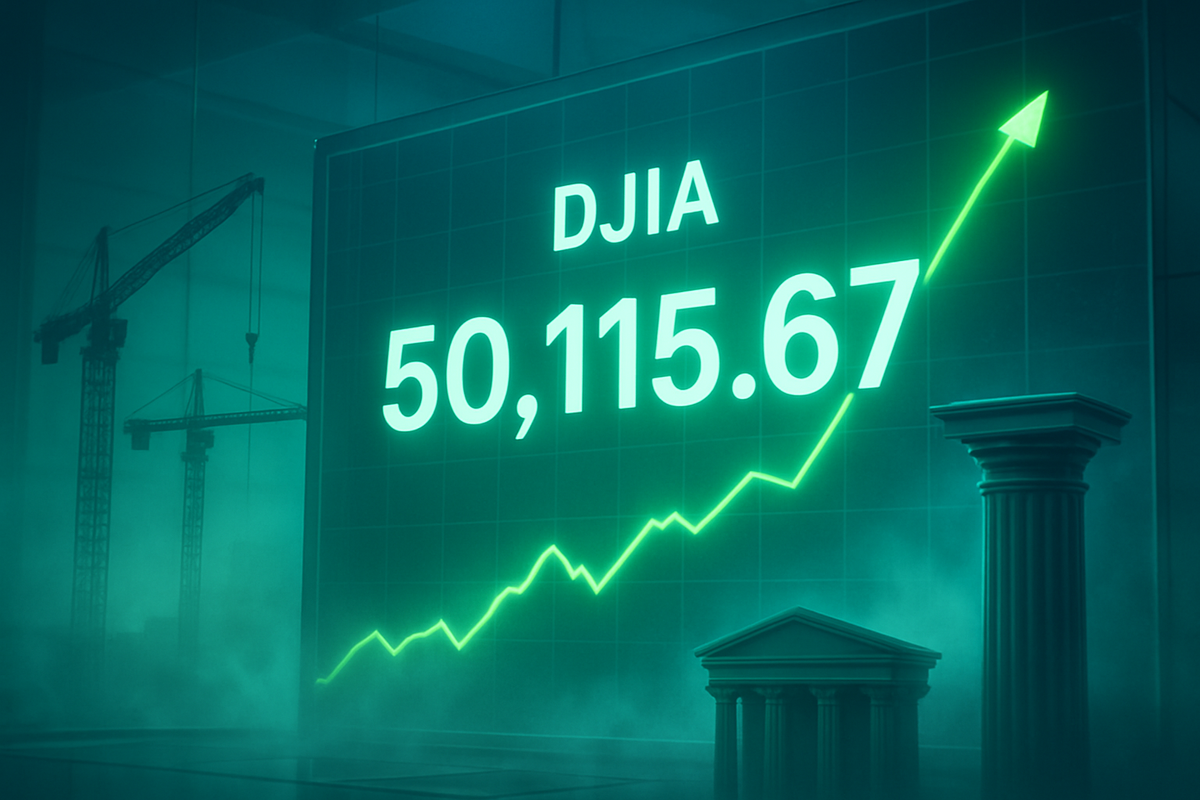
The Dow Jones Industrial Average (DJIA) achieved a monumental milestone on Friday, February 6, 2026, closing above the 50,000 mark for the first time in history. The index finished the week at 50,115.67, gaining over 1,200 points in a single session to cap off a historic journey that has redefined market expectations. This achievement represents more than just a psychological barrier; it signals a robust shift in investor confidence toward the foundational sectors of the American economy.
As markets opened this Monday morning, February 9, 2026, the momentum remains palpably bullish. Traders are continuing to digest the significance of Friday’s surge, with early morning futures indicating a sustained interest in the "broadening rally" that has characterized the start of the year. This breakthrough comes after a period of intense volatility and skepticism, suggesting that the "soft landing" sought by the Federal Reserve for the past two years has finally solidified into a runway for long-term growth.
A Record-Breaking Ascent Through the "Data Fog"
The trek from 40,000 to 50,000 took just 431 trading days, marking the fastest 10,000-point advance in the index’s 129-year history. This rapid ascent was punctuated by several moments of doubt, including a sharp 15% correction in April 2025 and a federal government shutdown late last year that created a "data fog," leaving investors flying blind for several weeks. However, the resolution of those fiscal uncertainties and a steady decline in inflation—which hit a two-year low of 2.7% in December—cleared the path for the current breakout.
The final push on Friday was particularly dramatic. The index surged 2.47% in the session, effectively rebounding from a mid-week slump known on trading floors as the "SaaSpocalypse." That brief but sharp selloff in software-as-a-service (SaaS) and high-valuation artificial intelligence stocks had many fearing a market peak. Instead, the capital rotated violently into the Dow’s heavyweights, proving that while tech remains a driver, the index's diverse mix of industrials and financials provides a sturdy floor.
Key stakeholders, from institutional asset managers to retail investors, have been recalibrating their portfolios to reflect this "new normal." The Federal Reserve's decision to hold interest rates at 3.5%–3.75% in January, following three cuts in late 2025, provided the necessary liquidity to fuel this record-setting run. Initial reactions from Wall Street have been overwhelmingly positive, with many analysts raising their year-end targets for the index to as high as 54,000.
The Drivers of the 50K Era: Winners and Losers
The Dow’s price-weighted structure meant that its most expensive components were the primary engines of the 50,000 breach. Caterpillar Inc. (NYSE: CAT) was the undisputed star of Friday's session, surging over 7% to hit a record high. The industrial giant has benefited immensely from a surge in domestic infrastructure projects and a global recovery in mining demand. Similarly, the financial sector provided the necessary horsepower to cross the finish line; Goldman Sachs Group Inc. (NYSE: GS) and JPMorgan Chase & Co. (NYSE: JPM) both saw significant gains as the yield curve stabilized and merger-and-acquisition activity reached its highest level since 2021.
UnitedHealth Group Inc. (NYSE: UNH) also played a pivotal role, maintaining its position as a stabilizing force within the index. The healthcare giant’s influence was bolstered late last year by a massive $1.5 billion investment disclosure from Berkshire Hathaway, which signaled a "flight to quality" among value-oriented investors. Additionally, the recent inclusion of NVIDIA Corp (NASDAQ: NVDA) in the Dow proved timely, as the chipmaker’s 8% jump on Friday provided the final mathematical nudge needed to push the index past the 50,000 threshold.
However, the rally was not universal. Amazon.com Inc. (NASDAQ: AMZN) faced a difficult session, with shares falling nearly 6% on the day of the milestone after announcing a massive $200 billion capital expenditure plan for 2026. Investors expressed concerns over potential margin compression as the e-commerce giant doubles down on AI infrastructure. Beyond the Dow, the automotive sector saw significant pain, with Stellantis N.V. (NYSE: STLA) plummeting 24% in early 2026 as it struggled with a difficult transition away from its legacy internal combustion engine lineup.
Broadening the Bull: Significance of the Milestone
The Dow’s move to 50,000 is a significant indicator of a "broadening bull market." For much of 2024 and 2025, the market's gains were concentrated in a handful of technology giants. The current rally is different; it is participation-driven. When the Dow outperforms the Nasdaq, as it did during the Friday breakout, it suggests that the economic recovery is reaching the "real economy"—manufacturing, logistics, and traditional banking. This shift mirrors the post-inflationary booms of the mid-1980s and the early 1950s, where industrial capacity expansion led the way.
From a regulatory standpoint, the milestone puts the Federal Reserve in a delicate position. With inflation at 2.7% and the market at record highs, the pressure to continue cutting rates may face resistance if the economy appears to be overheating. Policymakers will be watching the University of Michigan Consumer Sentiment Index, which recently hit its highest level since August 2025 at 57.3, indicating that the public’s "vibe-cession" may finally be ending as the stock market’s success begins to trickle down into household confidence.
This event also sets a new precedent for market resilience. The 50,000 mark was reached despite significant geopolitical tensions and the aforementioned government shutdown. It serves as a testament to the "soft landing" narrative—a scenario that many economists thought impossible in 2023. By successfully navigating the transition from high interest rates to a more moderate 3.5% environment without a recession, the U.S. economy has reinforced its position as the premier destination for global capital.
The Road to 60,000: Challenges and Opportunities
As the Dow enters the 50,000s, the primary challenge will be maintaining the valuation multiples that supported this rise. The "SaaSpocalypse" served as a warning that investors are no longer willing to pay any price for growth; they want to see actual returns on AI investments. The short-term focus for Dow components will likely be on operational efficiency and the integration of automation to combat rising labor costs, which have kept the unemployment rate steady at 4.4%.
Strategically, we may see a pivot among large-cap companies toward more aggressive share buybacks and dividend increases. With the "50,000" psychological hurdle cleared, companies like Caterpillar and JPMorgan may use their strong balance sheets to reward shareholders, further fueling the Dow’s price-weighted momentum. However, a potential risk remains in the form of "valuation fatigue." If corporate earnings for the first quarter of 2026 do not justify the current prices, the market could see a healthy but sharp pullback to the 48,000 support level.
Looking ahead, the market is pricing in at least two more interest rate cuts from the Federal Reserve in 2026. If these cuts materialize without a spike in inflation, the Dow could reach 55,000 by the end of the year. The biggest opportunity lies in the "unloved" sectors—small caps and mid-cap industrials—that have yet to fully participate in the 50,000 rally but are now starting to catch the eye of value seekers.
Conclusion: A New Benchmark for American Enterprise
The Dow Jones Industrial Average closing at 50,115.67 is a watershed moment for global finance. It marks the culmination of a decade of technological transformation and a successful navigation of the post-pandemic inflationary crisis. The key takeaway for investors is that the rally has evolved; it is no longer just a tech story, but an industrial and financial one. The index’s ability to shrug off the "SaaSpocalypse" and the "data fog" of late 2025 demonstrates a profound underlying strength in the U.S. corporate sector.
Moving forward, the market appears positioned for continued, albeit perhaps more moderate, gains. The era of 50,000 Dow points brings with it a higher level of scrutiny on corporate fundamentals and Federal Reserve policy. Investors should keep a close watch on Q1 earnings reports and the upcoming CPI data for March, as these will determine whether the 50,000 level becomes a floor or a ceiling. For now, the "Golden Era" of the Dow is in full swing, and the psychological momentum of this milestone is likely to keep the bulls in charge for the foreseeable future.
This content is intended for informational purposes only and is not financial advice.
Stay tuned for further updates as the market continues to react to this historic milestone.
- February 9, 2026