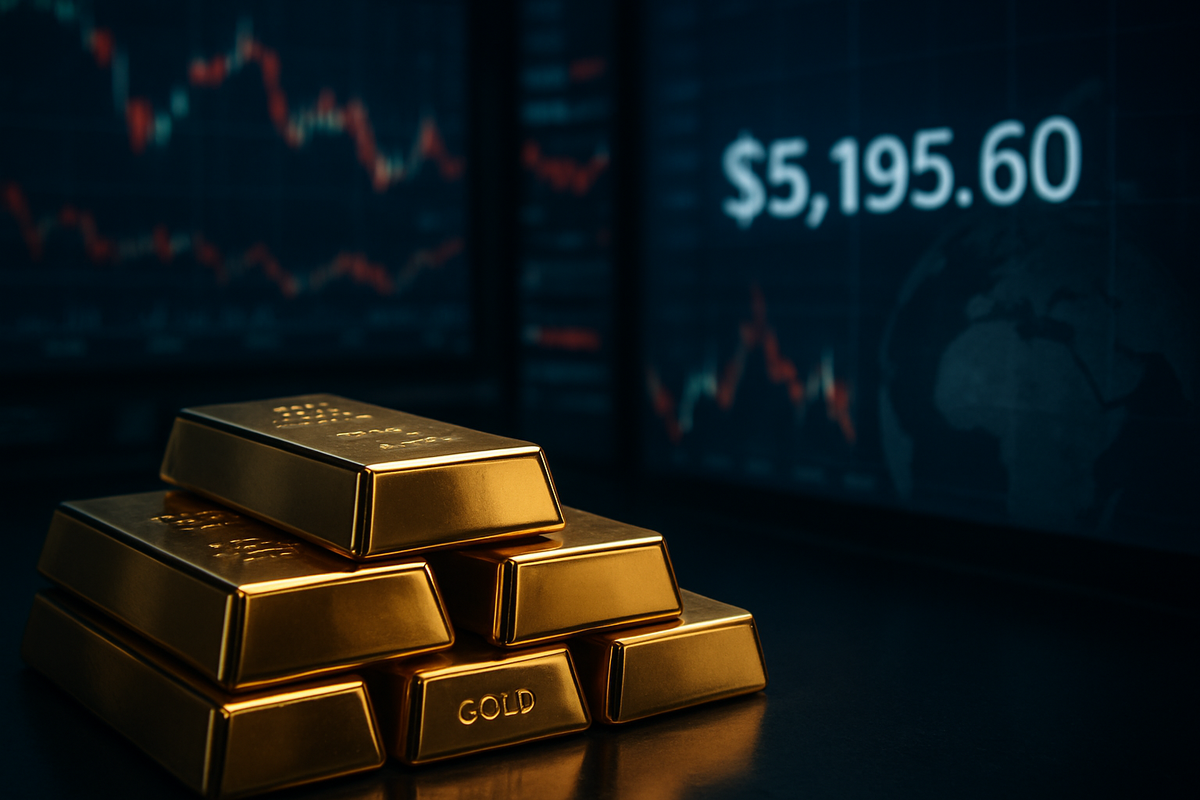
March 10, 2026 — In a historic day for global commodities, gold prices surged to an unprecedented $5,195.60 per ounce, marking a watershed moment in financial history. The precious metal, long considered the ultimate store of value, breached the $5,000 psychological barrier as a "perfect storm" of geopolitical chaos and systemic economic fragility sent investors scrambling for safety.
The rally reflects a profound shift in market sentiment. With traditional equities facing volatility and bond yields struggling to keep pace with "sticky" inflation, the flight to bullion has intensified. Today's price action confirms gold’s status not just as a commodity, but as the primary hedge against a world increasingly defined by high-stakes military conflict and a global debt burden that many analysts now view as unsustainable.
The Perfect Storm: War, Oil, and an Inflationary Trap
The immediate catalyst for today’s historic peak can be traced back to the final days of February 2026, when long-simmering tensions in the Middle East exploded into a full-scale regional conflict. Following a series of coordinated strikes against strategic infrastructure, the closure of the Strait of Hormuz—the world’s most critical energy transit point—sent shockwaves through global markets. By this morning, Brent crude had spiked toward $120 per barrel, further fueling fears of an energy-driven inflationary spiral.
While the geopolitical flashpoint provided the spark, the fuel for gold’s ascent has been building for years. Despite aggressive central bank interventions throughout 2025, inflation has remained stubbornly pegged at 3.0%, well above the long-coveted 2% target. This persistent price pressure has coincided with a global debt-to-GDP ratio that recently crossed the 100% threshold, with the United States national debt now hovering near 140% of its economic output.
Market participants are increasingly concerned that central banks are caught in a "structural trap." Raising interest rates further to combat the current 3% inflation risks a sovereign debt crisis by making interest payments unmanageable, while cutting rates would likely debase currencies further. In this environment, institutional heavyweights and retail investors alike have turned to gold as a "defensive debasement" asset, seeking protection from what many fear is an impending era of currency devaluation.
Gold’s Great Beneficiaries: Winners and Losers in a $5,000 World
The primary winners of this historic rally are the world's largest gold producers, which are seeing their profit margins expand at an exponential rate. Newmont Corporation (NYSE: NEM), the world’s largest miner, saw its shares climb significantly today as it reaped the rewards of its low-cost production profile. Similarly, Barrick Gold Corporation (NYSE: GOLD) has emerged as a top performer, with investors favoring its "Tier One" assets that provide massive leverage to the rising price of bullion.
The surge has also trickled down to mid-tier miners and royalty companies. Agnico Eagle Mines Limited (NYSE: AEM) has been a favorite for those seeking exposure in lower-risk jurisdictions like Canada and Finland, while Franco-Nevada Corporation (NYSE: FNV)—a leading royalty and streaming firm—has benefited from the rally without the direct operational risks of mining. For investors seeking direct exposure to the metal itself, the SPDR Gold Shares (NYSE Arca: GLD) and the iShares Gold Trust (NYSE Arca: IAU) recorded some of their highest trading volumes on record today, as massive inflows pushed their assets under management to historic highs.
Conversely, the rally spells trouble for sectors sensitive to energy costs and consumer spending. Airlines such as Delta Air Lines (NYSE: DAL) and United Airlines Holdings (NASDAQ: UAL) have seen their stock prices pressured by the concurrent spike in jet fuel costs. Additionally, consumer discretionary companies are facing a "double whammy" of rising input costs and a consumer base whose purchasing power is being eroded by the persistent 3% inflation and high energy prices.
A New Monetary Paradigm: Historical Precedents and Ripple Effects
The ascent to $5,195.60 is more than just a price move; it represents a fundamental re-evaluation of the global financial system. Historically, gold’s major rallies—such as those in the late 1970s and the aftermath of the 2008 financial crisis—were driven by a loss of confidence in fiat currencies. However, the 2026 rally is unique in its scale and the sheer volume of global debt involved.
Unlike the 2024 gold run, which was largely driven by central bank buying in emerging markets, today’s rally is being fueled by a broader "fear trade" involving Western institutional capital. The ripple effects are being felt across all asset classes. Silver and platinum have also seen sympathetic gains, while the "digital gold" narrative surrounding Bitcoin has been tested as investors seemingly prioritize the 5,000-year track record of physical bullion during this period of kinetic warfare.
Policymakers are now facing a daunting reality. If gold continues to climb, it could act as a signal of a "no-confidence" vote in the U.S. Dollar’s hegemony. Some analysts are already drawing comparisons to the stagflationary era of the 1970s, though they note that the current debt levels make the 1970s look fiscally conservative by comparison. This has led to renewed discussions in some circles about the necessity of a "New Bretton Woods" style agreement to stabilize global currencies.
What Lies Ahead: $6,000 or a Strategic Retreat?
In the short term, the trajectory of gold prices will largely depend on the de-escalation of the Middle East crisis. Early reports today suggest that diplomatic channels remain open, and any signal of the Strait of Hormuz reopening could lead to a sharp, albeit likely temporary, "relief rally" in risk assets, causing gold to consolidate or pull back from its $5,195.60 peak.
However, the long-term outlook remains tilted to the upside. Even if the immediate military conflict is resolved, the underlying issues of 3% inflation and a $111 trillion global debt mountain will not disappear overnight. Strategic pivots are already occurring; many hedge funds are shifting their portfolio allocations to hold as much as 10-15% in precious metals, up from the traditional 5%.
The market must now navigate several potential scenarios. A "soft landing" remains the hope of central bankers, but a "stagflationary entrenchment" appears more likely given the current energy shocks. If inflation continues to outpace wage growth and interest rate cuts become necessary to prevent a debt default, analysts suggest that gold testing the $6,000 mark by the end of 2026 is no longer a fringe theory, but a distinct possibility.
Navigating the Golden Era
Today’s move to $5,195.60 per ounce is a stark reminder of gold’s enduring relevance in the modern financial toolkit. It serves as a barometer for global anxiety, rising as confidence in the existing geopolitical and fiscal order wanes. For investors, the takeaway is clear: the era of low-volatility, low-inflation investing has been replaced by a new paradigm of "permacity" (permanent scarcity and volatility).
As we move forward, the market will be hyper-focused on two primary indicators: the status of oil shipments in the Middle East and the upcoming quarterly debt-servicing reports from the Treasury. The "Gold Era" of 2026 is officially here, and its impact on portfolios, policy, and the global power balance will be felt for years to come.
Investors should keep a close eye on the performance of the major miners and the stability of the U.S. Dollar. In a world where debt is high and peace is fragile, gold has once again proven that it is the only asset that carries no one else's liability.
This content is intended for informational purposes only and is not financial advice.