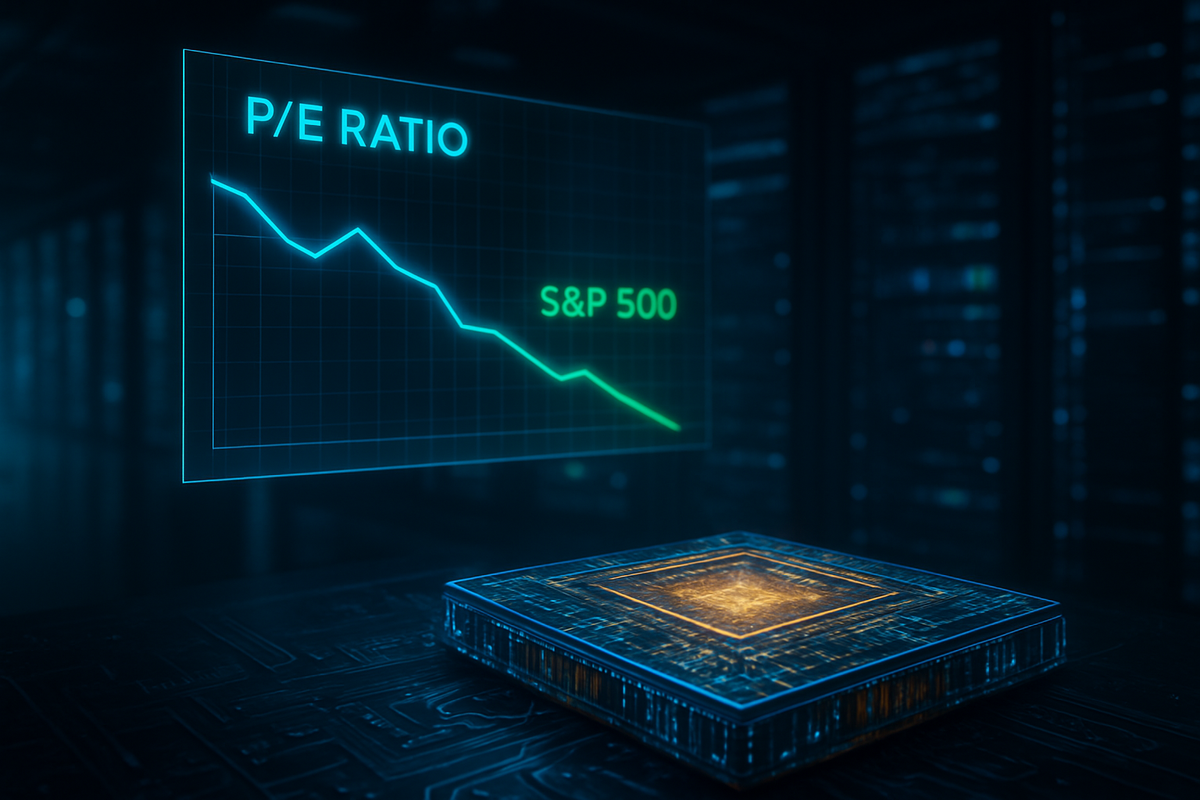
As of March 10, 2026, the financial markets are witnessing a phenomenon that few analysts would have predicted during the initial artificial intelligence gold rush of 2023. NVIDIA Corporation (NASDAQ: NVDA) has officially entered a "valuation inversion," where the world’s premier AI chipmaker is now trading at a forward price-to-earnings (P/E) ratio of 22.1—strikingly lower than the S&P 500’s broader average of 23.6. This shift comes despite Nvidia reporting a staggering 73% year-over-year revenue growth in its latest fiscal quarter, signaling a massive disconnect between the company’s fundamental performance and its market sentiment.
This "valuation floor" represents a pivot point for the U.S. technology sector. For years, Nvidia was characterized by high-premium momentum, with investors paying a heavy tax for a piece of the AI future. Today, that future has arrived with such overwhelming scale that the market appears to be treating Nvidia more like a high-growth utility or a mature industrial giant than a speculative tech start-up. The implications for long-term investors are profound: the most important company in the modern computing era has transitioned from a "growth-at-any-price" play into what many now consider the ultimate "growth-at-a-reasonable-price" (GARP) opportunity.
The Record-Breaking Quarter and the March Toward Rubin
The catalysts for this valuation shift are rooted in Nvidia’s Q4 FY26 earnings report, released in late February. The company posted total revenue of $68.1 billion, a 73% jump from the previous year, driven almost entirely by its Data Center segment. Record Data Center sales reached $62.3 billion, accounting for over 91% of the company's total top line. This growth was fueled by the full-scale deployment of the Blackwell architecture and the early-stage ramp-up of the newly announced Rubin platform. Despite these eye-popping figures, the stock price has stabilized, allowing the company’s explosive earnings per share (EPS) to outpace its share price appreciation, effectively "compressing" the multiple.
The timeline leading to this moment was defined by the transition from AI model training to AI inference. Throughout 2024 and 2025, the market focused on the massive clusters of H100 and B200 chips required to build Large Language Models (LLMs). By early 2026, the narrative shifted toward "Agentic AI"—autonomous AI systems that perform complex tasks without constant human oversight. This shift required a different kind of infrastructure, one focused on low-latency, high-throughput inference, where Nvidia’s software ecosystem, CUDA, proved to be an even more formidable moat than the hardware itself. Initial market reactions to the Q4 report were mixed, as some institutional investors feared a "digestion period" after two years of hyper-spending, yet the fundamental numbers suggested that the hunger for compute shows no signs of satiation.
Winners and Losers in the Post-Peak Hype Era
In this new valuation landscape, Nvidia (NASDAQ: NVDA) stands as the primary beneficiary of a stabilized market, as its lower P/E ratio mitigates much of the "bubble" risk that plagued the stock in 2024. However, the ripple effects are felt across the semiconductor industry. Advanced Micro Devices, Inc. (NASDAQ: AMD) continues to fight for the second-place spot in the GPU market, but as Nvidia’s valuation compresses, the "value argument" for AMD becomes harder to sustain unless they can significantly undercut Nvidia on price-to-performance. Meanwhile, Intel Corporation (NASDAQ: INTC) remains in a transitional state, attempting to capitalize on the domestic foundry push while struggling to gain meaningful ground in the high-end AI accelerator space.
The "Big Five" hyperscalers—Microsoft Corporation (NASDAQ: MSFT), Alphabet Inc. (NASDAQ: GOOGL), Amazon.com, Inc. (NASDAQ: AMZN), Meta Platforms, Inc. (NASDAQ: META), and Apple Inc. (NASDAQ: AAPL)—are the biggest "winners" in terms of infrastructure stability. These companies have projected a combined $700 billion in capital expenditure for 2026. Because Nvidia’s chips have become a standardized, "cheaper" component relative to the earnings they generate for these platforms, the hyperscalers are essentially locked into an upgrade cycle that is now a permanent fixture of their balance sheets. On the losing side are smaller AI hardware startups that relied on the "Nvidia is too expensive" narrative to lure venture capital; with Nvidia now trading at a discount to the broader market, the barrier to entry for new competitors has never been higher.
A New Framework for AI Infrastructure
The significance of Nvidia’s 22.1 forward P/E ratio extends far beyond a single stock chart. It signals that AI has matured from a speculative trend into a core industrial utility for the global economy. This "valuation floor" mirrors the historical precedents of the mid-2000s, when companies like Microsoft and Cisco saw their multiples compress even as their technologies became the backbone of the internet. The difference today is the sheer speed of the transition. The market is currently discounting Nvidia’s growth not because it doubts the technology, but because it is struggling to model the ceiling of a market where $700 billion in annual Capex has become the baseline.
Furthermore, the emergence of "Physical AI" and robotics has created a secondary wave of demand that is just beginning to be felt. As Nvidia moves into the robotics space with its Isaac platform, it is diversifying its revenue away from pure data centers and toward the automation of the physical world. This shift is also creating a new bottleneck: optical interconnects. In early March 2026, Nvidia’s strategic investments in photonics companies like Coherent Corp. (NYSE: COHR) and Lumentum Holdings Inc. (NASDAQ: LITE) highlighted that the next phase of AI scaling will be about how fast data moves between chips, rather than just the speed of the chips themselves. This evolution suggests that the "AI era" is moving into its second, more integrated phase.
Strategic Pivots and the Road Ahead
Looking toward the remainder of 2026 and into 2027, Nvidia is likely to undergo several strategic pivots to maintain its dominance. The most significant move will be a continued push into "AI-as-a-Service," where Nvidia provides not just the chips but the full software stack and cloud environment for enterprises to deploy agentic workflows. By shifting more toward recurring software revenue, Nvidia could potentially re-expand its multiple as investors begin to value it like a SaaS (Software-as-a-Service) company rather than a cyclical hardware manufacturer.
In the short term, investors should prepare for continued volatility as the market grapples with the concept of a "value-priced" Nvidia. A potential scenario involves Nvidia initiating a massive share buyback program or even a dividend increase, given its gargantuan cash reserves and $43 billion in quarterly net income. Such a move would be the ultimate signal of maturity, potentially attracting a new class of value-oriented institutional investors who had previously stayed away from the stock during its "meme-like" ascent in 2023. The challenge will be managing the transition from the Rubin platform to whatever comes next, as the cost of manufacturing these increasingly complex chips begins to test the limits of even the highest gross margins.
The Bottom Line for Investors
The surprising valuation shift of March 2026 marks the end of the "AI Hype" era and the beginning of the "AI Utility" era. Nvidia’s drop to a 22.1 forward P/E—making it technically cheaper than the average S&P 500 stock—is a clarion call for investors to re-evaluate their tech portfolios. The key takeaway is that the fundamental growth story of artificial intelligence remains intact, but the way the market values that growth has fundamentally changed. Nvidia is no longer a speculative bet on the future; it is the fundamental infrastructure of the present.
Moving forward, the market will likely be driven by "real-world" AI applications rather than theoretical models. Investors should watch for the continued scaling of Agentic AI and the integration of photonics into data center architectures. While the "easy money" of the 2023-2024 run-up is in the past, the current valuation provides a rare opportunity for disciplined investors to own the most influential company of the decade at a price that actually underrepresents its growth trajectory. The "valuation floor" is set; the question now is how high the ceiling can go as the physical and digital worlds continue to merge.
This content is intended for informational purposes only and is not financial advice.