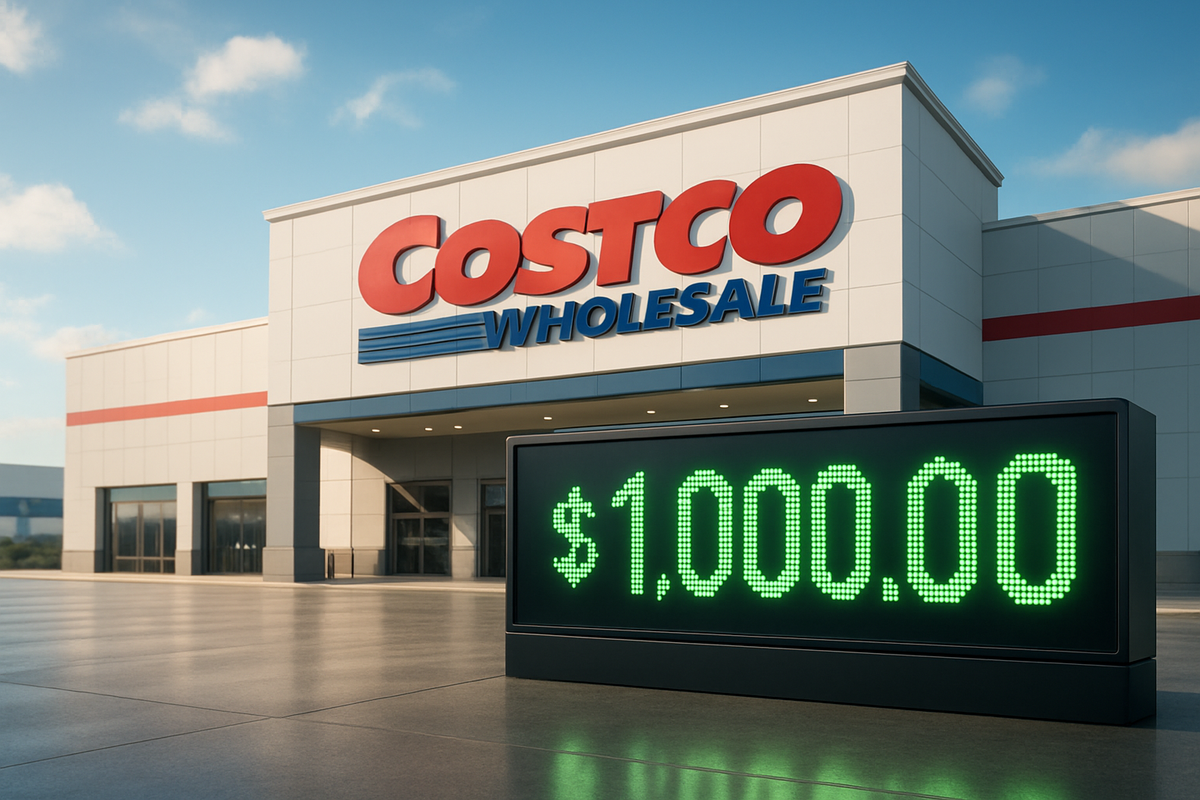
In a historic session for the retail sector, Costco Wholesale Corporation (NASDAQ: COST) officially crossed the $1,000 share price threshold on March 5, 2026, marking a new era for the membership-based warehouse giant. The milestone occurred just hours before the company released its fiscal second-quarter 2026 earnings report, which largely validated the stock’s meteoric rise. Driven by a rare combination of defensive stability and tech-like growth, Costco has become the definitive anchor for the Consumer Staples sector, which has seen a massive "rotation to safety" in the early months of 2026.
The psychological and financial weight of a $1,000 stock price places Costco in an elite tier of American corporations, transcending its origins as a bulk-goods retailer. As the broader market grapples with volatility in higher-growth tech sectors, investors have increasingly treated Costco’s recurring membership revenue as a high-margin "software-style" annuity. This shift in sentiment, coupled with a robust 17% year-to-date gain, has pushed the company’s valuation to levels rarely seen in the history of brick-and-mortar retail, sparking both celebration and caution on Wall Street.
A Perfect Storm: The Road to $1,000
The ascent to the four-figure mark was not an overnight phenomenon but the culmination of months of operational excellence. Throughout January and February 2026, Costco reported exceptional monthly sales figures, including a staggering 34.4% surge in e-commerce during January alone. On the morning of March 5, 2026, shares hit an intraday high of $1,006.74, cementing the company’s status as a market leader just as it prepared to pull back the curtain on its fiscal Q2 performance.
The subsequent earnings report for the 12 weeks ending February 15, 2026, provided the fundamental backing for the stock's premium. Costco reported earnings per share (EPS) of $4.58, surpassing the consensus estimate of $4.55 and representing a 14% increase year-over-year. Total revenue climbed to $69.6 billion, beating analyst expectations of $69.25 billion. Crucially, the "membership flywheel"—the heart of Costco’s business model—showed no signs of slowing. Membership fee income rose 13.6% to $1.36 billion, reflecting the successful absorption of the September 2024 fee hike. Despite the higher costs for members ($65 for Gold Star and $130 for Executive), renewal rates remained at a near-record 92.3% in the U.S. and Canada.
Initial market reactions were a mix of awe and a minor "sell the news" cooling period, as the stock had been "priced for perfection" leading up to the announcement. However, the underlying data—specifically a 7.4% jump in global comparable store sales and a 22.6% rise in digital growth—reaffirmed the company's dominant position in an environment where consumers are increasingly prioritizing value without sacrificing quality.
Sector Ripple Effects: Winners and Losers
Costco’s milestone has recalibrated the entire retail landscape, creating a "halo effect" for some while exposing the execution gaps for others. Walmart Inc. (NYSE: WMT) has been a primary beneficiary of this sentiment shift. Trading at a forward P/E of roughly 40x to 47x, Walmart saw its own shares rise 15% year-to-date as investors looked for the next most capable "omnichannel" executor. Walmart’s strategic focus on AI-powered logistics and its high-margin advertising business, Walmart Connect, helped it maintain pace with Costco’s momentum, though it still trails in membership loyalty metrics.
Target Corporation (NYSE: TGT) also emerged as a surprise winner in early 2026. After years of struggling with inventory challenges and soft discretionary demand, Target’s stock rose 15.6% by early March. While its revenue growth remained more modest than Costco’s, Target’s focus on its "Roundel" advertising network and store-within-a-store concepts (like Ulta Beauty) provided a much-needed boost to investor confidence, suggesting a broader recovery for well-run retailers.
Conversely, the "execution gap" became more apparent for BJ's Wholesale Club Holdings, Inc. (NYSE: BJ). While BJ's stock saw a respectable 7.5% to 9.4% gain, it lagged significantly behind its larger warehouse rival. Investors have begun to treat BJ's as a "value alternative" rather than a growth peer, with the company trading at nearly half the P/E multiple of Costco. For smaller or less efficient retailers, Costco's $1,000 milestone has raised the bar for what "perfection" looks like, making it harder for them to attract capital from the massive Consumer Staples Select Sector SPDR Fund (NYSE: XLP), which has surged 13% year-to-date as capital flees volatile tech sectors.
The "Software Retailer" Thesis and Industry Significance
The broader significance of Costco crossing $1,000 lies in its unique valuation profile. Trading at a forward price-to-earnings (P/E) ratio of 48x to 55x, Costco is no longer valued like a traditional grocery store; it is valued like a high-growth technology firm. This "Software Retailer" thesis, championed by analysts at firms like BMO Capital and Telsey Advisory Group, argues that Costco’s membership fees are essentially a recurring subscription service with nearly 100% margins, justifying a massive premium over peers.
This trend fits into a larger industry shift toward "locked-in" consumer loyalty. As inflation remains persistent—though cooling—consumers are seeking out ecosystems where they can consolidate their spending. Costco's ability to maintain high renewal rates while raising fees has set a historical precedent, proving that the warehouse model is perhaps the most resilient retail format in existence. This has potential regulatory implications, as the sheer dominance of the Costco-Walmart duopoly in the warehouse space may eventually draw closer scrutiny regarding market concentration, though for now, the focus remains on their role as deflationary forces for the consumer.
Historically, few retailers have reached this level of stock price without a split. Comparisons are being drawn to the pre-split days of other tech-adjacent giants. The psychological barrier of $1,000 often marks a point where institutional dominance is solidified, but retail accessibility begins to wane, leading to the next logical step in the company's financial evolution.
Looking Ahead: Splits, Dividends, and Valuation Risks
The most immediate question for investors is when Costco will execute its first stock split in 26 years. With the price now firmly above $1,000, speculation is reaching a fever pitch. Analysts suggest that a 10-for-1 or 5-for-1 split could be on the horizon later in 2026 to make the shares more accessible to retail investors. Additionally, with a cash pile of approximately $17 billion, rumors of a massive special dividend—potentially in the $15 to $20 range—continue to circulate, providing a "buy-the-dip" incentive for shareholders.
However, the "priced for perfection" risk cannot be ignored. While the fiscal Q2 report was stellar, any minor deceleration in comparable store sales or a dip in membership renewal rates in future quarters could lead to a significant "repricing." The challenge for Costco will be maintaining this high-velocity growth as it faces tougher year-over-year comparisons and the potential for a "time correction," where the stock trades sideways while earnings catch up to the valuation.
Strategically, Costco is likely to lean harder into its digital transformation and international expansion, particularly in China and Southeast Asia, to justify its 50x multiple. Investors should also watch for further integration of its "Costco Next" platform, which allows members to buy directly from high-end suppliers at a discount, further thickening the "moat" around its membership.
Final Assessment: The Gold Standard of Resilience
Costco’s breach of the $1,000 mark is more than just a numerical milestone; it is a testament to the enduring power of the membership-driven retail model in a volatile global economy. As of March 12, 2026, the company stands as the undisputed leader of a resurgent Consumer Staples sector, providing a "safe haven" for capital while delivering growth that rivals the technology sector.
For investors, the key takeaways are clear: Costco remains a "gold standard" asset, but its current valuation demands flawless execution. The market will be watching closely for any announcement regarding a stock split or special dividend, which could provide the next catalyst for upward movement. Moving forward, the focus will shift from the $1,000 milestone to how the company utilizes its massive cash reserves to future-proof its business against emerging AI-driven competitors and shifting consumer habits.
In the coming months, the retail sector's health will likely be judged through the lens of Costco's performance. As long as the membership renewal rates stay above 90% and digital sales continue their double-digit climb, the four-digit club may just be the beginning for this warehouse titan.
This content is intended for informational purposes only and is not financial advice.