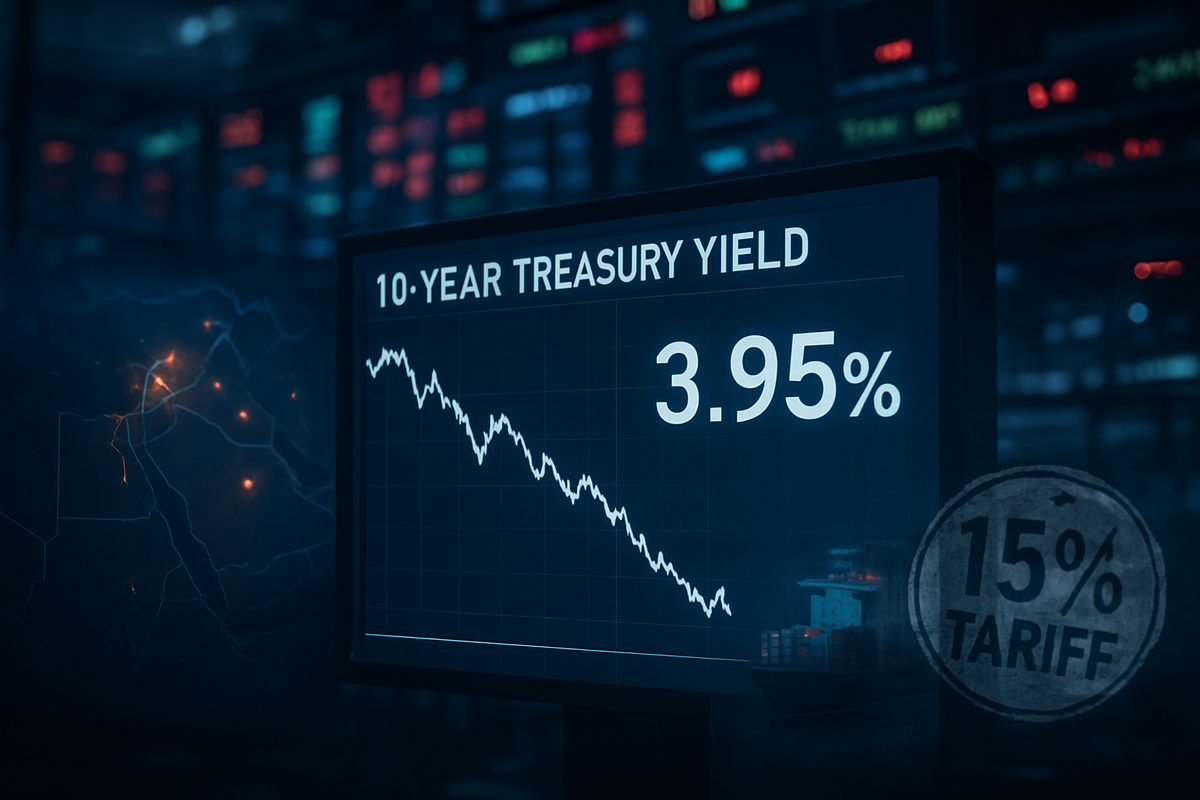
In a move that has left market strategists recalibrating their 2026 outlooks, the benchmark 10-year U.S. Treasury yield plummeted to a three-month low of 3.95% this morning, March 2, 2026. The descent below the critical 4% psychological threshold comes as a direct contradiction to "hot" inflation data released late last week, which showed the January Producer Price Index (PPI) surging by 0.5%—with Core PPI jumping a staggering 0.8%. Under normal market conditions, such inflationary pressure would send yields skyrocketing as investors braced for a hawkish Federal Reserve; however, a "perfect storm" of geopolitical conflict and trade policy upheaval has ignited a massive flight to safety.
The primary catalysts for this counter-intuitive market behavior are the sudden escalation of military operations in the Middle East and a transformative shift in U.S. trade policy. As the U.S. and Israel launched coordinated strikes against Iranian military infrastructure over the weekend, investors scrambled out of high-growth equities and into the perceived security of government debt and precious metals. Simultaneously, the administration’s swift implementation of a 15% global import surcharge—invoking rarely used emergency trade authorities—has cast a shadow over global growth projections, leading many to prioritize capital preservation over inflation-hedging.
A Perfect Storm: War, Tariffs, and Economic Contradictions
The timeline of events leading to this yield collapse began on February 20, 2026, when the U.S. Supreme Court struck down the administration’s broad use of the International Emergency Economic Powers Act (IEEPA) for tariff imposition. In an immediate and aggressive pivot, the President invoked Section 122 of the Trade Act of 1974, implementing a 15% global import surcharge effective February 24. This "tariff turmoil" created an atmosphere of extreme uncertainty, as the market began pricing in the potential for a localized recession and a significant cooling of global trade volumes.
The tension reached a breaking point on February 28, with the announcement of "Operation Epic Fury." Reports of joint U.S.-Israeli strikes on Iran triggered an immediate "risk-off" sentiment across global exchanges. While the PPI data suggested that the Federal Reserve, potentially under the new leadership of nominee Kevin Warsh, would need to keep rates "higher for longer," the immediate threat of a wider regional war in the Middle East overwhelmed these concerns. The resulting "yield curve twist" saw short-term T-bill rates rise on Fed hawkishness while the 10-year yield slid toward its current 3.95% level, signaling a profound fear of future economic stagnation.
Initial market reactions were swift and severe. Gold prices surged past $5,250 per ounce, while Brent crude oil spiked more than 14% as traders weighed the risk of disruptions in the Strait of Hormuz. The Dow Jones Industrial Average suffered a 700-point rout on the final trading day of February, as the "growth trade" was unceremoniously dumped in favor of the "liquidity trade." Analysts at LPL Financial noted that the current environment is a rare instance where geopolitical risk and trade-induced growth fears have completely decoupled the Treasury market from fundamental inflation prints.
Sector Divergence: Winners in Defense, Losers in High-Growth Tech
The volatility of the past 72 hours has created a stark divide between industry "winners" and "losers." In the defense sector, Lockheed Martin (NYSE: LMT) has emerged as a primary beneficiary, with its stock surging nearly 7% to a 52-week high of $692. The operational role of the F-35 fighter jet in "Operation Epic Fury" has led analysts at JPMorgan Chase & Co. (NYSE: JPM) to upgrade the stock to a "Buy," citing an expected increase in long-term procurement and service contracts. Similar gains were seen across the defense landscape, with Northrop Grumman (NYSE: NOC) and RTX Corp (NYSE: RTX) both trading up significantly as the conflict intensifies.
Conversely, the technology sector has faced a brutal reckoning. Nvidia Corporation (NASDAQ: NVDA) experienced a historic $1 trillion loss in market value over the final week of February, as investors fled the "AI-growth" narrative in favor of safe-havens. Apple Inc. (NASDAQ: AAPL) also felt the pinch, with shares dropping 3.2% as the 15% global tariff threatens its intricate supply chain, forcing a more rapid and costly production shift to regions like India. Retailers are also bracing for impact; while Walmart (NYSE: WMT) has utilized its massive inventory buffers to temporarily shield consumers from "tariff-flation," Target (NYSE: TGT) has been flagged as highly vulnerable due to its heavy reliance on discretionary imports.
The banking sector is navigating a complex "yield curve twist." While JPMorgan Chase signaled optimism regarding investment banking fees and trading revenue, Goldman Sachs (NYSE: GS) warned that the current yield drop might be short-lived. Goldman analysts have cautioned that the 15% tariff is inherently inflationary and will eventually force long-term yields back toward 4.4% by the end of the year. For now, however, the "bull flattener" is squeezing net interest margins for regional banks while providing a temporary boost to the trading desks of major Wall Street institutions.
The Specter of Stagflation and Policy Shifts
This convergence of high inflation and falling yields fits into a broader, more concerning industry trend: the potential return of "stagflation." The U.S. economy is still recovering from the hangover of a 43-day government shutdown in late 2025, which saw Q4 GDP growth revised down to a lackluster 1.4%. The current "hot" PPI data combined with falling yields suggests that the market believes the Fed may be trapped—forced to choose between fighting inflation and supporting an economy weakened by trade wars and geopolitical shocks.
Historically, such events parallel the trade-war volatility of 2018-2019, but with the added complication of active military engagement. The regulatory implications of the Supreme Court's IEEPA ruling cannot be overstated; by forcing the administration to rely on Section 122 of the Trade Act of 1974, the government has entered a legally capped 150-day tariff window. This creates a "fiscal cliff" on July 24, 2026, which will likely lead to massive inventory "front-loading" and further logistics volatility in the coming months.
The ripple effects are reaching beyond U.S. borders. Global partners are now forced to navigate a U.S. trade policy that can shift by 15% overnight via executive order. This unpredictability is driving structural changes in global supply chains, as companies move away from the "just-in-time" model toward a "just-in-case" strategy, holding larger inventories to buffer against sudden policy shifts. This shift, while safer, is inherently less efficient and more expensive, contributing to the long-term inflationary pressures that the PPI data first signaled.
Looking Ahead: The July Cliff and the "Warsh Fed"
In the short term, all eyes are on the upcoming Federal Reserve meeting and the confirmation process of Kevin Warsh. Investors are desperately seeking clarity on whether the Fed will prioritize the "hot" PPI data or the "cool" growth signals coming from the Treasury market. If Warsh maintains his hawkish reputation, a collision between Fed policy and market reality is inevitable. Market participants should also watch for retaliatory trade measures from major partners, which could further exacerbate the global growth slowdown.
Strategic pivots are already underway. Corporations are expected to accelerate their diversification away from Chinese manufacturing to avoid the 15% surcharge, which may provide opportunities for emerging markets in Southeast Asia and Latin America. However, the long-term challenge remains the "July 24 Cliff." If Congress does not act to extend or modify the Section 122 tariffs, the sudden removal of these surcharges could create a deflationary shock just as severe as the current inflationary one, leading to extreme whipsaw movements in the bond market.
Potential scenarios range from a diplomatic resolution in the Middle East—which would likely send yields back up toward 4.5%—to a full-scale regional conflict that could drive the 10-year yield even lower as a pure safety play. The most likely outcome is a period of sustained volatility, where the traditional correlations between inflation, employment, and interest rates remain fractured by the heavy hand of geopolitics and trade protectionism.
Summary of a Market in Transition
The drop in the 10-year Treasury yield to 3.95% is a vivid illustration of how fear can override fundamentals. Despite PPI data that would normally signal a "sell" for bonds, the combination of "Operation Epic Fury" and a new 15% global tariff has forced a retreat into the safety of government debt. The key takeaways are clear: the defense sector remains a resilient "safe haven" in the equity market, while high-growth tech is currently bearing the brunt of the "risk-off" sentiment.
Moving forward, the market is entering a phase of deep uncertainty. The "safe-haven" demand currently suppressing yields is a double-edged sword; while it keeps borrowing costs lower for now, it reflects a profound lack of confidence in global growth. Investors should brace for a "hot" summer, both in terms of temperature and trade policy, as the 150-day tariff window nears its expiration.
For the coming months, the most critical metrics to watch will be the Brent crude oil price, the rhetoric surrounding the July 24 tariff expiration, and any signals from the Fed regarding a potential pause in the face of geopolitical instability. In this environment, the "flight to quality" is not just a trend—it is the dominant strategy for a market navigating the most volatile geopolitical landscape of the decade.
This content is intended for informational purposes only and is not financial advice