The geopolitical landscape of the Middle East was fundamentally rewritten over the weekend of March 1–2, 2026, as the United States and Israel launched a massive, coordinated military offensive against the Islamic Republic of Iran. Dubbed "Operation Epic Fury" by the Pentagon and "Operation Roaring Lion" by the Israeli Defense Forces, the campaign has resulted in the reported death of Iran’s Supreme Leader, Ayatollah Ali Khamenei, and the destruction of over 1,000 strategic targets across the country. President Donald Trump, speaking from the White House, has vowed that major combat operations will continue for several weeks until the Iranian regime’s "ability to threaten the world is permanently extinguished."
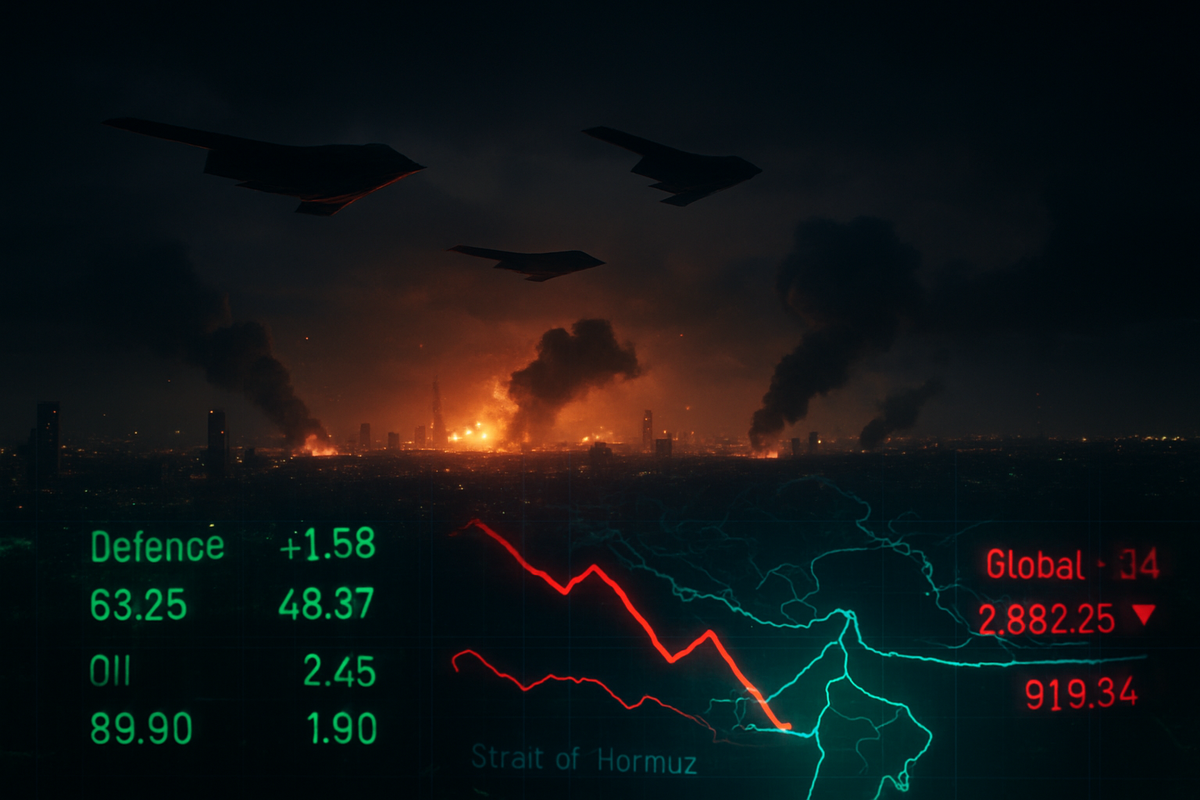
The immediate fallout has sent shockwaves through global financial markets, with Brent crude oil prices surging 13% to a 14-month high of $82 per barrel as the Strait of Hormuz—a chokepoint for 20% of the world’s oil supply—effectively shuttered. Investors are bracing for a period of extreme volatility, as the decapitation of the Iranian leadership creates a massive power vacuum in a region already on the brink. With the reported "martyrdom" of Khamenei confirmed by Iranian state media on Sunday, March 1, the prospect of a prolonged regional conflict or a total collapse of the Iranian state now looms over the global economy.
The Decapitation Strike and the Weekend of Fury
The escalation began in the pre-dawn hours of Saturday, February 28, 2026, with a "massive, overwhelming attack across all domains of warfare." According to Pentagon briefings, U.S. B-2 stealth bombers and Navy Tomahawk missiles were deployed to strike Revolutionary Guard (IRGC) facilities, ballistic missile silos, and air defense networks. The most critical blow occurred during a surgical strike on a secure compound in central Tehran, where Ayatollah Ali Khamenei was reportedly meeting with his inner circle. By Sunday morning, President Trump and Prime Minister Netanyahu confirmed the Supreme Leader’s death, an event later acknowledged by an interim leadership council in Tehran, which declared 40 days of mourning.
The timeline of the weekend was marked by rapid-fire developments. Following the initial strikes, Iran launched hundreds of retaliatory drones and missiles targeting U.S. installations in Bahrain and Kuwait, as well as civilian centers in Israel. In a tragic "friendly fire" incident, Kuwaiti air defenses mistakenly downed three U.S. F-15E Strike Eagles, though the pilots safely ejected. By Monday, March 2, the death toll in Iran was estimated at over 500, including nearly 50 senior regime officials such as Gen. Mohammad Pakpour, the Chief of the Revolutionary Guards.
Key stakeholders, including the U.S. Department of Defense and the Israeli Cabinet, have signaled that this is not a limited engagement. President Trump, in a high-profile interview on Monday morning, indicated that the mission is "ahead of schedule" but predicted operations could last up to four weeks. The stated objective has shifted from mere deterrence to explicit regime change, with Trump urging the Iranian people to "take back their country" as the military continues to dismantle the IRGC’s command and control infrastructure.
Market Winners and Losers: Defense Surges While Transports Reel
The sudden shift to "major combat operations" has created a stark divide in equity markets. Defense contractors saw immediate gains as the prospect of a multi-week campaign and the replenishment of munitions became a certainty. Lockheed Martin (NYSE: LMT), Northrop Grumman (NYSE: NOC), and RTX Corporation (NYSE: RTX) all saw shares rise between 2% and 4% in early Monday trading. In Europe, BAE Systems (LSE:BA.) jumped 4.5%, while in Asia, Mitsubishi Heavy Industries (TYO:7011) advanced as regional allies reconsidered their own security postures in light of the American escalation.
Conversely, the travel and logistics sectors are facing a crisis. The closure of Middle Eastern airspace and the threat of regional missile fire forced thousands of flight cancellations. Shares of International Consolidated Airlines Group (LSE:IAG) and EasyJet (LSE:EZJ) plummeted by 3% to 5% as fuel costs spiked and transit hubs like Dubai and Doha became virtually inaccessible. The broader market also felt the pinch; the S&P 500 futures fell over 1%, reflecting a "risk-off" sentiment that drove investors toward safe havens like gold, which hit record highs above $5,400 per ounce.
The energy sector remains the primary focal point for investors. While integrated oil giants like ExxonMobil (NYSE: XOM) and Chevron (NYSE: CVX) may benefit from higher crude prices in the short term, the logistics of a shuttered Strait of Hormuz present a nightmare for global supply chains. Analysts warn that if the Strait remains closed for more than a few days, oil could easily breach the $100 per barrel mark, potentially triggering a global inflationary spike that would complicate central bank policies worldwide.
A New Era of Geopolitical Risk
This event marks a definitive break from the "proxy war" status quo that has defined U.S.-Iran relations for decades. By directly targeting the Supreme Leader, the U.S. and Israel have moved into uncharted territory, signaling a return to high-intensity state-on-state conflict. This shift fits into a broader trend of "active containment," where Western powers are increasingly willing to use decapitation strikes to prevent nuclear proliferation or regional hegemony. The historical precedent most cited by analysts is the 2003 invasion of Iraq, though the 2026 operations are notably more reliant on air and cyber power rather than a large-scale ground invasion—at least for now.
The ripple effects are already being felt among Iran’s "Axis of Resistance." Hezbollah has initiated retaliatory strikes from Lebanon, and Houthi rebels in Yemen have targeted shipping in the Red Sea, effectively double-locking the world's most vital maritime energy routes. This puts immense pressure on global regulators and policymakers to secure alternative energy supplies. The suddenness of the conflict may also accelerate the transition toward renewable energy and domestic nuclear power in Europe and Asia as a matter of national security, though such shifts provide no relief for the immediate supply crunch.
Scenarios for the Coming Weeks
In the short term, the market will be hyper-focused on two factors: the duration of the "major combat" phase and the state of the Strait of Hormuz. If President Trump’s "four-week" timeline holds and the U.S. Navy can successfully de-mine and reopen the Strait, the initial oil price shock may subside into a "war premium" of $10 to $15. However, if Iran’s interim leadership or its decentralized IRGC units manage to sustain a low-level insurgency or launch a successful "suicide" strike on a major oil facility in Saudi Arabia, the ceiling for energy prices could be significantly higher.
Strategic pivots are already underway. Many multinational corporations are likely to accelerate "friend-shoring" initiatives, moving supply chains away from regions vulnerable to Middle Eastern instability. We may also see a significant increase in U.S. domestic oil production as the administration eases environmental regulations to offset the loss of Persian Gulf crude. The ultimate scenario—the total collapse of the Iranian clerical establishment—could lead to a generational opportunity for investment in a "New Iran," but the path to that outcome is fraught with the risk of a regional "forever war."
Investor Summary and Final Thoughts
The events of March 1–2, 2026, represent a "black swan" event that has permanently altered the global risk calculus. The reported death of Ayatollah Khamenei is a pivot point in history, marking the potential end of the 1979 revolutionary era. For investors, the takeaway is clear: volatility is no longer a temporary condition but the new baseline. The immediate surge in defense and energy stocks reflects the reality of a world at war, while the slump in consumer-facing sectors like airlines highlights the fragility of globalized travel in an era of kinetic conflict.
Moving forward, the market will be watching for any signs of a coordinated Iranian counter-response that could draw in other regional powers like Saudi Arabia or Turkey. Investors should remain hedged with safe-haven assets like gold and the U.S. dollar while maintaining exposure to the defense sector as the "four-week" operation unfolds. The coming months will determine whether this was a surgical strike that paved the way for a more stable Middle East or the opening salvo of a much larger and more devastating global confrontation.
This content is intended for informational purposes only and is not financial advice.