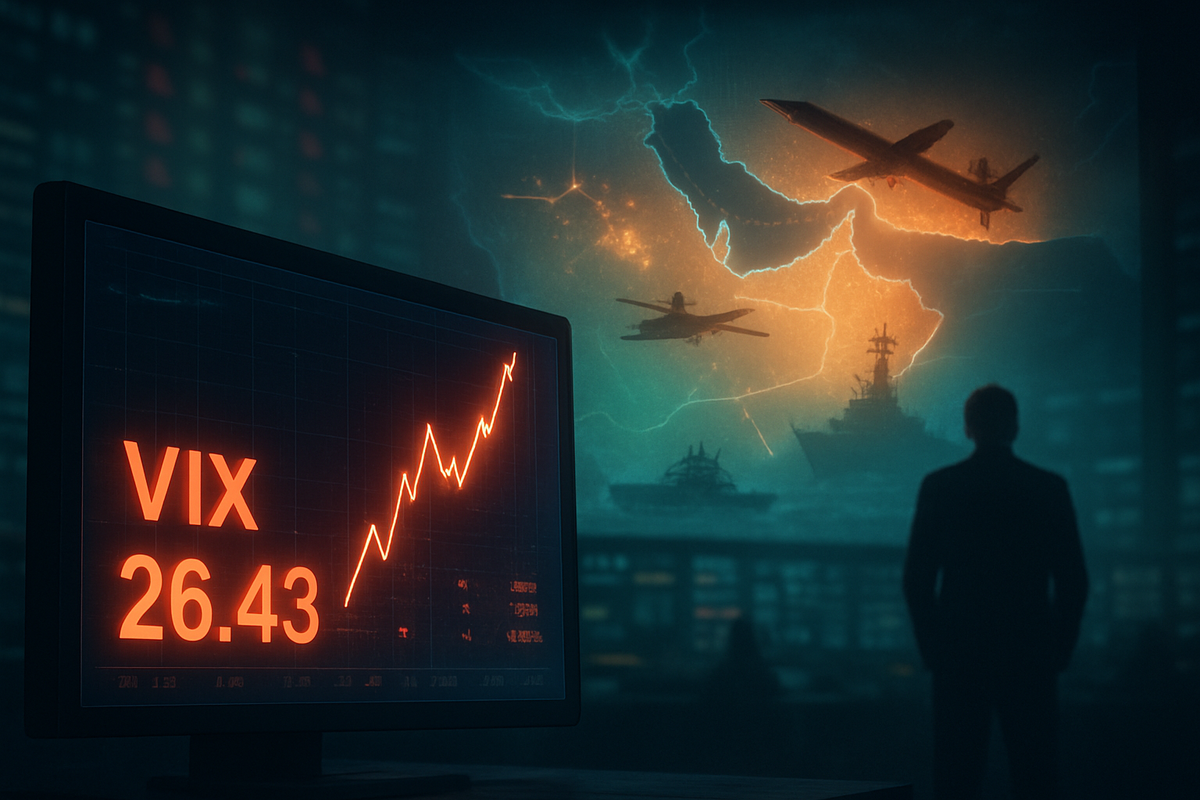
Wall Street entered a state of heightened alarm today, March 3, 2026, as the Cboe Volatility Index (VIX) surged by 23% to reach 26.43, its highest level in over three months. This dramatic spike reflects a fundamental "regime shift" in investor sentiment, moving from the relative complacency of early February into a defensive, "risk-off" posture. The sudden volatility follows a rapid and severe military escalation between the United States and Iran, which has threatened global energy supplies and destabilized the Middle East.
The jump in the VIX—often referred to as the market's "fear gauge"—indicates that traders are aggressively buying protective options to hedge against a potential stock market rout. As of mid-day trading, major indices are retreating, with the S&P 500 and the Nasdaq Composite seeing significant outflows as capital rotates into safe-haven assets. The 26.43 level is particularly significant, as it breaches the psychological 20-point threshold that traditionally separates a stable market from one characterized by genuine panic and structural uncertainty.
The Escalation: Operation Midnight Hammer and the Iranian Retaliation
The current crisis traces its roots to the early hours of February 28, 2026, when a coordinated US-Israeli military campaign, reportedly code-named "Operation Midnight Hammer," launched a series of "decapitation strikes" against high-ranking Iranian leadership and strategic nuclear facilities. According to intelligence reports, the strikes targeted several sites in Tehran and Isfahan, resulting in the reported deaths of several high-ranking Islamic Revolutionary Guard Corps (IRGC) commanders and government officials. The operation was described by the Pentagon as a "preemptive measure" to neutralize what it called "imminent threats to regional stability and US interests."
The retaliation was swift and multi-pronged. On March 1 and 2, 2026, Iran responded with a massive barrage of hundreds of ballistic missiles and "suicide" drones. These strikes were directed not only at Israel but also at US military installations in Iraq and Qatar. Most critically for global markets, the IRGC announced a "de facto" closure of the Strait of Hormuz, the world’s most vital oil chokepoint. Iranian naval forces have issued warnings to commercial shipping, effectively halting the transit of approximately 20% of the world’s daily oil supply and 22% of its liquefied natural gas (LNG).
Initial market reactions were characterized by a classic flight to quality. While the broader equity markets dipped, the commodities sector exploded. Brent crude oil prices surged over 10% in the last 48 hours, trading near $85 per barrel, while gold prices reached record highs as investors sought the security of "hard assets" in a time of war. The US Treasury yields also saw a sharp decline as investors piled into government bonds, pushing the 10-year note's yield down as prices rose inversely.
Strategic Shifts: Winners and Losers in a War Economy
The sudden shift to a high-volatility environment has created a stark divergence in performance across various sectors. The defense industry has emerged as the primary beneficiary of the escalation. Shares of RTX Corporation (NYSE: RTX), Lockheed Martin (NYSE: LMT), and Northrop Grumman (NYSE: NOC) have all seen gains of 3% to 5% as investors anticipate increased demand for missile defense systems and advanced munitions. These companies are viewed as essential "safety plays" during geopolitical conflicts, as their long-term government contracts provide a buffer against domestic economic downturns.
In the energy sector, the potential for a prolonged blockade of the Strait of Hormuz has sent oil majors soaring. ExxonMobil (NYSE: XOM) and Chevron (NYSE: CVX) are benefiting from the immediate spike in crude prices, which pads their profit margins. Similarly, the mining giant Newmont Corporation (NYSE: NEM) and the SPDR Gold Shares (NYSE Arca: GLD) have seen a surge in volume as gold becomes the preferred safe haven for institutional capital. On the other hand, the airline industry is facing a dual threat of rising fuel costs and decreased international travel demand. Delta Air Lines (NYSE: DAL) and United Airlines (NASDAQ: UAL) have both faced selling pressure, as higher jet fuel prices directly impact their bottom-line profitability.
The technology sector, particularly growth-oriented Software-as-a-Service (SaaS) companies, has also faced a sharp correction. As the VIX crosses the 26-point mark, the "discount rate" applied to future earnings increases, making high-valuation tech stocks less attractive to risk-averse investors. This "Software-mageddon" has led to a broad-based sell-off in names that have historically been sensitive to interest rate fluctuations and geopolitical instability.
Global Impact: The Strait of Hormuz and Historical Precedents
The wider significance of this VIX surge cannot be overstated. By jumping to 26.43, the index is approaching levels seen during the 2003 Iraq War invasion and the 2011 Arab Spring, though it still remains below the extreme panic levels of the 2020 pandemic or the 2022 invasion of Ukraine. This level indicates that while investors are fearful, they are not yet in a state of total capitulation. However, the closure of the Strait of Hormuz introduces a "supply shock" variable that could keep volatility elevated for months.
From a policy perspective, the US government is now facing immense pressure to utilize the Strategic Petroleum Reserve (SPR). As of March 3, 2026, the administration has signaled a "wait-and-see" approach, prioritizing domestic production over an emergency release. Meanwhile, global shipping insurance has reached a breaking point. "War Risk" premiums for transiting the Gulf have surged by nearly 300%, adding hundreds of thousands of dollars to the cost of every voyage. Major shipping conglomerates like Maersk have already begun rerouting vessels around the Cape of Good Hope, a move that could disrupt global supply chains for the remainder of the quarter.
Furthermore, this event fits into a broader trend of "de-globalization" and the weaponization of energy resources. The 2026 crisis differs from the 2020 Soleimani incident in its scale; the current conflict involves multiple regional actors and the systematic targeting of infrastructure, suggesting that the "geopolitical risk premium" is here to stay. Regulatory bodies are currently monitoring the situation for potential force majeure declarations from Gulf oil producers, which would further complicate international trade agreements.
Looking Ahead: Strategic Pivots and Market Scenarios
In the short term, the market will likely remain in a state of flux as it awaits the next move from Tehran or Washington. If the US and its allies can successfully reopen the Strait of Hormuz within the next 14 days, we may see a "relief rally" similar to the one observed after the initial stages of the 2003 Iraq War. In such a scenario, the VIX would likely mean-revert toward the 18-20 range as the "uncertainty of the unknown" is removed.
However, a long-term blockade or an expansion of the conflict into a broader regional war could push the VIX into the 35-40 range. This would require a significant strategic pivot from investors, moving away from traditional "60/40" portfolios and toward alternative investments, including energy-focused ETFs and inflation-protected securities. The Federal Reserve, which had been focused on managing a "soft landing" for the US economy, may now be forced to reconsider its interest rate path if energy-driven inflation begins to re-accelerate.
Conclusion: Takeaways for the Cautious Investor
The jump in the VIX to 26.43 is a clear signal that the period of low-volatility complacency has ended. The US-Iran military escalation has fundamentally altered the risk landscape for 2026, reintroducing "geopolitical tail risk" as a primary concern for asset managers. The key takeaways for investors are the importance of diversification into tangible assets like energy and defense, and the need for a robust hedging strategy in the face of shifting global alliances.
Moving forward, the market will be hyper-sensitive to any news regarding the Strait of Hormuz and the status of the US Strategic Petroleum Reserve. Investors should watch for the VIX to either stabilize or breach the 30-point mark, which would indicate a deeper, more systemic crisis. For now, caution is the order of the day; the "fear gauge" is screaming, and history suggests that when the VIX speaks this loudly, it is wise to listen.
This content is intended for informational purposes only and is not financial advice