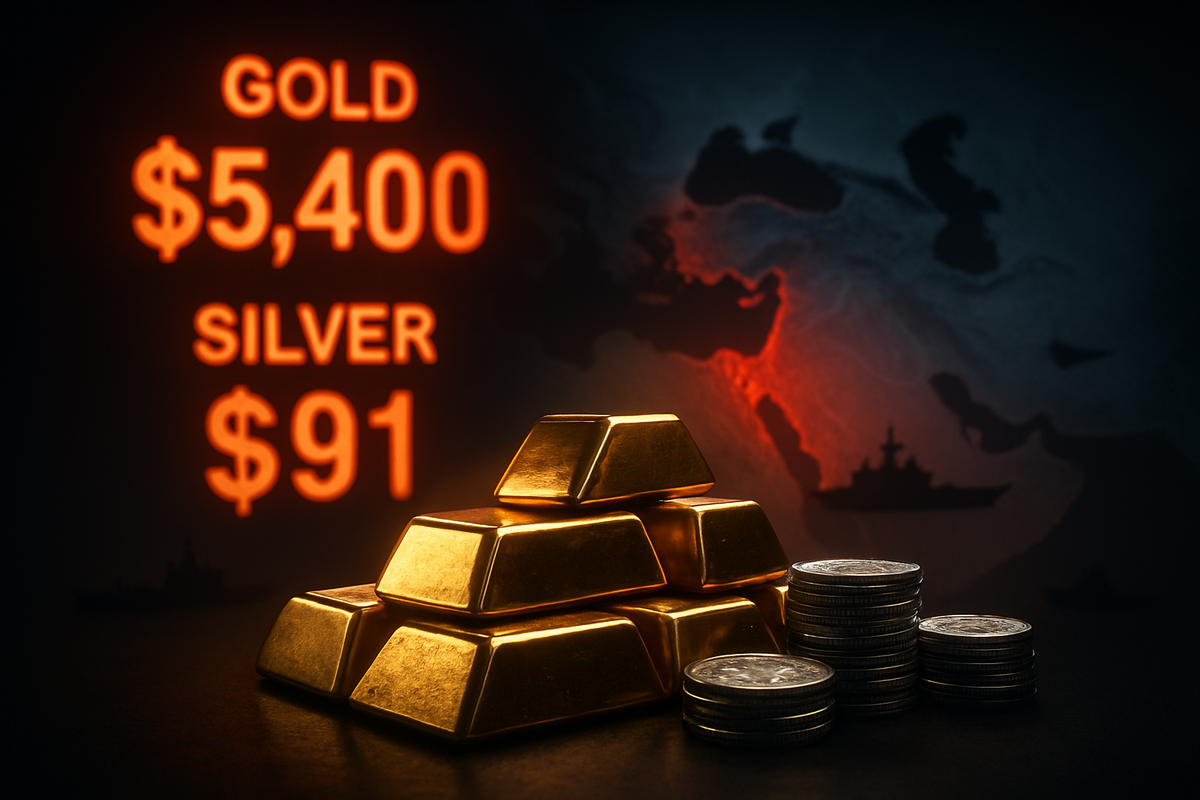
The global financial markets are in a state of high-octane volatility today, March 3, 2026, as precious metals reach prices that were once considered unthinkable. Gold has shattered all previous records, surging past $5,400 per ounce, while Silver has rocketed to $91 per ounce, marking one of the most significant single-day moves in the history of the commodities market. This vertical climb is the direct result of a catastrophic escalation in the Middle East, characterized by joint U.S.-Israel military strikes on Iranian strategic sites and the subsequent reported closure of the Strait of Hormuz—the world’s most critical maritime oil artery.
The immediate implications are profound: a massive flight to safety has drained liquidity from risk assets, sending global equity indices into a tailspin while safe-haven demand reaches a fever pitch. Investors are bracing for a prolonged period of stagflation as the threat of energy supply disruptions looms large over the global economy. With nearly 20% of the world’s oil and liquefied natural gas (LNG) now effectively trapped behind a naval blockade, the surge in gold and silver is not merely a speculative bubble but a frantic re-pricing of global risk.
The Trigger: 'Operation Epic Fury' and the Hormuz Blockade
The catalyst for today’s market mayhem began in the early hours of March 2, 2026, when a coalition of U.S. and Israeli forces launched "Operation Epic Fury," a series of targeted precision strikes against Iranian nuclear enrichment facilities and command centers. The military action followed weeks of escalating rhetoric and proxy skirmishes that had already kept the markets on edge. By the evening of March 2, reports surfaced that Tehran had retaliated by deploying sea mines and swarming fast-attack craft to block the Strait of Hormuz, declaring the waterway a "war zone" and effectively halting all commercial traffic.
This timeline of events has paralyzed the energy market, with Brent crude prices tracking toward $120 per barrel and analysts warning of $200 oil if the blockade is not cleared within the week. For the precious metals market, the closure of the Strait represents a "perfect storm." The immediate threat to the global energy supply has revived the specter of 1970s-style inflation, while the direct involvement of major world powers has forced institutional investors to dump sovereign debt in favor of "hard money."
Key players in this geopolitical drama include the U.S. Central Command and the Israeli Defense Forces, whose joint operations have signaled a shift from containment to active degradation of regional threats. On the other side, the Iranian Revolutionary Guard Corps (IRGC) remains the primary antagonist regarding maritime stability. The initial market reaction was instantaneous: as news of the blockade hit the wires, gold jumped $300 in a matter of hours, and silver followed suit with a 15% intraday gain, driven by panic-buying and the liquidation of short positions.
Winners and Losers: Mining Giants Surge as Industrials Suffer
In the wake of this historic price spike, the equity markets are witnessing a stark divergence. The primary winners are the major precious metals producers and streaming companies. Newmont Corporation (NYSE: NEM), the world’s largest gold producer, has seen its stock price soar as its massive reserves are now valued at these record-breaking spot prices. Similarly, Barrick Gold Corp. (NYSE: GOLD) and Agnico Eagle Mines (NYSE: AEM) are reporting unprecedented free cash flow projections, as their all-in sustaining costs (AISC) remain largely fixed while their realized selling prices have doubled in a year.
The silver sector is seeing even more dramatic percentage gains. Pan American Silver (NYSE: PAAS) and Hecla Mining Company (NYSE: HL)—the largest producer in the United States—have become the darlings of retail and institutional investors alike. First Majestic Silver (NYSE: AG), a pure-play silver miner, has seen its market capitalization swell as silver’s dual role as a monetary hedge and a critical industrial metal creates a supply-demand squeeze. Furthermore, royalty and streaming firms like Wheaton Precious Metals (NYSE: WPM) and Franco-Nevada Corp. (NYSE: FNV) are benefiting from high margins without the direct operational risks associated with mining in volatile regions.
Conversely, the losers are widespread. Transport and logistics giants are reeling from the spike in fuel costs and the rerouting of ships around the Cape of Good Hope. Manufacturers that rely on silver for electronics and green energy technology are facing a severe margin squeeze. Furthermore, the broader tech sector, represented by companies heavily dependent on global supply chains, is seeing a sell-off as the cost of capital rises alongside inflation expectations.
A New Era of Geopolitical Risk and Monetary De-Dollarization
The significance of gold hitting $5,400 goes beyond a mere geopolitical headline; it represents a fundamental shift in the global financial architecture. For years, the "de-dollarization" trend has been a slow simmer, but the current conflict has turned it into a boil. Central banks, particularly in the Global South, have been aggressively diversifying away from U.S. Treasuries and into physical gold to insulate themselves from potential sanctions and the volatility of the petrodollar system. Today's events have validated that strategy, potentially accelerating the move toward a multi-polar monetary world.
Historically, this event draws comparisons to the 1973 oil embargo and the 1979 Iranian Revolution, both of which saw gold prices move parabolically. However, the scale of today's movement is amplified by a global economy that is far more interconnected and debt-burdened than it was fifty years ago. The ripple effects are already being felt in the currency markets, where the U.S. Dollar is showing strength against the Euro and Yen but is losing ground to the "commodity currencies" and, most notably, to gold itself.
Regulatory bodies and central banks are now in a difficult position. The Federal Reserve must balance the need to combat the inflationary surge caused by $120 oil with the risk of triggering a deep recession by raising rates into a geopolitical crisis. There is also the threat of "emergency" market measures, such as position limits on commodities or even temporary halts in trading, if the volatility becomes systemic.
What Comes Next: Escalation or De-escalation?
In the short term, the direction of gold and silver will be dictated entirely by the naval situation in the Persian Gulf. If the U.S. Navy successfully conducts "Freedom of Navigation" operations to reopen the Strait of Hormuz, we could see a sharp, tactical pullback in precious metals as the "fear premium" dissipates. However, any sign of a prolonged conflict—or worse, a direct spillover into other oil-producing nations—could see gold challenge the $6,000 mark before the month is out.
Long-term, this crisis may force a strategic pivot in Western energy and industrial policy. The extreme price of silver will likely accelerate the search for substitutes in the solar and EV industries, though such transitions take years, not weeks. For investors, the challenge will be distinguishing between a temporary "war spike" and a permanent re-rating of assets. Market opportunities may emerge in the defense sector, with companies like Lockheed Martin (NYSE: LMT) and Northrop Grumman (NYSE: NOC) already seeing increased demand for missile defense systems and maritime surveillance.
The most likely scenario is one of continued high volatility. Even if a ceasefire is reached, the "geopolitical risk premium" has likely been reset at a permanently higher level. The era of cheap, reliable energy and low-inflation global trade appears to be under direct threat, cementing gold's role as the ultimate portfolio insurance.
Final Thoughts for the Investor
The events of March 3, 2026, will be remembered as a watershed moment for the commodities market. The spike in gold to $5,400 and silver to $91 is a stark reminder that in times of extreme geopolitical duress, physical assets remain the final arbiter of value. The combination of military conflict, energy blockades, and a return to safe-haven demand has created a market environment that rewards caution and diversification into hard assets.
Moving forward, the market will be hyper-sensitive to any diplomatic cables or military briefings coming out of the Middle East. Investors should watch for the "Hormuz Premium" in oil prices, as it will serve as a leading indicator for further moves in the gold market. While the current prices may seem astronomical, they reflect a world where the traditional rules of global trade are being rewritten in real-time.
For those holding positions in the mining sector or physical bullion, the coming months will require a steady hand. The volatility will be gut-wrenching, but the fundamental drivers—supply disruption and systemic instability—are unlikely to vanish overnight. As the world watches the Strait of Hormuz, the financial world is learning once again that gold is not just a metal, but a mirror reflecting the stability, or lack thereof, of the global order.
This content is intended for informational purposes only and is not financial advice.