As of March 3, 2026, the global financial landscape is grappling with a stark departure from the optimistic forecasts that characterized the start of the year. What was initially presented by the Trump administration as a "surgical, 48-hour precision engagement" to neutralize Iranian nuclear capabilities has officially entered its fourth day, with no sign of a cessation in hostilities. President Donald Trump, speaking from the Oval Office late yesterday, signaled a shift in strategy, acknowledging that the "Special Military Operation" in Iran could now stretch into several weeks as U.S. and allied forces move to secure "total regional stability."
This pivot from a lightning strike to a protracted engagement has sent shockwaves through the equity markets, fundamentally altering the risk landscape for 2026. While the SPDR S&P 500 ETF Trust (NYSEARCA: SPY) initially dipped 1.1% on the first news of the strikes, the index has seen a bifurcated recovery. Investors are aggressively rotating out of high-growth technology sectors and into "tangible" assets, specifically defense and energy, as the reality of a sustained Middle Eastern conflict sets in. The transition from a "transitory" geopolitical event to a potential regional war is forcing analysts to redraw their year-end targets, with a heavy emphasis on commodity-driven inflation and supply chain resilience.
From Surgical Strike to Sustained Engagement: The Timeline of 'Operation Epic Fury'
The military campaign, codenamed "Operation Epic Fury," began in the pre-dawn hours of February 28, 2026. Following a 2025 characterized by a "maximum pressure" campaign and a final 60-day ultimatum delivered to Tehran in January, the U.S. Navy launched a massive cruise missile barrage from the USS Abraham Lincoln and USS Gerald R. Ford carrier groups stationed in the Persian Gulf. Initial reports confirmed the death of several high-ranking members of the Islamic Revolutionary Guard Corps (IRGC) and suggested the possible demise of Supreme Leader Ayatollah Ali Khamenei, though the latter remains unverified by independent sources.
The administration’s initial messaging suggested that the destruction of Iran’s primary nuclear enrichment facilities at Natanz and Fordow would be the climax of the operation, allowing for a swift withdrawal. However, as of this morning, March 3, the IRGC has shown unexpected resilience, deploying decentralized drone swarms and asymmetric maritime tactics in the Strait of Hormuz. This resistance has forced the Pentagon to expand the scope of the mission to include the systematic dismantling of Iranian air defenses and inland command structures. President Trump’s recent rhetoric has mirrored this reality, stating that while the first 48 hours were a "tremendous success," the mission must now continue until the "job is finished once and for all."
Key stakeholders, including Israeli Prime Minister Benjamin Netanyahu and various Gulf State leaders, have publicly backed the extension of the timeline, citing the need to prevent a "power vacuum" that could be exploited by regional proxies. On the other hand, major trading partners like China and India have expressed "grave concern" over the disruption of energy flows. The initial market reaction was a flight to safety, with gold prices soaring to a historic $5,395 per ounce, while the U.S. Dollar Index (DXY) hit a three-year high as capital seeks refuge in the world’s reserve currency.
Winners and Losers: The Great Sector Rotation of 2026
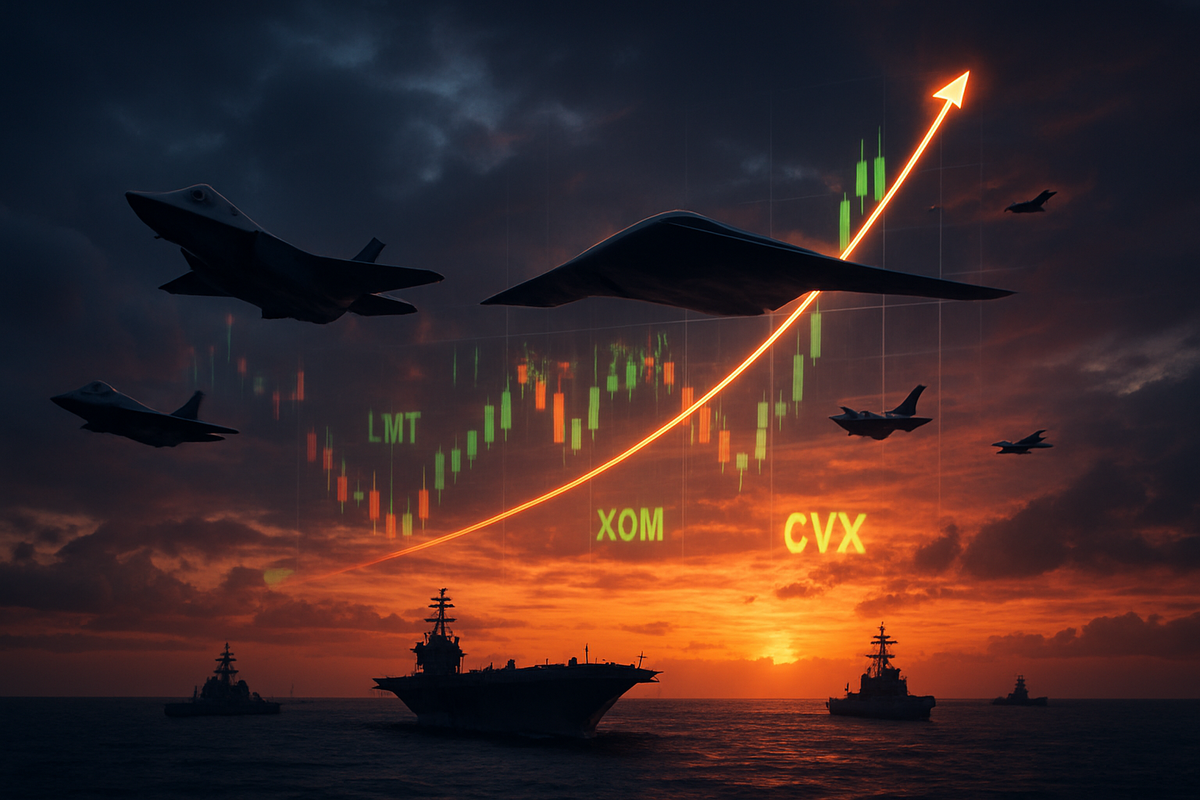
The primary beneficiaries of this shift are the aerospace and defense giants, which are seeing their backlogs swell to unprecedented levels. Lockheed Martin (NYSE: LMT) has emerged as the clear leader in this environment; its shares have surged nearly 39% year-to-date as of early March. With a record backlog of $194 billion and its F-35 fighter jets leading the sorties over Tehran, LMT is effectively the "infrastructure" of the current conflict. Similarly, Northrop Grumman (NYSE: NOC) saw a 6% jump in the last 72 hours, driven by the strategic importance of its B-21 Raider stealth bombers and the administration's renewed focus on the Sentinel ICBM modernization program as a deterrent against potential Iranian escalation.
The energy sector is also reaping the rewards of a massive "risk premium" being baked into crude prices. ExxonMobil (NYSE: XOM) is currently trading at record highs near $160 per share, as Brent crude hovers between $78 and $84 per barrel. Analysts believe that if the conflict forces a prolonged closure of the Strait of Hormuz, which handles 20% of global oil consumption, XOM and Chevron (NYSE: CVX) are uniquely positioned to profit from their massive Permian Basin production and diversified global assets. Chevron, currently trading at a 52-week high of $196, is being favored by institutional investors for its disciplined capital structure and a dividend yield that provides a cushion against broader market volatility.
Conversely, the "losers" in this scenario are sectors sensitive to energy costs and global logistics. The technology sector, particularly companies reliant on semi-conductor manufacturing in the Asia-Pacific region, faces a dual threat of rising shipping costs and potential geopolitical spillover that could disrupt trade lanes. Consumer discretionary stocks are also under pressure, as the prospect of $5-per-gallon gasoline in the United States looms, potentially curtailing the robust consumer spending that had fueled the early 2025 economic recovery.
A Fundamental Shift in the Global Risk Paradigm
The "Special Military Operation" represents more than just a temporary spike in volatility; it signifies a definitive end to the "peace dividend" that markets have enjoyed for much of the post-pandemic era. This event fits into a broader industry trend of "onshoring" and "friend-shoring," as the vulnerability of global energy and supply chains is once again exposed. The ripple effects are already being felt among competitors; while Western defense firms rally, European aerospace companies are struggling with the potential loss of Iranian airspace for civilian transit and the rising cost of aviation fuel.
From a regulatory standpoint, the Trump administration’s decision to label this a "Special Military Operation" rather than a formal war has significant implications. By bypassing a formal Congressional declaration, the executive branch maintains greater flexibility in allocating emergency funds, a move that has already sparked debate on Capitol Hill but has emboldened defense contractors who see a faster path to procurement. Historical precedents, such as the initial phases of the Iraq War in 2003 or the 1991 Gulf War, suggest that the "quick victory" narrative often underestimates the long-term inflationary pressures and regional destabilization that follow.
Furthermore, the involvement of Israel and the silence of Russia—who is currently balancing its own regional interests—adds a layer of complexity not seen in previous conflicts. The potential for the conflict to evolve into a multi-theater engagement involving Hezbollah in Lebanon or the Houthis in Yemen is now being factored into "worst-case" market models. This shift in the risk paradigm suggests that 2026 will be a year defined by "macro-dominance," where geopolitical headlines carry more weight than individual corporate earnings.
Strategic Pivots: Navigating the 'New Normal'
In the short term, investors should expect a "risk-off" environment characterized by high volatility in the bond markets as the U.S. Treasury likely increases issuance to fund the expanded military operation. Strategically, we are seeing a pivot toward "energy independence" stocks. Companies specializing in Liquefied Natural Gas (LNG) and domestic nuclear energy are likely to see accelerated regulatory approval as the U.S. seeks to decouple its allies from Middle Eastern reliance. This creates a secondary market opportunity for firms that can provide immediate energy security solutions.
The long-term scenario hinges on whether the administration can achieve a "managed regime change" or if the region descends into a prolonged civil war. Strategic pivots for corporations will include a rapid reassessment of supply chain routes, with a likely shift toward the Atlantic and domestic logistics. For the market, the challenge will be navigating a "higher-for-longer" interest rate environment, as the inflationary nature of war forces the Federal Reserve to reconsider any planned rate cuts for the latter half of 2026.
Market Outlook: What Investors Should Watch
The events of late February and early March have rewritten the 2026 playbook. The core takeaway for investors is that the era of low-volatility, AI-driven growth has been interrupted by the harsh realities of geopolitical friction. Moving forward, the market is likely to remain in a state of "tactical alert," with price action dictated by the daily briefings from the Pentagon and the status of the Strait of Hormuz.
Investors should closely monitor the "60-day window" that the Trump administration has implicitly set for the achievement of primary objectives. If the operation extends beyond this timeframe without a clear exit strategy, the risk of "mission creep" could lead to a deeper market correction. Key indicators to watch in the coming months include the price of Brent crude, the U.S. Dollar Index, and the performance of the "defense-energy" complex compared to the broader tech-heavy indices. While the initial "48-hour" promise has faded, the 2026 market remains resilient, albeit recalibrated for a more dangerous and expensive world.
This content is intended for informational purposes only and is not financial advice