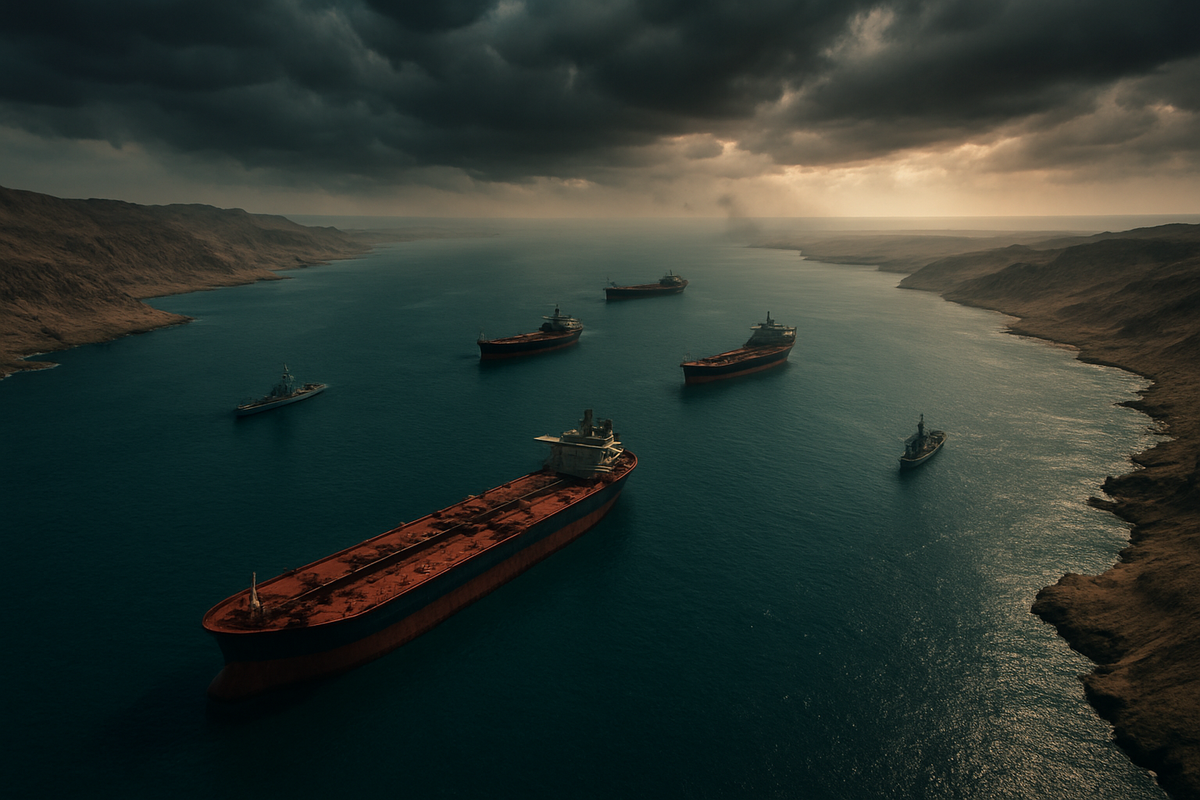
As of March 3, 2026, the global energy landscape has been plunged into a state of high-alert paralysis. Following the weekend’s dramatic military escalations in the Middle East, the Iranian Revolutionary Guard Corps (IRGC) has successfully enacted a de facto closure of the Strait of Hormuz. This critical maritime chokepoint, often referred to as the "aorta" of the global oil trade, is currently impassable for commercial tankers after Tehran deployed a sophisticated layer of naval mines, drone swarms, and anti-ship cruise missiles in response to Western kinetic actions.
The immediate implications are staggering. Brent Crude oil prices have gapped up by over 15% in a single session, while maritime insurance providers have effectively redlined the entire Persian Gulf, freezing the movement of approximately 20 million barrels of oil per day. For the United States, this event has birthed a "toxic combo": a violent supply shock paired with an inflationary spike that threatens to derail a fragile economic recovery and send the national average for gasoline toward the $5.00 mark.
Operation Epic Fury and the Brink of Total Blockade
The current crisis was ignited on February 28, 2026, when a joint U.S.-Israeli military initiative, titled "Operation Epic Fury," conducted precision strikes against Iranian command centers and nuclear infrastructure. The operation resulted in the death of Iran’s Supreme Leader, Ayatollah Ali Khamenei, creating a power vacuum and a mandate for immediate, asymmetric retaliation. By the morning of March 1, the IRGC declared the Strait of Hormuz a "closed military zone," warning that any vessel entering the waterway would be treated as a hostile combatant.
While the U.S. Navy’s Fifth Fleet has maintained a presence in the region, the nature of the "closure" is more psychological and risk-based than a physical chain across the water. The threat of "swarm" tactics involving fast-attack boats and the suspected deployment of sophisticated underwater IEDs have forced major shipping conglomerates to halt operations. By today, March 3, an estimated 150 tankers are sitting idle outside the Gulf of Oman, unable to secure the "War Risk" insurance necessary to proceed.
Key stakeholders, including the UN Security Council, remain deadlocked. While the U.S. government maintains that its initial strikes were a lawful exercise of self-defense under Article 51 of the UN Charter, major energy consumers like China and India are facing a catastrophic shortfall. The diplomatic rift is widening as Russia and China officially condemned the U.S. actions, while the European Union scrambles to activate emergency energy reserves to prevent a total industrial shutdown.
Winners and Losers: Defense Surges as Shipping Stalls
The financial markets have reacted with surgical precision, separating companies that stand to benefit from heightened conflict and energy scarcity from those crippled by logistics costs. Major Western oil producers like ExxonMobil (NYSE: XOM) and Chevron (NYSE: CVX) have seen their valuations surge as the "risk premium" on crude oil expands their profit margins overnight. With Brent crude hitting $84.05 and trending toward the $100 mark, these upstream giants are effectively "winners" in a high-price environment, despite the geopolitical instability.
Conversely, the shipping and logistics sector is in a tailspin. A.P. Moller - Maersk (CPH:MAERSK-B) has suspended all transits through the region, opting for the lengthy and expensive route around the Cape of Good Hope. This detour adds 10 to 14 days to global supply chains, driving up freight surcharges and further fueling global inflation. Similarly, airlines and transportation companies are seeing their stock prices crater as the prospect of sustained high fuel costs threatens to eat through their 2026 earnings projections.
In the defense sector, the reaction has been overwhelmingly bullish. Shares of Lockheed Martin (NYSE: LMT) and RTX Corporation (NYSE: RTX) have climbed 6-8% in the last 48 hours. Investors are betting on a massive influx of government spending for missile defense systems and replacement munitions, particularly the Patriot and THAAD systems that are currently being mobilized to protect regional allies like Saudi Arabia and the UAE from Iranian missile blowback.
The 'Toxic Combo' and the Ghost of the 1970s
Analysts are calling this the "Toxic Combo" because it represents the worst-case scenario for central banks. Unlike a demand-driven price increase, this is a pure supply-side shock. The Strait of Hormuz handles roughly 20-25% of the world’s petroleum liquids; there is simply no way for other producers, such as those in the Permian Basin or the North Sea, to bridge a 20-million-barrel-per-day gap in the short term. This mirrors the oil embargoes of the 1970s, where energy-led inflation forced the Federal Reserve into aggressive rate hikes that eventually triggered a recession.
This event also signals a potential end to the era of "just-in-time" energy logistics. For years, the market assumed the Strait of Hormuz would remain open due to mutual economic destruction, but the "Epic Fury" strikes have rewritten the geopolitical playbook. We are now seeing a massive acceleration in the "friend-shoring" of energy supplies, as the U.S. and its allies realize that the world’s most critical energy artery is far more vulnerable than previously modeled.
Furthermore, the regulatory landscape is set to shift. We expect the U.S. Department of the Treasury to issue unprecedented emergency maritime insurance guarantees to encourage tankers to run the blockade under naval escort. This move would represent a significant government intervention into private insurance markets, a policy shift necessitated by the sheer scale of the potential economic collapse if the oil remains stranded.
Looking Ahead: Escorts, Reserves, and Uncertainty
In the immediate term, the market is watching for a "convoy system" to emerge. The U.S. Navy and its "Operation Prosperity Guardian" partners are expected to begin escorting tankers through the Strait within the next 72 hours. However, the success of these convoys depends entirely on whether Iran chooses to escalate with land-based anti-ship missiles or if they will allow a limited flow of oil to avoid a direct full-scale war with the U.S. military.
The long-term scenario is even more complex. A prolonged closure—anything lasting more than 30 days—would likely exhaust the Strategic Petroleum Reserve (SPR), which has already been drawn down significantly over the last few years. This would leave the U.S. economy uniquely exposed to future shocks. Investors should prepare for a period of extreme volatility, where headlines regarding naval skirmishes or diplomatic breakthroughs can cause $10 swings in oil prices in a single afternoon.
Market Outlook and Final Thoughts
The strategic closure of the Strait of Hormuz is more than a regional conflict; it is a fundamental reconfiguration of global trade. The "toxic combo" of reduced supply and surging prices is currently the greatest threat to the 2026 economic outlook. While energy and defense stocks may provide a temporary hedge for investors, the broader market remains at the mercy of a geopolitical stalemate that has no easy exit.
As we move forward, investors must keep a close eye on three things: the daily "tanker count" in the Gulf of Oman, any shifts in the stance of OPEC+ regarding spare capacity, and the U.S. Federal Reserve’s commentary on "transitory" energy inflation. The aorta of the world is constricted, and until the pressure is released, the global economy will remain in a state of precarious instability.
This content is intended for informational purposes only and is not financial advice.