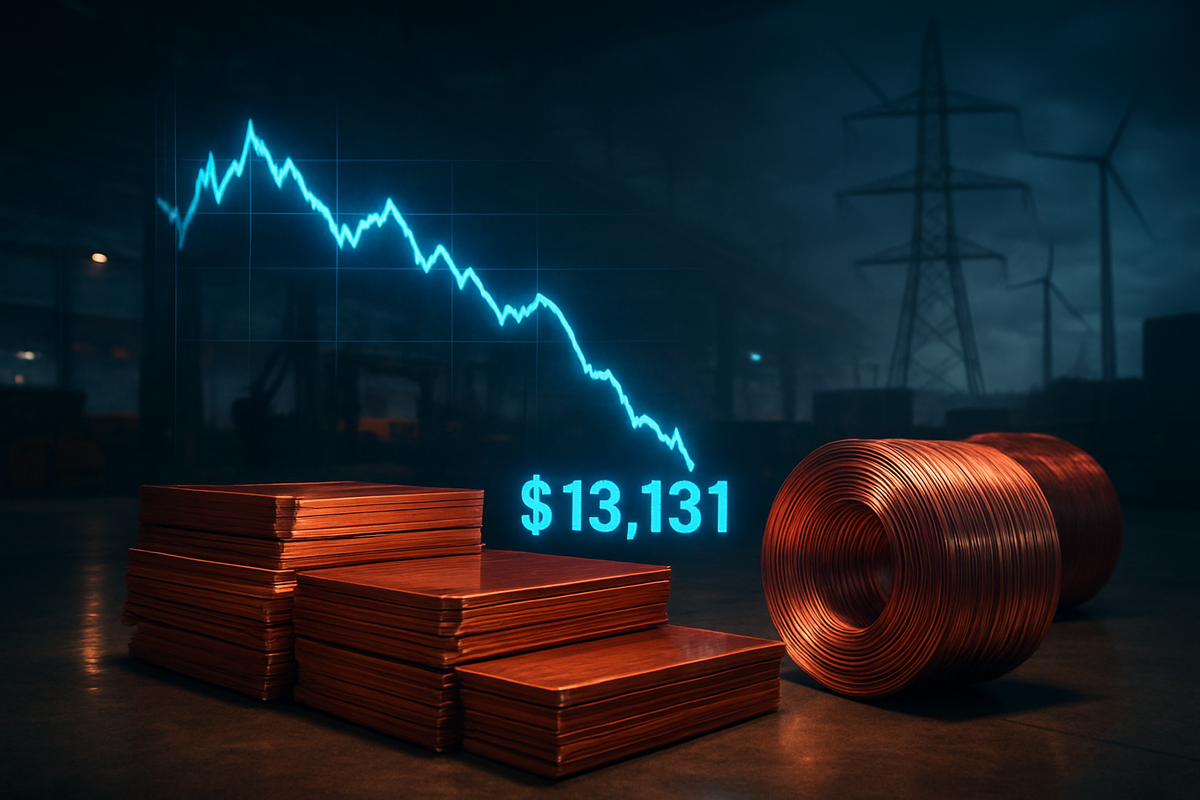
Copper prices on the London Metal Exchange (LME) experienced a sharp 1.6% decline on Friday, March 6, 2026, settling near $13,131 per metric ton. This retreat marks a significant cooling period for the industrial bellwether, which had reached historic highs above $14,500 just two months prior. The slump highlights a growing "Great Divergence" in the commodities market, where the robust structural demand for electrification is being temporarily overshadowed by macroeconomic anxieties and a decoupling of industrial metals from volatile energy prices.
The immediate fallout of this price drop has sent ripples through the global manufacturing and mining sectors. While long-term bulls remain committed to the narrative of a "structural deficit" in the copper market, the short-term reality of rising inventories and hawkish central bank rhetoric has forced a tactical retreat. Investors are now closely monitoring whether this $13,000 level will serve as a new psychological floor or if the "Age of Electricity" is facing its first major valuation crisis.
Inventory Surge and the Speculative Unwinding
The descent to $13,131 per metric ton was precipitated by a sudden accumulation of physical copper stocks. LME-registered warehouses reported a 16-month high in inventories in early March 2026, particularly across Asian and U.S. hubs. This unexpected build-up signaled a temporary easing of the acute supply squeeze that characterized the end of 2025. Market analysts suggest that the replenishment of these stocks reflects a cautious "wait-and-see" approach by industrial buyers who are hesitant to commit to large-scale procurement at record-high price points.
Timeline-wise, the current volatility follows a blistering start to the year. In January 2026, copper hit an all-time peak of $14,527 per ton, driven by massive demand from AI data centers and grid modernization projects. However, by mid-February, algorithmic trading platforms and large-scale hedge funds began a cycle of "speculative unwinding." These players, who had held record-long positions, moved to lock in profits as the U.S. dollar strengthened and geopolitical tensions in the Middle East kept energy prices stubbornly high, raising the specter of "stagflation."
Key stakeholders, including major trading houses like Glencore (OTC: GLNCY), have noted that the 1.6% drop is partly a technical correction. Institutions like Goldman Sachs had previously warned that the market needed a "consolidation phase" to digest the rapid gains of the past year. Initial market reactions saw a broad sell-off in base metals, with aluminum and nickel also seeing minor declines as traders repositioned for a higher-for-longer interest rate environment.
Winners and Losers: The Corporate Impact
For major mining corporations, the current price levels remain highly profitable, yet the downward momentum poses a risk to near-term earnings growth. BHP Group (NYSE: BHP), the world’s largest producer, now sees copper accounting for over 51% of its EBITDA. While BHP continues to aggressively expand its "Copper South Australia" projects, the 1.6% dip suggests a tightening of margins for projects with higher operational costs. Similarly, Freeport-McMoRan (NYSE: FCX) is in the midst of a multi-billion dollar capital expenditure cycle to restore capacity at its Grasberg mine in Indonesia; a prolonged slump toward $12,000 could lead to a reassessment of its 2026-2027 dividend outlook.
On the losing side of the ledger, pure-play copper miners like Southern Copper (NYSE: SCCO) face immediate pressure. The company has already guided for a 4.7% production decline in 2026 due to falling ore grades at its Peruvian sites. With prices retreating from January highs, the capital-intensive nature of their $20 billion long-term investment plan becomes more scrutinize by shareholders. Conversely, Antofagasta (LSE: ANTO) remains a "winner" in terms of resilience, as its recent investments in the Los Pelambres expansion are expected to bring online higher-grade ore that can withstand price volatility better than its peers.
Industrial consumers present a mixed picture. Eaton (NYSE: ETN), a primary provider of electrical infrastructure, is grappling with a record $19.6 billion backlog. While lower copper prices theoretically reduce their input costs, the company has already warned of a 130–180 basis point margin headwind due to supply chain bottlenecks. Meanwhile, Tesla (NASDAQ: TSLA) continues to face the reality of "input cost inflation." Each electric vehicle requires significantly more copper than its internal combustion counterpart, and Tesla has been forced to explore "demand destruction" tactics—such as switching to aluminum for certain components—to mitigate the impact of $13,000 copper on its vehicle margins.
The 'Great Divergence' and Economic Significance
The decline in copper prices is a symptom of a broader economic phenomenon: the decoupling of industrial demand from the energy cycle. Traditionally, copper and oil moved in tandem, but 2026 has seen oil prices held high by Middle Eastern geopolitical premiums (Brent crude above $82/bbl) while copper faces headwinds from manufacturing slowdowns. This divergence is significant because it complicates the mandates of central banks. The Federal Reserve, currently maintaining rates at 3.5%–3.75%, is forced to deal with energy-driven inflation while trying not to stifle the industrial transition to green energy.
Historically, copper has been viewed as "Dr. Copper," the metal with a Ph.D. in economics because of its ability to predict global turning points. In the current context, the price drop suggests that while the "structural" story of the energy transition is intact, the "cyclical" reality of high interest rates is finally biting into industrial demand. This mirrors the market behavior seen in the early 2010s but at a much higher price floor, reflecting the massive new demand coming from the AI sector.
Furthermore, the surge in AI infrastructure has fundamentally altered the copper demand curve. Each new AI training facility is estimated to require up to 50,000 tons of copper—three to four times more than traditional data centers. This "AI floor" is what prevents copper from returning to the $8,000 levels seen in previous years. However, the current slump serves as a reminder that even the most robust structural trends are not immune to the gravity of monetary policy and inventory cycles.
Navigating the 'Copper Cliff'
In the short term, the market is likely to see continued volatility as it seeks a definitive bottom. The potential for further speculative liquidations remains high if the U.S. Federal Reserve delays its planned rate cuts into late 2026. However, the long-term outlook remains underpinned by a projected global refined copper deficit of over 150,000 metric tons for the remainder of the year. This supply-demand gap, often referred to as the "Copper Cliff," suggests that any significant price retreat will likely be met by aggressive buying from industrial giants and sovereign wealth funds.
A potential strategic pivot for the industry may involve more vertical integration. There is growing speculation that major consumers like Tesla or even tech giants like Microsoft or Amazon—who are building the data centers of the future—might begin acquiring direct stakes in copper mining projects to bypass the volatility of the LME. We may also see a renewed push for "green copper" premiums, where low-carbon produced metal fetches a higher price, further fragmenting the global market.
Conclusion and Market Outlook
The 1.6% decline to $13,131 per metric ton is a sobering check for a market that had become perhaps too optimistic at the start of 2026. The key takeaways for investors are clear: while the long-term transformation toward an electrified, AI-driven global economy provides a powerful tailwind for copper, the path is fraught with cyclical volatility. The "Great Divergence" between energy-led inflation and industrial metal demand is the defining macro theme of the year, creating a "two-speed" economy that requires nimble portfolio management.
Moving forward, the market will remain sensitive to inventory data and central bank rhetoric. Investors should keep a close watch on LME stock levels in Asia and any signs of cooling in the AI infrastructure spend. While "Dr. Copper" may be feeling a bit under the weather today, the fundamental diagnosis remains one of scarcity. The coming months will determine if $13,000 is merely a pit stop or a major turning point in the most important commodity cycle of the decade.
This content is intended for informational purposes only and is not financial advice.