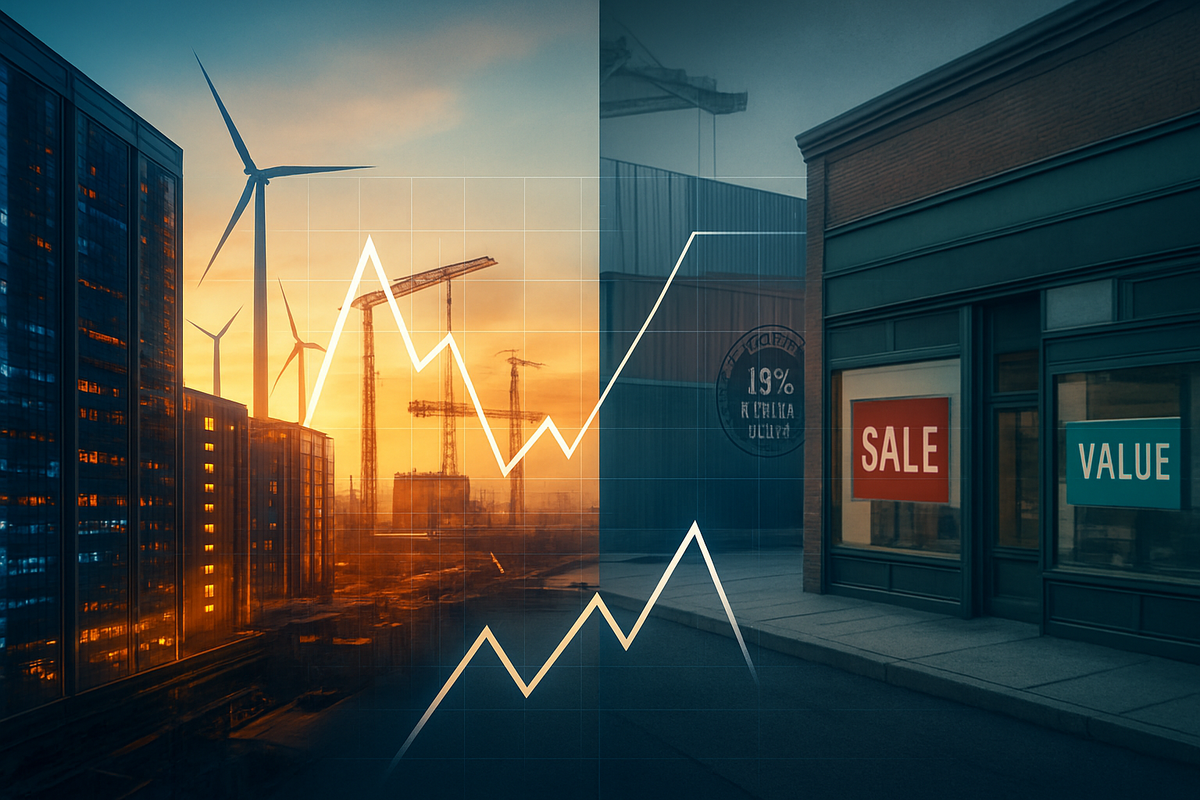
The Federal Reserve’s latest Beige Book, released on March 4, 2026, has revealed a starkly "bifurcated" U.S. economy, where a booming industrial sector is increasingly at odds with a "buckling" consumer-facing market. While regional growth in the Midwest and South remains robust—driven by massive investments in energy and artificial intelligence infrastructure—coastal hubs are cooling under the weight of high living costs and shifting sentiment. This divide is creating a volatile environment for cyclical stocks, which are now navigating the dual pressures of a "K-shaped" consumer pullback and the sudden implementation of a 15% global tariff that took effect the same week as the report's release.
The immediate implications of the report suggest a Federal Reserve that is likely to remain in a "wait-and-see" mode. With industrial activity surging but lower-income households increasingly "price sensitive," the central bank faces a complex balancing act. For investors, the Beige Book confirms a significant rotation away from the mega-cap tech dominance of 2025 toward "real economy" sectors like energy and industrials, even as the new trade protectionism threatens to squeeze margins for manufacturers and middle-market retailers alike.
A Tale of Two Economies: Regional Disparity and the Tariff Shock
The March 2026 Beige Book, which compiles anecdotal evidence from the 12 Federal Reserve districts through late February, highlighted a widening gap in regional performance. Growth was described as "slight to moderate" in seven districts, but the number of regions reporting flat or declining activity rose to five—including the New York and San Francisco districts. These coastal hubs are reportedly struggling with a cooling technology sector and a "high-cost-of-living" drag that has led to a noticeable pullback in discretionary spending. In contrast, the Chicago, Cleveland, and Atlanta districts are thriving, fueled by a historic capital investment cycle in data centers and energy infrastructure projects.
The timeline of this economic shift has been accelerated by recent policy changes. The implementation of a 15% global tariff starting the week of March 4, 2026—following the Supreme Court’s February ruling in Learning Resources, Inc. v. Trump—has sent shockwaves through supply chains. While the industrial sector remains a bright spot, the Beige Book noted that manufacturers are already adjusting their guidance downward to account for rising raw material costs. Furthermore, severe winter storms in February and increased immigration enforcement in certain urban areas were cited as additional factors dampening retail traffic and customer demand in specific regions.
Market reactions to the findings were immediate and divided. Cyclical stocks, which typically move in tandem with economic health, saw significant volatility. While energy and industrial sectors have outperformed the broader S&P 500 so far this year (up 25% and 17% YTD, respectively), the prospect of "sticky" inflation hovering near 3% has tempered enthusiasm for a potential interest rate cut at the upcoming mid-March FOMC meeting. Analysts from JPMorgan and Goldman Sachs have noted that the "K-shaped" recovery is becoming the defining feature of 2026, with the top tier of the economy flourishing while the middle and lower tiers struggle to keep pace with the rising costs of necessities like insurance and utilities.
Winners and Losers: The "K-Shaped" Impact on Public Companies
The clearest winners in this environment are companies positioned to benefit from either the value-seeking behavior of the struggling middle class or the massive "AI-driven" infrastructure boom. Costco Wholesale Corporation (NASDAQ: COST) has emerged as a primary beneficiary of the "value-seeking" trend, as even middle-income households trade down from traditional department stores. Similarly, infrastructure giants like Eaton Corporation plc (NYSE: ETN) and NextEra Energy, Inc. (NYSE: NEE) are viewed by analysts as "tariff-moated" winners. These companies are deeply integrated into the data center and energy transition supercycle, which remains less sensitive to the immediate whims of consumer discretionary spending.
Conversely, the "losers" of this report are the mid-market retailers and manufacturers caught in the tariff crossfire. The Gap, Inc. (NYSE: GAP) saw its stock slide nearly 9% following the Beige Book and its own quarterly earnings, citing a 200-basis-point headwind from the new 15% tariff. Target Corporation (NYSE: TGT) also reported struggling sales, as its core demographic prioritizes essentials over discretionary "affordable chic" items. Best Buy Co., Inc. (NYSE: BBY) missed revenue targets, reporting that while high-end AI tech is selling well, legacy categories like home theater and large appliances are seeing sharp declines.
The industrial sector is not immune to the volatility. Despite the reported growth in manufacturing, Caterpillar Inc. (NYSE: CAT) shares fell over 3% following the report as investors fretted over how the 15% global tariff would compress margins on heavy machinery exports and raw material imports. Other "mid-tier" retailers like Kohl’s Corporation (NYSE: KSS) and Abercrombie & Fitch Co. (NYSE: ANF) have also forecasted muted growth, explicitly factoring the "tariff shock" and a "stressed consumer base" into their 2026 outlooks.
Wider Significance: Industry Shifts and Policy Implications
This Beige Book signals a broader transition in the U.S. economy, moving away from the consumption-led growth of the post-pandemic era toward a production-led "supercycle." The "data center boom" mentioned in the report is more than just a trend; it is a fundamental restructuring of the industrial landscape, benefiting regions that can provide the land and energy required for AI infrastructure. However, the emergence of the 15% global tariff marks a return to aggressive trade protectionism that hasn't been seen in this form for decades, potentially leading to a period of "imported inflation" that could complicate the Federal Reserve's mandate.
The ripple effects of these tariffs are expected to be felt throughout the second half of 2026. Goldman Sachs estimates that consumers may ultimately absorb up to 70% of these tariff costs, which would further strain the lower arm of the "K-shaped" economy. This fits into a larger historical context of trade disputes, but with a modern twist: the current tariffs are being implemented at a time when global supply chains are still fragile and domestic energy needs are at an all-time high. The policy implications are clear—the Fed may be forced to keep interest rates "higher for longer" to combat the inflationary pressures of the tariffs, even as the consumer-facing side of the economy pleads for relief.
The Road Ahead: Strategic Pivots and Market Scenarios
In the short term, investors should prepare for a period of heightened sensitivity to retail earnings and inflation data. The mid-March Federal Reserve meeting will be the next major catalyst, with many now expecting a "hawkish hold" as Chairman Powell balances industrial strength against consumer fragility. Companies that have not already localized their supply chains may be forced into rapid, costly strategic pivots to mitigate the impact of the 15% tariff. We may see an increase in "near-shoring" to Mexico or Canada, provided those regions remain exempt from the most punitive measures of the new trade policy.
Long-term, the market may see a more permanent shift in how cyclical stocks are valued. If the "data center boom" and energy transition continue at their current pace, industrial stocks could see their multiples expand, effectively becoming the new "growth" stocks of the decade. Conversely, traditional retail may undergo a painful consolidation. The recent liquidation of historic icons like Hudson's Bay Co. and the ongoing restructuring of luxury giants like Saks Global suggest that the retail landscape of 2027 and beyond will be unrecognizable from that of the early 2020s.
Final Assessment: What to Watch in the Coming Months
The March 2026 Beige Book serves as a definitive warning that the "Goldilocks" economy of the past year has given way to a more fractured reality. The key takeaways for the market are the resilience of the industrial sector, the fragility of the middle-market consumer, and the looming shadow of global tariffs. Moving forward, the market is likely to remain bifurcated, with "real economy" winners pulling away from companies that are overly dependent on discretionary consumer spending or vulnerable to international trade volatility.
Investors should keep a close eye on upcoming Consumer Price Index (CPI) reports and the Q1 earnings season, particularly for updates on how retailers are passing tariff costs to consumers. The ability of companies to maintain margins in the face of 15% import duties will be the ultimate test of their pricing power and strategic agility. As the Federal Reserve navigates this "K-shaped" landscape, the margin for error for both policymakers and investors has rarely been thinner.
This content is intended for informational purposes only and is not financial advice.