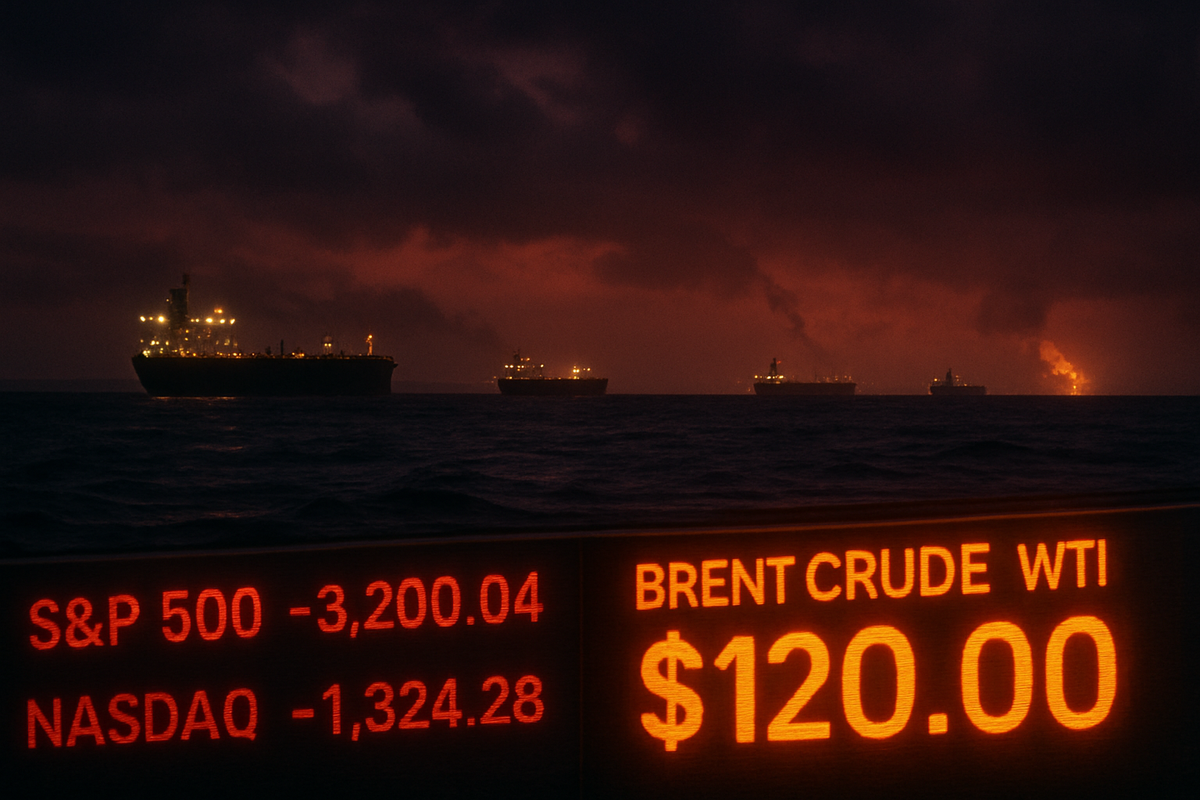
On March 9, 2026, global financial markets are reeling as Brent crude oil prices surged toward $120 per barrel, driven by a rapid military escalation between the United States and Iran. The benchmark West Texas Intermediate (WTI) has concurrently eclipsed $111 per barrel, trading near $118.82 as traders price in the catastrophic disruption of energy flows through the Middle East. The primary catalyst for this price spike is the effective closure of the Strait of Hormuz, a critical maritime chokepoint through which approximately 20% of the world’s daily oil consumption typically passes.
The surge in energy costs has triggered a broad-based sell-off across global equity markets. The S&P 500 has surrendered its year-to-date gains in a single week of trading, as investors weigh the dual threats of localized physical infrastructure damage and a global inflationary shock. With the U.S. and its allies fully engaged in "Operation Epic Fury," the immediate outlook for energy futures remains dominated by the duration of the maritime blockade and the extent of Iranian retaliatory strikes on regional energy infrastructure.
The Path to $120: Operation Epic Fury and the Strait of Hormuz Blockade
The current crisis traces back to late February 2026, when the United States and Israel launched a massive aerial campaign targeting Iranian nuclear facilities and command centers. The intervention, sanctioned following months of internal Iranian unrest and the subsequent government crackdown, reached a fever pitch on February 28 with a decapitation strike that resulted in the death of Iran's Supreme Leader. In the nine days since, the conflict has transformed from a targeted operation into a regional conflagration. Tehran has responded with "asymmetric" warfare, deploying thousands of drones and ballistic missiles against U.S. military installations in Iraq and Jordan, and notably striking a U.S. consulate in Dubai.
The most critical blow to the global economy has been the Islamic Revolutionary Guard Corps’ (IRGC) warning against all tanker traffic through the Strait of Hormuz. As of March 9, tanker traffic has plummeted by an estimated 70% to 90%. Over 150 commercial vessels are currently anchored outside the Persian Gulf, refusing to transit the waterway due to the high risk of missile strikes and the astronomical rise in maritime insurance premiums, which have spiked from 0.125% to 0.4% in just one week. The logistical paralysis of this 20-million-barrel-per-day artery has created an immediate supply vacuum that global inventories are struggling to fill.
Market Bifurcation: Defense and Domestic Energy Gain as Airlines and Tech Retreat
The volatility has created a sharp divide between market "winners" and "losers." On the winning side, major U.S. defense contractors have seen a surge in valuation as global defense spending projections for 2026 are revised upward. Lockheed Martin (NYSE: LMT) and Northrop Grumman (NYSE: NOC) have seen their share prices rise by more than 6% this week. Similarly, domestic energy producers are outperforming the broader market. Companies like ExxonMobil (NYSE: XOM), Chevron (NYSE: CVX), and Occidental Petroleum (NYSE: OXY) are benefiting from higher margins on U.S.-sourced crude, which remains physically insulated from the blockade in the Middle East.
Conversely, the airline sector is facing its most significant crisis since the 2020 pandemic. Jet fuel prices have nearly doubled in the last 30 days, creating a multi-billion dollar headwind for carriers. American Airlines (NASDAQ: AAL) and United Airlines (NASDAQ: UAL) have seen their stock prices drop by 14% or more as they announce fuel surcharges and flight cancellations to regions adjacent to the conflict. The technology sector is also feeling the pressure; infrastructure risks were highlighted by a missile strike on an Amazon (NASDAQ: AMZN) data center in the UAE. High-growth tech stocks, including semiconductor firms like Marvell Technology (NASDAQ: MRVL) and Lam Research (NASDAQ: LRCX), have declined by 3-7% as investors fear supply chain disruptions and a "higher for longer" interest rate environment fueled by energy-driven inflation.
Geopolitical Friction and Historical Context
The effective closure of the Strait of Hormuz places the 2026 crisis in a league with the most severe energy disruptions in history, surpassing the price shocks seen during the 1973 oil embargo and the 2022 Russian invasion of Ukraine. Unlike previous spikes, the current situation involves a direct military confrontation between two of the world's most significant military powers in a concentrated geographical area. The closure of the Strait not only affects crude oil but also jeopardizes a quarter of the world’s seaborne liquefied natural gas (LNG), threatening energy security for major economies in Europe and Asia that had recently transitioned away from Russian gas.
From a policy perspective, the U.S. administration is facing immense pressure to secure the waterway. However, the use of "asymmetric" drone swarms by Iranian forces presents a new tactical challenge that traditional naval superiority has yet to fully neutralize. Analysts suggest this event may accelerate a permanent decoupling of global energy markets, with Western nations potentially doubling down on domestic production and renewable infrastructure to mitigate the risk of "chokepoint diplomacy." The Federal Reserve is now in an precarious position, forced to choose between raising rates to combat energy-led inflation or easing them to support a slowing economy.
Strategic Pivots and the Road Ahead
In the short term, the market's focus remains on whether the U.S. Navy can successfully implement a convoy system to restart tanker traffic through the Strait. If the blockade persists for more than three weeks, analysts from JP Morgan warn that regional storage will be exhausted, potentially pushing Brent crude toward its all-time high of $148 per barrel. There is also the looming threat of "demand destruction," where the high price of fuel forces a global economic slowdown that eventually causes prices to collapse.
Long-term, this conflict is likely to trigger a massive strategic pivot among global energy firms. If the Middle East remains a volatile theater, capital expenditure is expected to shift toward offshore drilling in the Atlantic and accelerated hydrogen and nuclear projects. For investors, the coming months will be defined by "volatility clusters," where any news of a ceasefire or a successful naval escort could cause oil prices to drop as rapidly as they rose.
Conclusion: A Turning Point for Global Markets
The surge toward $120 oil on March 9, 2026, marks a definitive turning point in the post-pandemic economic era. The combination of "Operation Epic Fury" and the closure of the Strait of Hormuz has reintroduced a level of geopolitical risk that many investors had assumed was a thing of the past. The immediate result is a bifurcated market where energy and defense are the only havens in a landscape of declining consumer discretionary and tech stocks.
As the market moves forward, the primary metric for stability will be the daily transit count through the Persian Gulf. Investors should closely watch for signs of conflict spillover into other oil-producing nations like Saudi Arabia or Kuwait, which could exacerbate the supply crisis. While the U.S. remains more energy-independent than in decades past, the global nature of oil pricing means that no sector is truly immune to the $120-per-barrel reality.
This content is intended for informational purposes only and is not financial advice.