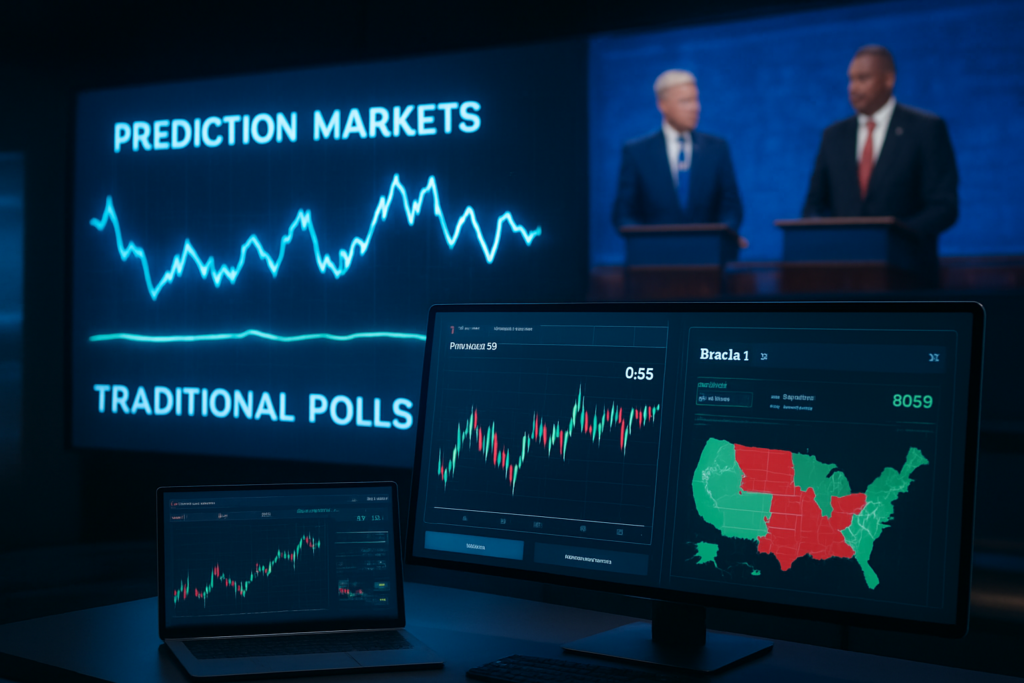
In the high-stakes theater of the 2024 U.S. Presidential Election, two narratives competed for the public’s trust. One, driven by traditional pollsters like NYT/Siena and FiveThirtyEight, suggested a race "too close to call"—a coin-flip election destined for a weeks-long recount. The other, broadcast in real-time by prediction markets like Polymarket and Kalshi, signaled a decisive Donald Trump advantage as early as October.
As of early 2026, the debate over which signal to follow is effectively settled. While major polling outfits struggled with a 3.8% error rate and missed the "Trump floor" for the third consecutive cycle, prediction markets correctly priced in a 312-electoral-vote sweep. This success has transformed the industry from a fringe interest for crypto-enthusiasts into a cornerstone of the global financial apparatus, lending these platforms "serious credibility" that has only intensified as we head into the 2026 midterms.
The Market: What's Being Predicted
The 2024 presidential market was the largest collective wagering event in human history. At its peak, Polymarket saw over $3.3 billion in volume on the winner alone, while Kalshi, following a landmark legal victory over the CFTC, processed hundreds of millions in regulated U.S. trades. On the eve of the election, while polls showed a dead heat, Kalshi traders priced Trump at a 62% favorite, and Polymarket hovered at 63%.
The resolution criteria for these markets were strictly binary: who would be inaugurated on January 20, 2025? However, the real value lay in the swing-state markets. A December 2025 study by Vanderbilt University revealed that while PredictIt had a higher "hit rate" on the final binary outcome (93%), Polymarket was superior in predicting the magnitude of the shift in key states like Pennsylvania and Arizona. The liquidity in these markets allowed for a level of precision that traditional "margin of error" polling simply couldn't replicate.
Why Traders Are Betting
The primary driver of the 2024 market success was its ability to act as a "news thermometer." Unlike traditional polling, which functions as a "rearview mirror," prediction markets process information in seconds. The most cited example remains the June 2024 presidential debate. Within 15 minutes of the opening statements, Joe Biden’s odds on Polymarket collapsed from 38% to 19%. Traditional pollsters took nearly 14 days to release data reflecting that same collapse.
Traders are also incentivized by "skin in the game," a factor that analysts say eliminates the "social desirability bias" often found in telephone polling. In 2024, many "shy Trump voters" were hesitant to tell a pollster their intentions but were more than happy to back their conviction with capital. Furthermore, the entry of major financial institutions like Intercontinental Exchange (NYSE: ICE)—which invested $2 billion into Polymarket in late 2025—has brought a more sophisticated class of institutional "whales" to the markets, further refining the price signal.
Broader Context and Implications
The shift in credibility has had profound regulatory and corporate implications. Following the 2024 election, Interactive Brokers (NASDAQ: IBKR) launched its ForecastEx platform, which has grown to represent a significant portion of its 4.13 million customer accounts as of January 2026. Similarly, Robinhood (NASDAQ: HOOD) reported that its election contracts were its fastest-growing revenue stream in 2025, generating $300 million in a single quarter.
This mainstreaming has turned prediction markets into a "news thermometer" that is now integrated into daily journalism. In late 2025, Kalshi signed exclusive data partnerships with CNN and CNBC, the latter of which now runs a dedicated "Kalshi Ticker" alongside the S&P 500. The regulatory environment has also thawed; Polymarket’s acquisition of a CFTC-licensed exchange in late 2025 allowed it to legally re-enter the U.S. market, effectively ending the era of "gray market" offshore betting.
What to Watch Next
As we look toward the 2026 Midterm Elections, the markets are already providing a sharp divergence from "generic ballot" polls. While polls suggest a competitive environment, current markets on Polymarket and Kalshi are aggressively pricing in a Democratic takeover of the House of Representatives with a 75-80% probability. Conversely, Republicans are currently given a 66% chance of retaining the Senate, thanks to a structurally favorable map that traders believe will outweigh national sentiment.
Another key metric to watch is the "Vance Premium." Current 2028 Presidential markets show Vice President JD Vance as the undisputed favorite at 48%, a figure that far outpaces his current public approval ratings. Traders are betting on the power of incumbency and institutional support—a nuance that traditional "favorability" polling often fails to capture.
Bottom Line
The 2024 election was not just a political event; it was the "proof of concept" for prediction markets. By correctly identifying the shift toward Donald Trump weeks before pollsters—and reacting to events like the June debate in minutes rather than weeks—these platforms proved they are the most efficient processors of political information currently available.
As we move deeper into 2026, the question is no longer whether prediction markets are accurate, but rather how much they will disrupt the $18 billion polling and political consultancy industry. For investors and observers, the message is clear: if you want to know where the country is going, stop looking at the polls and start looking at the prices.
This article is for informational purposes only and does not constitute financial or betting advice. Prediction market participation may be subject to legal restrictions in your jurisdiction.
PredictStreet focuses on covering the latest developments in prediction markets.
Visit the PredictStreet website at https://www.predictstreet.ai/.