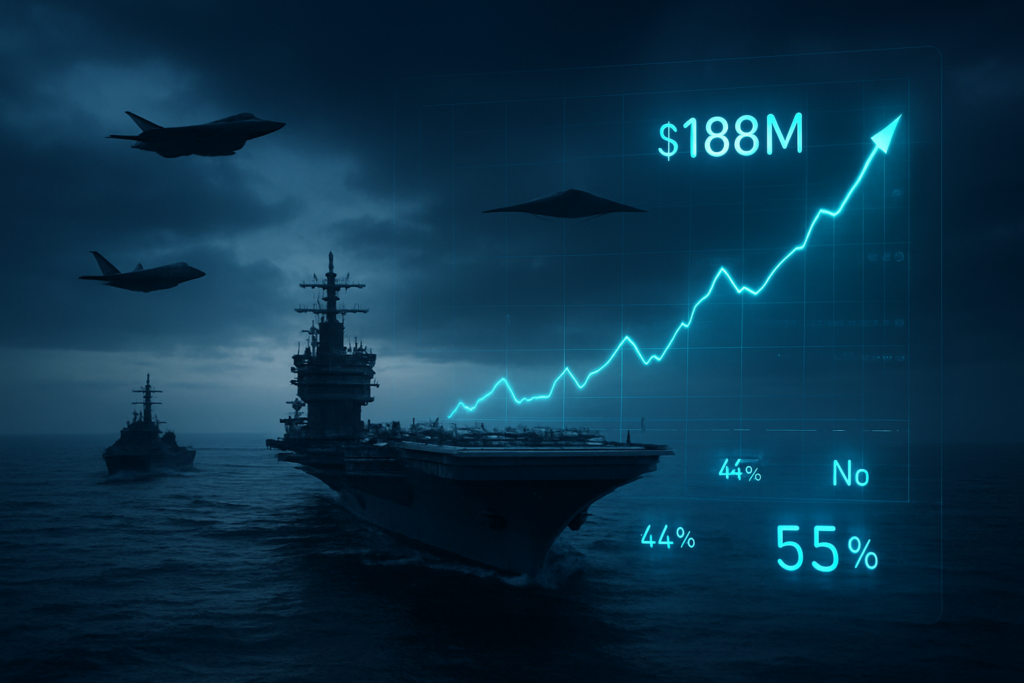
As of February 7, 2026, the intersection of high-stakes diplomacy and military posturing has turned the eyes of the world toward the Persian Gulf. Prediction markets are currently pricing in a significant probability of military conflict between the United States and Iran, with the flagship "U.S. strike on Iran" market on Polymarket seeing its cumulative volume surge to a staggering $188 million. This massive influx of capital comes as the USS Abraham Lincoln carrier strike group takes its position in the Gulf of Oman, creating a visual and strategic catalyst that has sent traders into a frenzy.
Current odds reflect a complex geopolitical landscape: the probability of a U.S. strike by the mid-February deadline (February 13) stands at 31%, while the odds for a strike by the end of the month (February 28) have climbed to 44%. These figures represent a volatile "truth signal" that often moves faster than traditional news cycles, as participants bet millions on whether the current "maximum pressure" campaign will culminate in kinetic action or de-escalate through high-stakes diplomacy currently unfolding in Oman.
The Market: What's Being Predicted
The primary theater for this financial forecasting is Polymarket, a decentralized prediction platform that has dominated the geopolitical betting space throughout late 2025 and into early 2026. The specific contract, "U.S. strikes Iran by…?", has become a focal point for institutional hedgers and retail speculators alike. While Polymarket handles the bulk of the decentralized volume, Kalshi, a U.S.-regulated exchange, has captured over $87 million in volume for related contracts concerning Iranian leadership stability and domestic government shutdown risks, providing a regulated alternative for American participants.
The resolution criteria for these markets are notoriously strict. For a "Yes" resolution on the February deadlines, the U.S. military must conduct a confirmed kinetic strike—ranging from drone strikes to manned aerial bombardments—within Iranian territory or territorial waters. As of early February, the liquidity in these markets is exceptionally high, with approximately $1 million in standing buy/sell orders, ensuring that even large "whale" trades do not cause irrational price swings without significant conviction.
Why Traders Are Betting
The current surge in volume is not occurring in a vacuum. Traders are heavily weighing the precedent set by "Operation Absolute Resolve" on January 3, 2026, which saw the surprise U.S. capture of Nicolás Maduro. This event signaled to the markets that the current administration is willing to authorize high-risk, high-reward operations. Furthermore, the memory of "Operation Midnight Hammer" in June 2025—a massive U.S.-Israeli strike on the Fordow nuclear facility—remains fresh, establishing a baseline expectation for military intervention if diplomatic red lines are crossed.
Recent movements have also been influenced by the domestic political climate. A fatal Border Patrol shooting in late January led to a U.S. government shutdown on January 31, 2026. Initially, this caused "strike" odds to plummet, as traders assumed a distracted Washington would avoid foreign entanglements. However, the deployment of the USS Abraham Lincoln has reversed that trend. Notably, "Unusual Whales" recently flagged a massive $5 million "No" bet on the February 28 deadline, suggesting that some high-net-worth traders believe the naval buildup is a leverage play for the Oman nuclear talks rather than a precursor to immediate war.
Broader Context and Implications
The activity in these prediction markets is mirrored in the traditional equities market, particularly within what analysts are calling the "Security Supercycle." Shares of Lockheed Martin (NYSE: LMT) have surged nearly 28% year-to-date, trading near $628 as investors eye the company’s $194 billion backlog and the prominent role of the F-35 Lightning II in regional deployments. Similarly, Northrop Grumman (NYSE: NOC) has seen increased scrutiny as its B-21 Raider stealth bombers are viewed as the primary assets for any deep-strike mission into fortified Iranian airspace.
This trend highlights a growing reliance on prediction markets as a more accurate gauge of sentiment than traditional polling or expert punditry. When millions of dollars are on the line, "noise" tends to be filtered out, leaving a raw probability that incorporates everything from troop movements to leaked diplomatic cables. The accuracy of these markets was recently vindicated in January, when "insider" betting patterns correctly predicted the Maduro ouster hours before it was officially announced, leading to increased regulatory scrutiny but also increased public trust in the markets' predictive power.
What to Watch Next
The immediate focus for traders is the outcome of the bilateral talks in Muscat, Oman, which began on February 6. If these talks show signs of stalling or if either side issues a formal walk-away statement, the 44% probability for a late-February strike could easily spike above 60%. Conversely, any joint statement regarding a "de-escalation framework" would likely cause the markets to "fade," rewarding the "No" bettors who have recently taken large positions.
Key milestones to monitor include the February 13 deadline, which serves as a psychological "checkpoint" for the market. If this date passes without incident, attention will shift entirely to the February 28 deadline, which many see as the "breaking point" for the current diplomatic cycle. Beyond the military aspect, watch for movements in the United States Oil Fund (NYSEARCA: USO) and Brent crude futures, which are currently forecasting a $64/bbl floor but remain highly sensitive to "Strait of Hormuz closure" odds, currently sitting at 31%.
Bottom Line
The $188 million volume on Polymarket’s Iran contracts is a testament to the maturation of prediction markets as a vital tool for geopolitical risk assessment. By aggregating the collective intelligence of thousands of traders—and the heavy conviction of million-dollar "whales"—these platforms offer a real-time probability of conflict that traditional media simply cannot replicate.
While the current odds of 44% for a strike by the end of February suggest a "coin-flip" scenario, the underlying data points to a period of unprecedented tension. Whether the USS Abraham Lincoln’s presence in the Gulf of Oman leads to a "kinetic event" or serves as the ultimate diplomatic bargaining chip, the prediction markets will likely be the first to know the outcome. For now, the "smart money" is split, but the massive volume indicates that the world is bracing for a definitive conclusion to this February standoff.
This article is for informational purposes only and does not constitute financial or betting advice. Prediction market participation may be subject to legal restrictions in your jurisdiction.
PredictStreet focuses on covering the latest developments in prediction markets.
Visit the PredictStreet website at https://www.predictstreet.ai/.