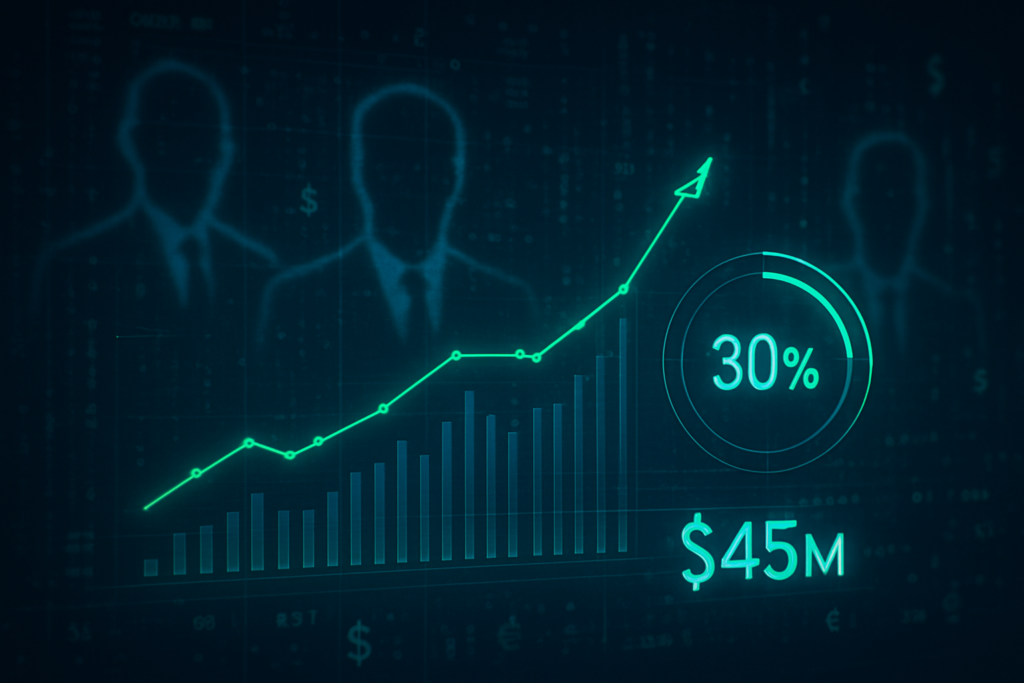
While the dust of the 2024 election has long since settled, the gaze of the political and financial worlds has already shifted toward the next horizon. As of February 7, 2026, prediction markets for the 2028 Democratic Nominee have reached an unprecedented level of early activity. On Kalshi, the premier regulated event contract exchange, the market for the 2028 Democratic Presidential Nominee has seen a staggering $45.2 million wagered, a figure that dwarfs the liquidity of any primary market at this stage in history.
Currently, California Governor Gavin Newsom sits atop the leaderboard with a dominant 30% probability of securing the nomination. This early "market pricing" reveals a political landscape that is consolidating much faster than traditional polling suggests. While voters are still years away from casting their first ballots, traders are already putting massive sums behind a specific vision of the Democratic future—one characterized by high-visibility "resistance" politics and a formidable West Coast fundraising machine.
The Market: What's Being Predicted
The "2028 Democratic Nominee" market on Kalshi is a simple "Yes/No" binary contract that resolves to $1 for the candidate who ultimately wins the party’s nomination at the 2028 Democratic National Convention. Unlike the speculative "gray markets" of previous decades, this is a fully CFTC-regulated environment, attracting not just political hobbyists but institutional liquidity.
Gavin Newsom’s 30% odds place him in a tier of his own. The next closest contenders are Pennsylvania Governor Josh Shapiro at 9%, followed by former Vice President Kamala Harris at 8%. Progressive standard-bearer Alexandria Ocasio-Cortez and Maryland Governor Wes Moore are locked in a dead heat for fourth place at 7% each.
The liquidity in this market has been bolstered by Kalshi’s expansion of position limits to $3,500 per contract and the entry of major market-making firms like Susquehanna International Group (SIG) and Jane Street. These firms are now providing deep order books, allowing high-net-worth individuals and institutional desks to take significant positions without the "slippage" that plagued earlier, more volatile cycles.
Why Traders Are Betting
The discrepancy between market odds and public polling is perhaps the most fascinating aspect of the current 2028 landscape. While traditional polls still show high name recognition for Kamala Harris, prediction markets have effectively "priced her out," viewing her 8% odds as "dead money" compared to Newsom’s momentum.
Traders are betting on Newsom for three primary reasons:
- The Shadow Campaign: Throughout 2025 and into early 2026, Newsom has conducted a relentless national media blitz, including a high-profile memoir launch and frequent appearances as the primary critic of the Trump-Vance administration. Traders view this as a "de facto" campaign launch.
- Fundraising Supremacy: Newsom’s PAC has already outpaced his rivals, tapping into deep donor networks in Silicon Valley and Hollywood. Markets value "cash on hand" as a leading indicator of nominee longevity.
- Institutional Backing: Unlike the more progressive or "outsider" candidates, Newsom is seen by traders as the establishment’s safest bet for a high-resource national campaign.
Conversely, the market is pricing in "electability insurance" with Josh Shapiro. His 9% odds reflect a belief among traders that if the party pivots toward a moderate, mid-Atlantic strategy to win back the "Blue Wall," Shapiro is the natural successor to the Biden-era coalition.
Broader Context and Implications
This surge in betting volume marks the definitive arrival of the "Information Finance" (InfoFi) era. Following landmark court victories in 2024 that prevented the CFTC from banning election contracts, prediction markets have become integrated into the broader financial ecosystem. Major public brokerages have taken notice. Interactive Brokers (NASDAQ: IBKR) has expanded its ForecastEx platform, and Robinhood (NASDAQ: HOOD) recently integrated Kalshi-regulated contracts directly into its retail app, bringing millions of small-dollar traders into the fold.
Other public companies are also jockeying for position in this new asset class. Coinbase (NASDAQ: COIN) has moved toward a "one-stop-shop" model for regulated event contracts, while DraftKings (NASDAQ: DKNG) and Flutter Entertainment (NYSE: FLUT) have launched dedicated prediction verticals to capture the "political-gaming" crossover. Even the Intercontinental Exchange (NYSE: ICE), parent of the New York Stock Exchange, recently made a strategic investment in the space, signaling that prediction markets are no longer a niche curiosity.
This shift has real-world implications: political campaigns now monitor Kalshi and Polymarket odds as closely as internal polling. The "wisdom of the crowd" is being used to price political risk for everything from corporate tax planning to treasury exposure.
What to Watch Next
The immediate catalyst for market movement will be the 2026 midterm elections. While the 2028 nominees aren't on the ballot, their "proxies" are. If Gavin Newsom-endorsed candidates underperform, or if Josh Shapiro wins a resounding reelection in Pennsylvania with significant crossover support, the odds could flip overnight.
Additionally, the battle over the Democratic primary calendar remains a critical factor. Michigan Governor Gretchen Whitmer, currently at 5% odds, is leading the charge to make Michigan the first-in-the-nation primary state. If she succeeds, her odds are expected to spike as she gains a home-field advantage in the crucial opening act of the primary season.
Traders should also watch for "black swan" candidates. Prediction markets are famously sensitive to "viral" moments. A breakout performance by a "dark horse" like Wes Moore at a national dinner or a high-profile Senate hearing could see his 7% odds double in a matter of hours.
Bottom Line
The $45 million wagered on Kalshi is more than just a bet on a person; it is a bet on the direction of the Democratic Party and the maturity of a new financial instrument. Gavin Newsom’s 30% lead suggests that, at least in the eyes of the most capitalized observers, the 2028 primary is his to lose.
However, as any seasoned trader knows, "early" is a dangerous word in politics. While Newsom has the visibility and the bankroll, the high liquidity in these markets means they are incredibly efficient at pricing in new information. As we head into the heart of the 2026 midterm cycle, these markets will provide the most accurate, real-time barometer of who the next leader of the Democratic Party will be.
This article is for informational purposes only and does not constitute financial or betting advice. Prediction market participation may be subject to legal restrictions in your jurisdiction.
PredictStreet focuses on covering the latest developments in prediction markets.
Visit the PredictStreet website at https://www.predictstreet.ai/.