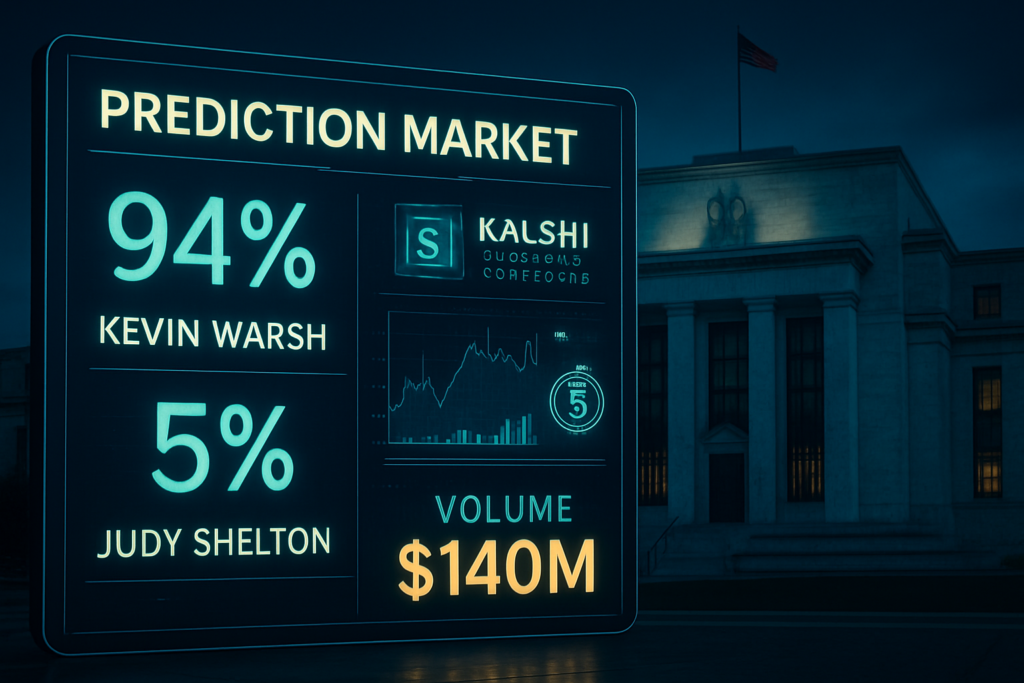
The race to lead the world’s most powerful financial institution has moved from the boardrooms of Washington to the high-stakes arena of prediction markets. As of February 7, 2026, Kevin Warsh has emerged as the overwhelming favorite to succeed Jerome Powell as Chair of the Federal Reserve, commanding a staggering 94% probability on the prediction platform Kalshi. Meanwhile, the once-buzzy candidacy of sound-money advocate Judy Shelton has collapsed to a mere 5%, reflecting a market that is increasingly pricing in a "traditional-but-aligned" transition for the U.S. central bank.
This market has become a focal point for institutional investors and political junkies alike, generating an unprecedented $140.8 million in total volume. The surge in activity underscores a growing reliance on event contracts to navigate the volatile intersection of monetary policy and presidential politics. With Jerome Powell’s term as Chair officially set to expire on May 15, 2026, the betting action is no longer just about who gets the job, but how quickly they can navigate a contentious Senate confirmation process.
The Market: What's Being Predicted
The primary battleground for this financial forecasting is Kalshi, the federally regulated prediction market that has seen its volume explode following its successful legal challenges against the CFTC. The specific contract, "Who will Trump nominate as Fed Chair?", has seen its liquidity deepen as the administration’s plans became clearer. While Robinhood Markets, Inc. (Nasdaq: HOOD) and Interactive Brokers Group, Inc. (Nasdaq: IBKR) have expanded their own event-trading offerings, Kalshi remains the epicenter for this specific $140.8 million pool of capital.
The odds have undergone a dramatic shift over the last month. In late 2025, the market was a fragmented field with candidates like Kevin Hassett and Rick Rieder of BlackRock, Inc. (NYSE: BLK) holding significant shares. However, following President Trump’s official announcement on January 30, 2026, Kevin Warsh’s odds catapulted from 65% to the current 94%. Conversely, Judy Shelton, who traded as high as 20% in early January, saw her shares crater as the administration signaled a preference for Warsh’s "central casting" appeal.
The resolution criteria for these contracts are tied to the formal nomination and, in secondary markets, the successful confirmation by the U.S. Senate. With the nomination now official, the focus of traders has shifted to the "Confirmation" contracts, which are currently trading at a slight discount to the nomination odds due to potential legislative friction.
Why Traders Are Betting
The 94% conviction in Warsh is driven by a combination of presidential endorsement and strategic political maneuvering. President Trump has publicly praised Warsh, stating he is a leader who "will never let you down." This endorsement was reportedly heavily influenced by Treasury Secretary Scott Bessent, who favored Warsh’s ability to maintain market stability while remaining more receptive to the administration's economic vision than the incumbent Powell.
Traders are also closely watching the "shadow" surrounding Jerome Powell’s exit. A public DOJ investigation into Powell regarding alleged cost overruns in the $2.5 billion renovation of the Fed’s headquarters has provided significant tailwinds for the "Change" side of the market. Critics, including several prominent Democratic senators, have characterized the investigation as a political tool to pressure Powell, but for prediction market participants, the controversy simply hardens the reality that the Powell era is concluding.
Meanwhile, Judy Shelton’s decline is attributed to a "flight to credibility" by the administration. While Shelton’s advocacy for the gold standard resonates with a specific segment of the base, institutional players—many of whom hedge their interest-rate exposure on these platforms—viewed her nomination as a potential source of "market jitters." The 5% odds remaining for her represent a "black swan" hedge in case the Warsh confirmation hits a fatal snag in the Senate Banking Committee.
Broader Context and Implications
The $140 million volume in the Fed Chair market represents a watershed moment for the prediction market industry. It proves that these platforms are no longer just for predicting election winners but are vital tools for pricing "policy risk." The sheer size of the pool suggests that major financial institutions are likely using these contracts to hedge against different interest rate regimes. If Warsh is seen as more "dovish" or more "aligned" with the White House, the prediction market acts as a leading indicator for the bond market.
This market also reveals a shift in public sentiment regarding the independence of the Federal Reserve. By betting so heavily on a candidate praised for being "aligned" with the executive branch, traders are implicitly pricing in a future where the Fed’s "political independence" is more fluid than it has been in decades. This has significant real-world implications for the S&P 500 (SPX) and the broader global economy, as the Fed’s posture on inflation and employment is the primary driver of capital costs.
Historically, prediction markets have often outpaced traditional pundits in identifying presidential favorites. In the 2024 cycle, these markets were significantly more sensitive to shift in momentum than traditional polling. The high confidence in Warsh suggests that despite potential Senate "holds," the market views his path to the 20th floor of the Eccles Building as nearly inevitable.
What to Watch Next
The next major catalyst for this market will be the Senate Banking Committee hearings, expected to begin in late February 2026. While Warsh has the numbers on paper, Senator Thom Tillis (R-NC) and several key Democrats have signaled they may place a "hold" on the nomination until more clarity is provided regarding the DOJ’s investigation into Powell. Any delay in the committee vote could see Warsh’s 94% odds dip toward the 80s as "process risk" increases.
Key dates to monitor include:
- Late February 2026: Opening of Senate Banking Committee hearings.
- April 2026: The administration's target window for a full Senate confirmation vote.
- May 15, 2026: The official expiration of Jerome Powell’s term as Chair.
Should the DOJ investigation take an unexpected turn—either exonerating Powell or revealing deeper issues—the volatility in the "Confirmation" market will likely spike. Additionally, any public comments from Warsh regarding the "neutral rate" of interest will be scrutinized by traders looking to front-run the first FOMC meeting of the post-Powell era.
Bottom Line
The $140 million battle for the Fed Chairmanship has effectively been won by Kevin Warsh, at least in the eyes of the market. The 94% odds reflect a belief that the Trump administration has successfully cleared the path for its preferred candidate, combining political loyalty with a profile that the financial markets can digest. The collapse of Judy Shelton’s odds further suggests that while the administration seeks change, it is not yet ready for the radical structural shifts Shelton represents.
As a tool, this market has demonstrated remarkable maturity. The high volume and tight spreads show that prediction markets are becoming a primary source of truth for high-stakes political appointments. For investors, the message is clear: the transition to "Warsh’s Fed" is the base case for the global economy in 2026.
Whether Warsh can maintain the Fed’s delicate balance between fighting inflation and supporting the administration’s growth agenda remains to be seen. But for now, the "smart money" is betting $140 million that he is the man who will be tasked with trying.
This article is for informational purposes only and does not constitute financial or betting advice. Prediction market participation may be subject to legal restrictions in your jurisdiction.
PredictStreet focuses on covering the latest developments in prediction markets. Visit the PredictStreet website at https://www.predictstreet.ai/.