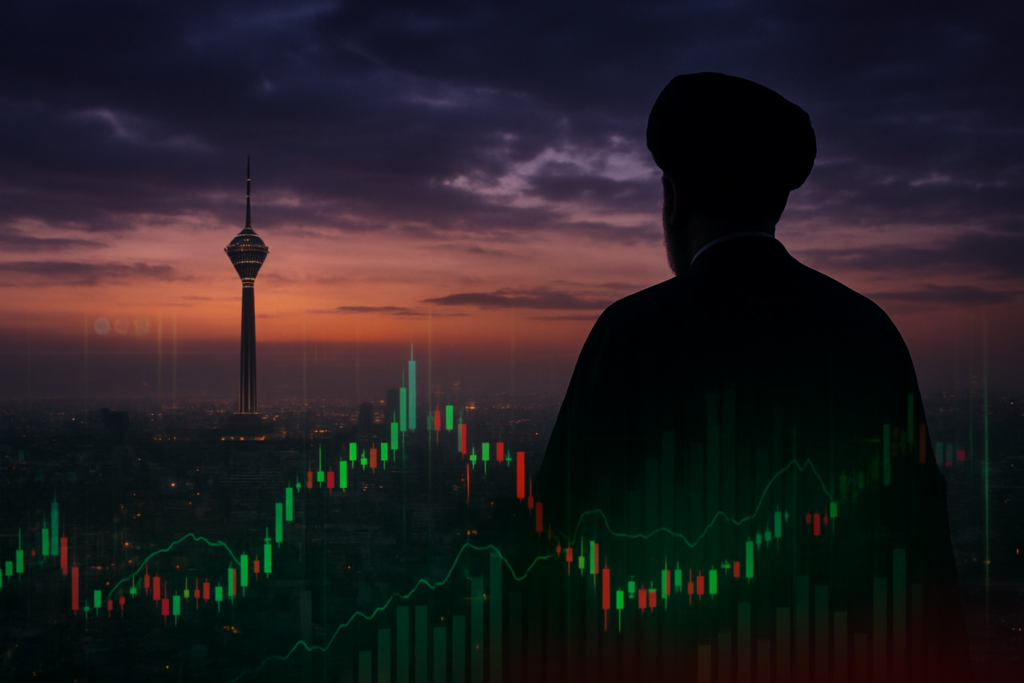
As of February 7, 2026, the geopolitical world is fixated on a high-stakes question that has long been whispered in the corridors of power in Tehran: when will the era of Ayatollah Ali Khamenei end? For years, this was the subject of classified intelligence briefs and academic speculation. Today, it is a $17 million market on the regulated exchange Kalshi. Traders are currently pricing in a 38% probability that Khamenei will exit his position as Supreme Leader of Iran by September 1, 2026.
This market is not merely a curiosity for political junkies; it has become a focal point for global finance and intelligence analysts alike. The 38% odds represent a volatile consensus that has fluctuated wildly over the last six months, driven by reports of the 86-year-old leader's deteriorating health and a series of unprecedented internal and external pressures on the Islamic Republic. As the volume nears the $20 million mark, the contract is now one of the most liquid geopolitical instruments in the history of prediction markets.
The Market: What's Being Predicted
The primary vehicle for this speculation is the Kalshi contract titled "Ali Khamenei out as Supreme Leader?" Specifically, the September 2026 series (Series: KXKHAMENEIOUT) has captured the lion's share of the volume. The rules are clinical and definitive: the market resolves to "Yes" if Ali Khamenei officially leaves the office of Supreme Leader, is removed, or if an official state announcement is made regarding a definitive transition within the designated timeframe.
The resolution criteria are rigorous, relying on official announcements from the Iranian government or corroboration by at least two major international news organizations, such as The New York Times (NYSE: NYT) or The Wall Street Journal, owned by News Corp (NASDAQ: NWSA). To maintain ethical standards, the market includes a "Death Provision"—if the Leader passes away in office, the market resolves based on the last traded price prior to the announcement, effectively preventing the contract from becoming an "assassination bounty" while still allowing traders to hedge against the political vacuum a death would create.
Currently, the market boasts over $17 million in total volume, with hundreds of thousands of individual contracts changing hands. Liquidity is remarkably deep, allowing institutional players to take significant positions. This is a far cry from the "play money" markets of a decade ago; the capital at risk suggests that those with access to high-level intelligence are using the platform to express their views on the stability of the Iranian regime.
Why Traders Are Betting
The 38% probability reflects a complex "perfect storm" of factors that traders are weighing daily. Chief among them is the physical fragility of the Supreme Leader. Throughout late 2025 and into early 2026, reports have surfaced regarding Khamenei's retreat into a hardened bunker in Lavizan, with some intelligence leaks suggesting he has suffered from "advanced cognitive impairment" or intermittent medical crises.
Furthermore, the succession race has been thrown into chaos. Following the 2024 death of Ebrahim Raisi, who was the hand-picked successor, the field has narrowed to a few contentious figures. Traders are closely monitoring the influence of Mojtaba Khamenei, the Leader's second son. While he commands the loyalty of the IRGC Intelligence Organization, the possibility of a "hereditary" transition is a flashpoint for internal dissent. Recent market activity spiked following reports that Ali Khamenei excluded his son from a "shortlist" presented to the Assembly of Experts, a move intended to preserve the revolutionary ideology of the state but one that creates a massive power vacuum.
External pressures are also priced in. Continued regional escalations involving Israel and the United States have forced the Iranian leadership into a defensive crouch. Traders often move the "Yes" odds higher following major kinetic events in the region, betting that external shocks could accelerate a transition or collapse of the current leadership structure.
Broader Context and Implications
The "Khamenei Exit" market serves as a leading indicator for several global sectors. The energy market is perhaps the most sensitive; a sudden transition in Tehran could lead to massive volatility in crude prices, affecting giants like Exxon Mobil (NYSE: XOM) and Chevron (NYSE: CVX). Similarly, defense contractors such as Lockheed Martin (NYSE: LMT) and RTX Corporation (NYSE: RTX) often see their stock prices correlate with the perceived instability in the Middle East, a sentiment that is now being distilled into a single percentage on prediction platforms.
Beyond the financial implications, this market represents a milestone for prediction platforms as a tool for "nowcasting" geopolitical stability. Unlike traditional polling or intelligence reports, which can be lagging or biased, prediction markets provide a real-time, incentivized aggregate of information. The historical accuracy of such markets—often outperforming expert panels in high-uncertainty environments—gives this 38% figure a weight that the Iranian government cannot easily ignore.
However, regulatory scrutiny remains a shadow over the industry. As markets like Kalshi and Polymarket grow in influence, regulators are increasingly wary of the potential for market manipulation or the ethical implications of "betting" on the death or removal of foreign heads of state. For now, the Kalshi market remains a legal, regulated venue for U.S. participants to trade on one of the most significant transitions of the 21st century.
What to Watch Next
The next six months will be critical for this market. Investors should keep a close eye on the biennial meetings of the Assembly of Experts. Any sudden change in the composition of this 88-member body or an unscheduled "emergency" session would likely send the "Yes" odds for a September 2026 exit soaring above 50%.
Additionally, the "January 2026 Uprising"—a wave of domestic protests sparked by economic stagnation and 45%+ inflation—remains a wildcard. If the IRGC’s response to these protests shows signs of fracturing or if the "Regency Council" currently managing day-to-day affairs in Tehran loses its grip on the narrative, the probability of an "early" exit will likely climb. Traders should also watch for any rare public appearances by Khamenei; his physical presence (or lack thereof) during the upcoming Persian New Year (Nowruz) in March will be a binary event for the market.
Bottom Line
The $17 million volume on the Ali Khamenei exit market is a testament to the growing role of prediction markets in deciphering the world’s most opaque political systems. At 38%, the market is signaling that while a transition is not yet the "base case" for the next 18 months, it is a high-probability risk that is no longer being ignored by the global financial community.
For participants and observers alike, this market highlights a shift in how we process global risk. We are moving away from the era of the "expert opinion" and into the era of the "incentivized consensus." Whether or not Khamenei remains in power by September 2026, the movement of this market will provide the most accurate real-time barometer of the regime’s longevity that we have ever seen.
This article is for informational purposes only and does not constitute financial or betting advice. Prediction market participation may be subject to legal restrictions in your jurisdiction.
PredictStreet focuses on covering the latest developments in prediction markets. Visit the PredictStreet website at https://www.predictstreet.ai/.