SolarEnergies.ca, a Canadian solar education publication, announced the release of a free Solar Panels Calculator built to help homeowners estimate system size and compare installer quotes with fewer surprises. The tool was created by Vitaliy Lano, owner of SolarEnergies.ca, after years of reviewing solar companies and seeing the same pattern repeat: quotes that look confident on the surface, while the assumptions stay hidden.
https://www.youtube.com/watch?v=BEgMdMU0iIw
Lano said the calculator is meant to answer a practical question early, before a homeowner burns time on calls and sales pressure: does solar likely pencil out for the home at all, and if so, roughly what size system might be needed to match real consumption? The company notes that many online “calculators” act more like lead forms, producing vague ranges without explaining key inputs.
The SolarEnergies.ca calculator starts with an address-based roof analysis. According to the publication, the system uses AI with high-resolution satellite imagery to estimate usable roof area and roof angle, then uses that angle as part of an NREL PVWatts-based production estimate, aiming to avoid generic “best-case roof” assumptions that can inflate projected output.
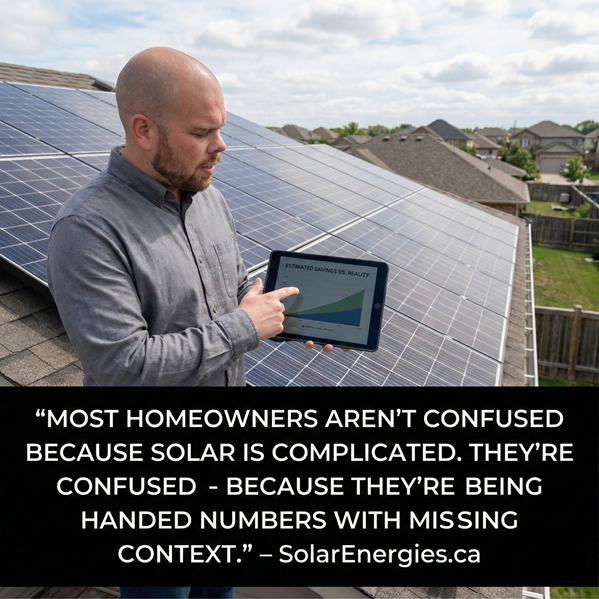
“Most homeowners aren’t confused because solar is complicated,” Lano stated. “They’re confused because they’re being handed numbers with missing context. Two quotes can be thousands of dollars apart, and neither one tells the full story unless the homeowner knows what questions to ask.”
SolarEnergies.ca points to a growing consumer-protection problem: not only quote inconsistency, but also outright fraud attempts that piggyback on solar interest and rebate headlines. BC Hydro reported a surge in scams in 2025, including deceptive online ads and cases where scammers posed as utility employees, sometimes pushing “solar or battery services” and dangling rebates as bait. Outside British Columbia, provincial and national fraud agencies have issued broad warnings about misleading home-services sales, pressure tactics, and “below-market” grant claims spread through social media ads, telemarketing, and door-to-door visits.
A major reason quotes get messy is that solar is not “quick math.” SolarEnergies.ca explains that panel count changes based on annual energy use (kWh), roof direction and tilt, shading, and real-world losses from wiring, inverter efficiency, snow, dirt, and other operating factors. The calculator asks for an average monthly electricity bill after the roof analysis, using it as a practical input that most homeowners can find quickly.
The publication also highlights a common misunderstanding: “covering the bill” rarely means the bill becomes zero. Utilities often keep fixed charges that do not disappear just because a home generates electricity. BC Hydro’s self-generation guidance says bill credits cover “Energy Charges only,” and customers still pay other charges such as the Basic Charge. Ontario’s net metering guidance similarly describes credits applying against electricity usage, with other bill components remaining, and notes that unused credits can carry forward for up to 12 months before being reduced to $0.
That detail matters because “too-good-to-be-true” pitches often use the fantasy of a “zero bill” to rush decisions. Alberta’s consumer-facing utility guidance calls out “free solar panels,” “large grants,” and promises to reduce a "utility bill to nothing” as classic red flags, noting that transmission and distribution charges often remain. The Better Business Bureau has also warned that “free solar” offers can be used to harvest personal information, collect upfront payments tied to fake government programs, or start incomplete/poor installs before the seller disappears.
SolarEnergies.ca says the calculator is built to support comparison, not to replace a site visit. “This tool is a fast estimate, not an engineering plan,” Lano commented. “If the estimate looks promising, the next step is a real assessment: shade check, electrical panel review, and a permit-ready design. That’s where good installers stand out.”
SolarEnergies.ca states that homeowners who want guidance after running the calculator can request a human follow-up and compare offers against a national installer's track record. The calculator page notes an option to connect homeowners with a top installer described as having over 13,200 installs across the country, and states that contact details are not sold to multiple companies. “A homeowner should be able to compare one solid offer against the rest of the market without being swamped,” Lano expressed. “Clear math first, then a calm decision.”
SolarEnergies.ca’s Solar Panels Calculator and supporting explanation page are available for free on the publication’s website. Media contact information and calculator access details are listed on the same page.
###
For more information about Solar Energies In Canada SEIC, contact the company here:
Solar Energies In Canada SEIC
Vitaliy Lano
2368680609
admin@solarenergies.ca