Industrials automation company Rockwell (NYSE: ROK) announced better-than-expected revenue in Q4 CY2025, with sales up 11.9% year on year to $2.11 billion. On the other hand, the company’s full-year revenue guidance of $8.8 billion at the midpoint came in 0.6% below analysts’ estimates. Its non-GAAP profit of $2.75 per share was 10.7% above analysts’ consensus estimates.
Is now the time to buy Rockwell Automation? Find out by accessing our full research report, it’s free.
Rockwell Automation (ROK) Q4 CY2025 Highlights:
- Revenue: $2.11 billion vs analyst estimates of $2.08 billion (11.9% year-on-year growth, 1.4% beat)
- Adjusted EPS: $2.75 vs analyst estimates of $2.48 (10.7% beat)
- Adjusted EBITDA: $513 million vs analyst estimates of $439.4 million (24.4% margin, 16.7% beat)
- Management slightly raised its full-year Adjusted EPS guidance to $11.80 at the midpoint
- Operating Margin: 20.7%, up from 13.1% in the same quarter last year
- Free Cash Flow Margin: 8.1%, down from 15.6% in the same quarter last year
- Organic Revenue rose 10% year on year (beat)
- Market Capitalization: $48.33 billion
Company Overview
One of the first companies to address industrial automation, Rockwell Automation (NYSE: ROK) sells products that help customers extract more efficiency from their machinery.
Revenue Growth
A company’s long-term sales performance is one signal of its overall quality. Any business can put up a good quarter or two, but many enduring ones grow for years. Unfortunately, Rockwell Automation’s 6.6% annualized revenue growth over the last five years was mediocre. This fell short of our benchmark for the industrials sector and is a tough starting point for our analysis.
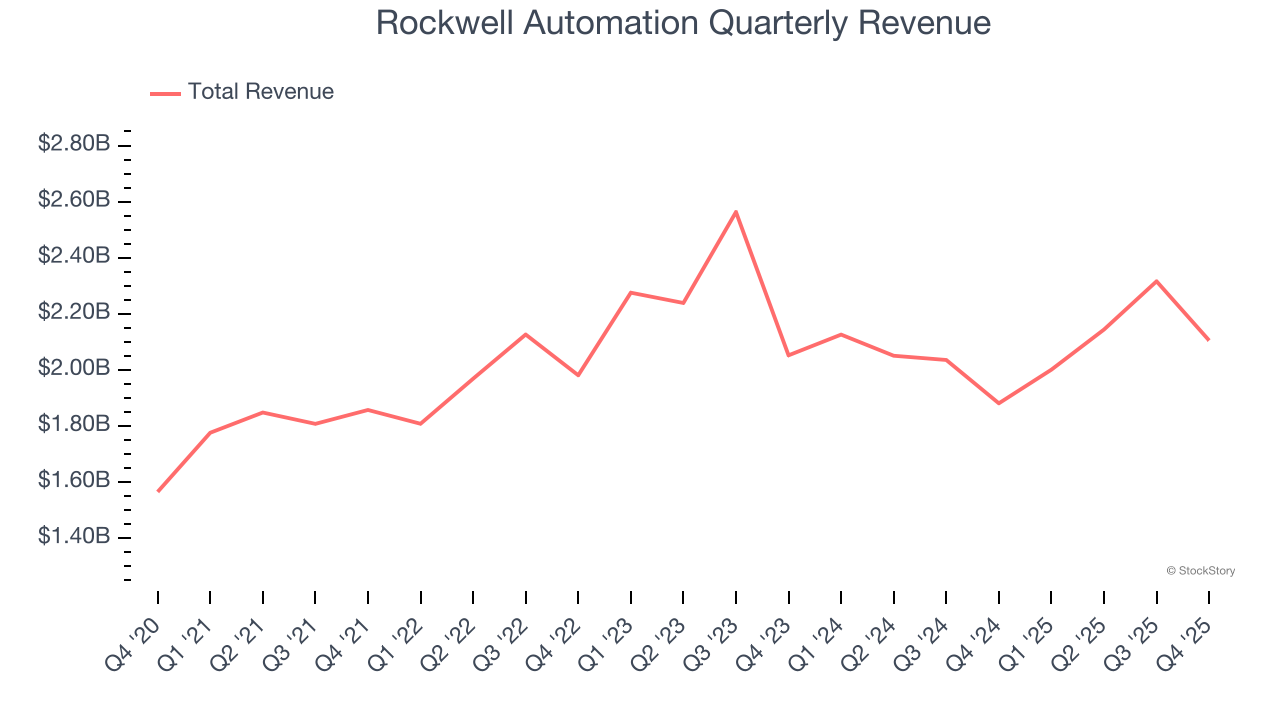
We at StockStory place the most emphasis on long-term growth, but within industrials, a half-decade historical view may miss cycles, industry trends, or a company capitalizing on catalysts such as a new contract win or a successful product line. Rockwell Automation’s performance shows it grew in the past but relinquished its gains over the last two years, as its revenue fell by 3.1% annually. 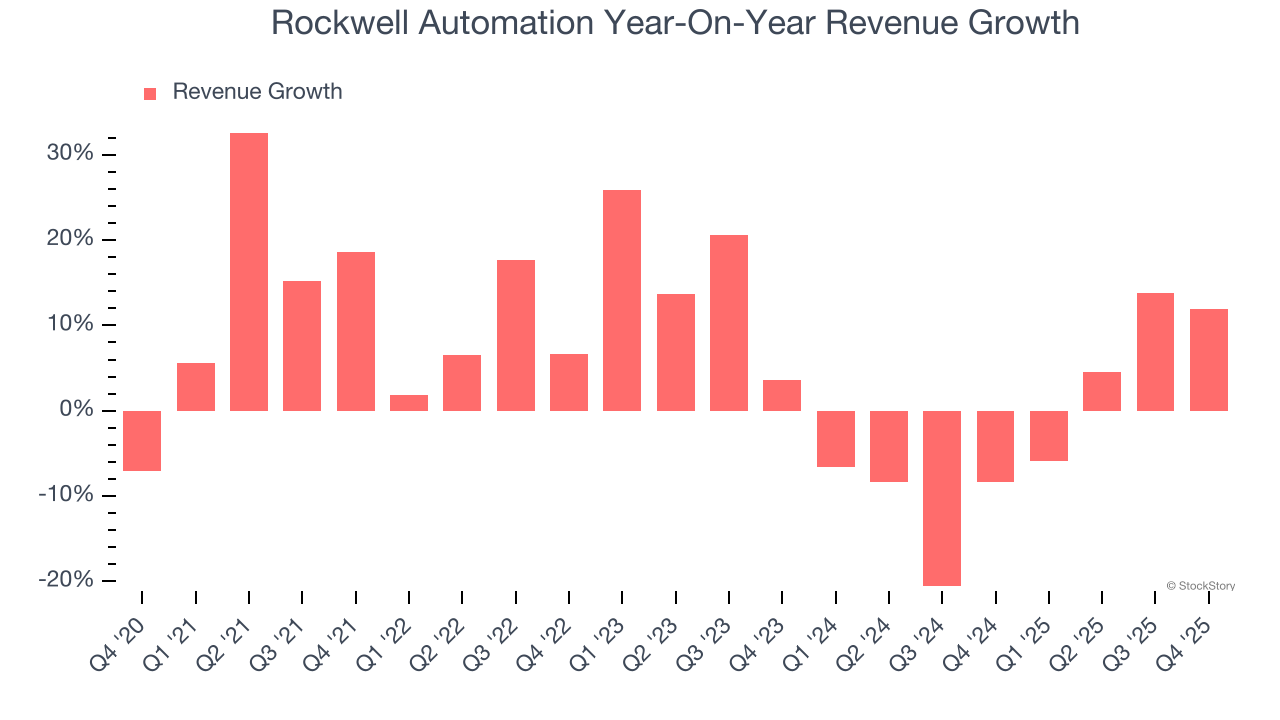
Rockwell Automation also reports organic revenue, which strips out one-time events like acquisitions and currency fluctuations that don’t accurately reflect its fundamentals. Over the last two years, Rockwell Automation’s organic revenue averaged 2.8% year-on-year declines. Because this number aligns with its two-year revenue growth, we can see the company’s core operations (not acquisitions and divestitures) drove most of its results. 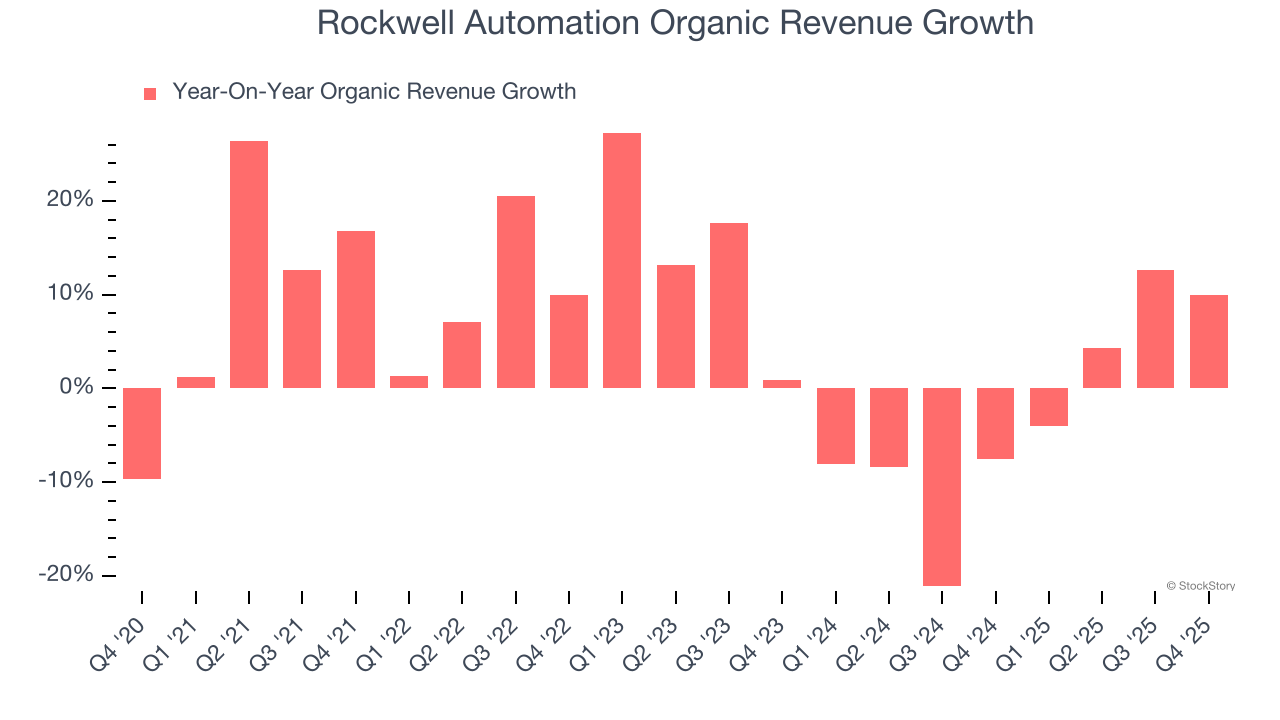
This quarter, Rockwell Automation reported year-on-year revenue growth of 11.9%, and its $2.11 billion of revenue exceeded Wall Street’s estimates by 1.4%.
Looking ahead, sell-side analysts expect revenue to grow 5% over the next 12 months. While this projection suggests its newer products and services will spur better top-line performance, it is still below the sector average.
The 1999 book Gorilla Game predicted Microsoft and Apple would dominate tech before it happened. Its thesis? Identify the platform winners early. Today, enterprise software companies embedding generative AI are becoming the new gorillas. a profitable, fast-growing enterprise software stock that is already riding the automation wave and looking to catch the generative AI next.
Operating Margin
Rockwell Automation has been a well-oiled machine over the last five years. It demonstrated elite profitability for an industrials business, boasting an average operating margin of 17.1%. This result isn’t surprising as its high gross margin gives it a favorable starting point.
Looking at the trend in its profitability, Rockwell Automation’s operating margin rose by 1.7 percentage points over the last five years, as its sales growth gave it operating leverage.
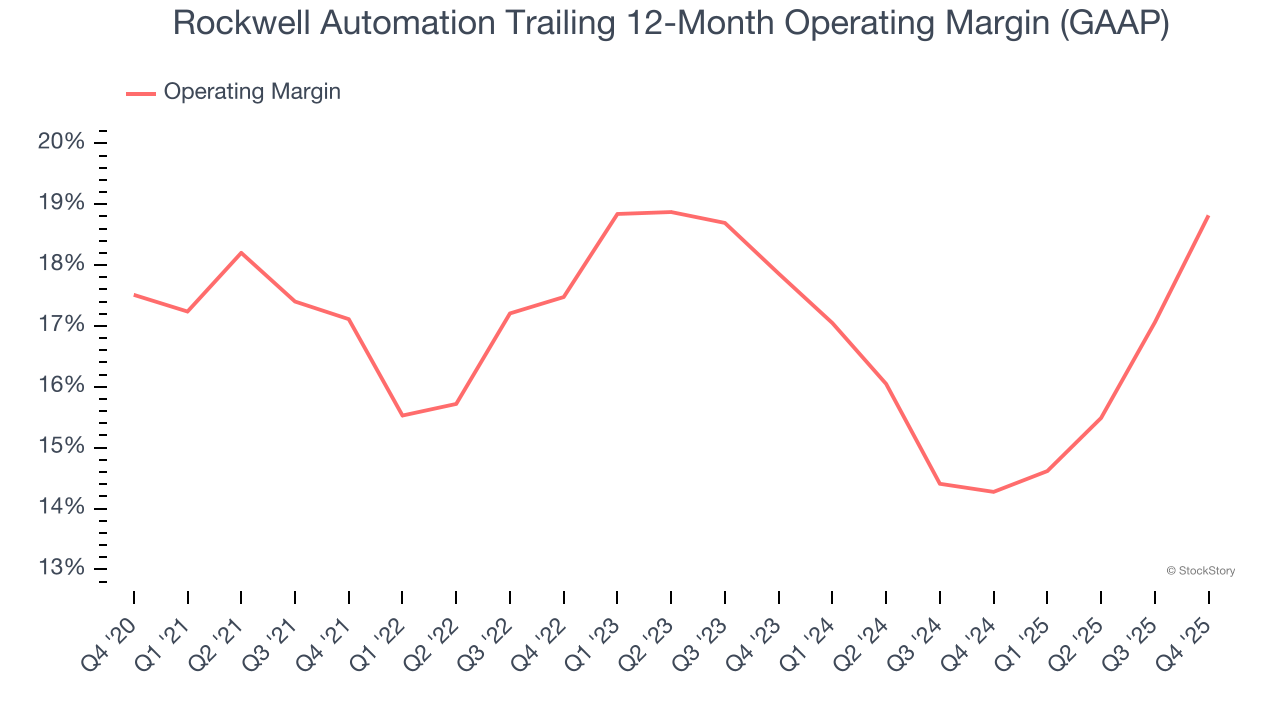
This quarter, Rockwell Automation generated an operating margin profit margin of 20.7%, up 7.6 percentage points year on year. The increase was driven by stronger leverage on its cost of sales (not higher efficiency with its operating expenses), as indicated by its larger rise in gross margin.
Earnings Per Share
We track the long-term change in earnings per share (EPS) for the same reason as long-term revenue growth. Compared to revenue, however, EPS highlights whether a company’s growth is profitable.
Rockwell Automation’s unimpressive 7.4% annual EPS growth over the last five years aligns with its revenue performance. On the bright side, this tells us its incremental sales were profitable.
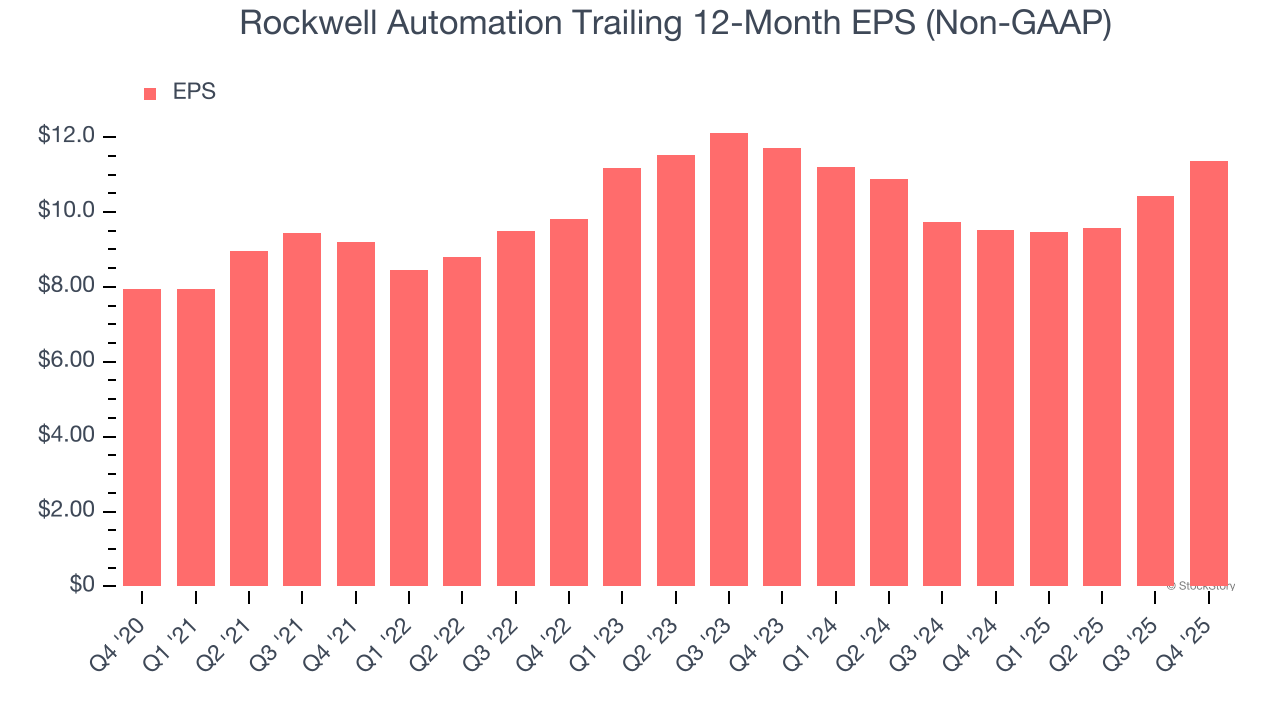
Like with revenue, we analyze EPS over a shorter period to see if we are missing a change in the business.
For Rockwell Automation, its two-year annual EPS declines of 1.5% show it’s continued to underperform. These results were bad no matter how you slice the data.
In Q4, Rockwell Automation reported adjusted EPS of $2.75, up from $1.83 in the same quarter last year. This print easily cleared analysts’ estimates, and shareholders should be content with the results. Over the next 12 months, Wall Street expects Rockwell Automation’s full-year EPS of $11.36 to grow 9.2%.
Key Takeaways from Rockwell Automation’s Q4 Results
We were impressed by how significantly Rockwell Automation blew past analysts’ EBITDA expectations this quarter. We were also happy its organic revenue narrowly outperformed Wall Street’s estimates. On the other hand, its full-year EPS guidance missed and its full-year revenue guidance fell slightly short of Wall Street’s estimates. Overall, this print was mixed but the guide is weighing heavily on shares. The market seemed to be hoping for more, and the stock traded down 5.3% to $407.09 immediately following the results.
Big picture, is Rockwell Automation a buy here and now? The latest quarter does matter, but not nearly as much as longer-term fundamentals and valuation, when deciding if the stock is a buy. We cover that in our actionable full research report which you can read here (it’s free).