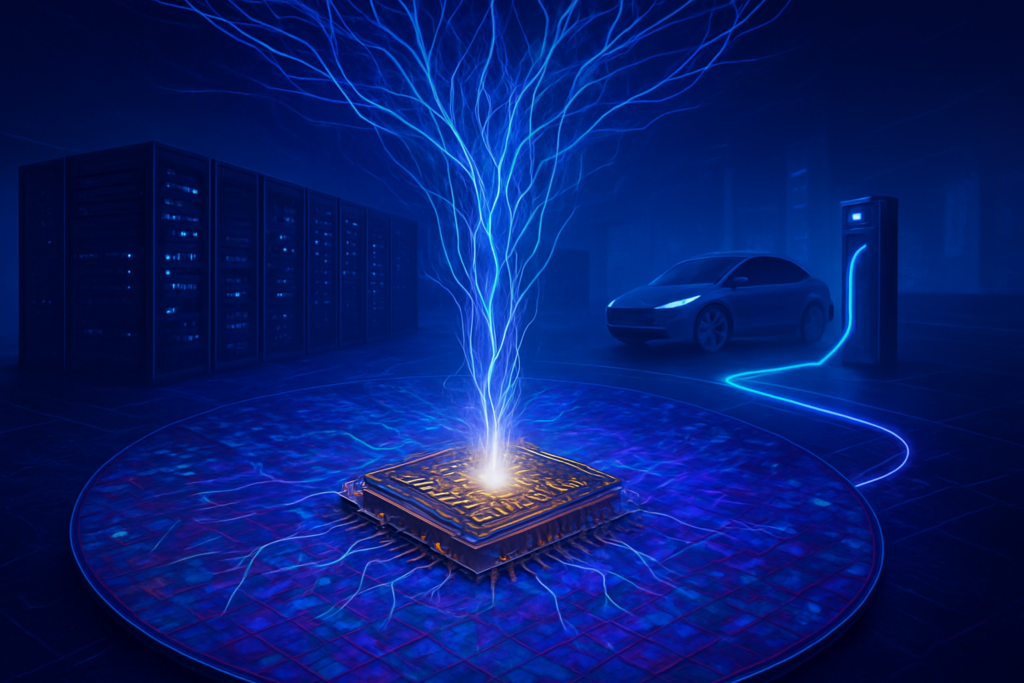
As of late 2025, the artificial intelligence boom has hit a literal physical limit: the "energy wall." With large language models (LLMs) like GPT-5 and Llama 4 demanding multi-megawatt power clusters, traditional silicon-based power systems have reached their thermal and efficiency ceilings. To keep the AI revolution and the electric vehicle (EV) transition on track, the industry has turned to a pair of "miracle" materials—Gallium Nitride (GaN) and Silicon Carbide (SiC)—known collectively as Wide-Bandgap (WBG) semiconductors.
These materials are no longer niche laboratory experiments; they have become the foundational infrastructure of the modern high-compute economy. By allowing power supply units (PSUs) to operate at higher voltages, faster switching speeds, and significantly higher temperatures than silicon, WBG semiconductors are enabling the next generation of 800V AI data centers and megawatt-scale EV charging stations. This shift represents one of the most significant hardware pivots in the history of power electronics, moving the needle from "incremental improvement" to "foundational transformation."
The Physics of Efficiency: WBG Technical Breakthroughs
The technical superiority of WBG semiconductors stems from their atomic structure. Unlike traditional silicon, which has a narrow "bandgap" (the energy required for electrons to jump into a conductive state), GaN and SiC possess a bandgap roughly three times wider. This physical property allows these chips to withstand much higher electric fields, enabling them to handle higher voltages in a smaller physical footprint. In the world of AI data centers, this has manifested in the jump from 3.3 kW silicon-based power supplies to staggering 12 kW modules from leaders like Infineon Technologies AG (OTCMKTS: IFNNY). These new units achieve up to 98% efficiency, a critical benchmark that reduces heat waste by nearly half compared to the previous generation.
Perhaps the most significant technical milestone of 2025 is the transition to 300mm (12-inch) GaN-on-Silicon wafers. Pioneered by Infineon, this scaling breakthrough yields 2.3 times more chips per wafer than the 200mm standard, finally bringing the cost of GaN closer to parity with legacy silicon. Simultaneously, onsemi (NASDAQ: ON) has unveiled "Vertical GaN" (vGaN) technology, which conducts current through the substrate rather than the surface. This enables GaN to operate at 1,200V and above—territory previously reserved for SiC—while maintaining a package size three times smaller than traditional alternatives.
For the electric vehicle sector, Silicon Carbide remains the king of high-voltage traction. Wolfspeed (NYSE: WOLF) and STMicroelectronics (NYSE: STM) have successfully transitioned to 200mm (8-inch) SiC wafer production in 2025, significantly improving yields for the automotive industry. These SiC MOSFETs (Metal-Oxide-Semiconductor Field-Effect Transistors) are the "secret sauce" inside the inverters of 800V vehicle architectures, allowing cars to charge faster and travel further on a single charge by reducing energy loss during the DC-to-AC conversion that powers the motor.
A High-Stakes Market: The WBG Corporate Landscape
The shift to WBG has created a new hierarchy among semiconductor giants. Companies that moved early to secure raw material supplies and internal manufacturing capacity are now reaping the rewards. Wolfspeed, despite early scaling challenges, has ramped up the world’s first fully automated 200mm SiC fab in Mohawk Valley, positioning itself as a primary supplier for the next generation of Western EV fleets. Meanwhile, STMicroelectronics has established a vertically integrated SiC campus in Italy, ensuring they control the process from raw crystal growth to finished power modules—a strategic advantage in a world of volatile supply chains.
In the AI sector, the competitive landscape is being redefined by how efficiently a company can deliver power to the rack. NVIDIA (NASDAQ: NVDA) has increasingly collaborated with WBG specialists to standardize 800V DC power architectures for its AI "factories." By eliminating multiple AC-to-DC conversion steps and using GaN-based PSUs at the rack level, hyperscalers like Microsoft and Google are able to pack more GPUs into the same physical space without overwhelming their cooling systems. Navitas Semiconductor (NASDAQ: NVTS) has emerged as a disruptive force here, recently releasing an 8.5 kW AI PSU that is specifically optimized for the transient load demands of LLM inference and training.
This development is also disrupting the traditional power management market. Legacy silicon players who failed to pivot to WBG are finding their products squeezed out of the high-margin data center and EV markets. The strategic advantage now lies with those who can offer "hybrid" modules—combining the high-frequency switching of GaN with the high-voltage robustness of SiC—to maximize efficiency across the entire power delivery path.
The Global Impact: Sustainability and the Energy Grid
The implications of WBG adoption extend far beyond the balance sheets of tech companies. As AI data centers threaten to consume an ever-larger percentage of the global energy supply, the efficiency gains provided by GaN and SiC are becoming a matter of environmental necessity. By reducing energy loss in the power delivery chain by up to 50%, these materials directly lower the Power Usage Effectiveness (PUE) of data centers. More importantly, because they generate less heat, they reduce the power demand of cooling systems—chillers and fans—by an estimated 40%. This allows grid operators to support larger AI clusters without requiring immediate, massive upgrades to local energy infrastructure.
In the automotive world, WBG is the catalyst for "Megawatt Charging." In early 2025, BYD (OTCMKTS: BYDDY) launched its Super e-Platform, utilizing internal SiC production to enable 1 MW charging power. This allows an EV to gain 400km of range in just five minutes, effectively matching the "refueling" experience of internal combustion engines. Furthermore, the rise of bi-directional GaN switches is enabling Vehicle-to-Grid (V2G) technology. This allows EVs to act as distributed battery storage for the grid, discharging power during peak demand with minimal energy loss, thus stabilizing renewable energy sources like wind and solar.
However, the rapid shift to WBG is not without concerns. The manufacturing process for SiC, in particular, remains energy-intensive and technically difficult, leading to a concentrated supply chain. Experts have raised questions about the geopolitical reliance on a handful of high-tech fabs for these critical components, mirroring the concerns previously seen in the leading-edge logic chip market.
The Horizon: Vertical GaN and On-Package Power
Looking toward 2026 and beyond, the next frontier for WBG is integration. We are moving away from discrete power components toward "Power-on-Package." Researchers are exploring ways to integrate GaN power delivery directly onto the same substrate as the AI processor. This would eliminate the "last inch" of power delivery losses, which are significant when dealing with the hundreds of amps required by modern GPUs.
We also expect to see the rise of "Vertical GaN" challenging SiC in the 1,200V+ space. If vGaN can achieve the same reliability as SiC at a lower cost, it could trigger another massive shift in the EV inverter market. Additionally, the development of "smart" power modules—where GaN switches are integrated with AI-driven sensors to predict failures and optimize switching frequencies in real-time—is on the horizon. These "self-healing" power systems will be essential for the mission-critical reliability required by autonomous driving and global AI infrastructure.
Conclusion: The New Foundation of the Digital Age
The transition to Wide-Bandgap semiconductors marks a pivotal moment in the history of technology. As of December 2025, it is clear that the limits of silicon were the only thing standing between the current state of AI and its next great leap. By breaking the "energy wall," GaN and SiC have provided the breathing room necessary for the continued scaling of LLMs and the mass adoption of ultra-fast charging EVs.
Key takeaways for the coming months include the ramp-up of 300mm GaN production and the competitive battle between SiC and Vertical GaN for 800V automotive dominance. This is no longer just a story about hardware; it is a story about the energy efficiency required to sustain a digital civilization. Investors and industry watchers should keep a close eye on the quarterly yields of the major WBG fabs, as these numbers will ultimately dictate the speed at which the AI and EV revolutions can proceed.
This content is intended for informational purposes only and represents analysis of current AI developments.
TokenRing AI delivers enterprise-grade solutions for multi-agent AI workflow orchestration, AI-powered development tools, and seamless remote collaboration platforms.
For more information, visit https://www.tokenring.ai/.