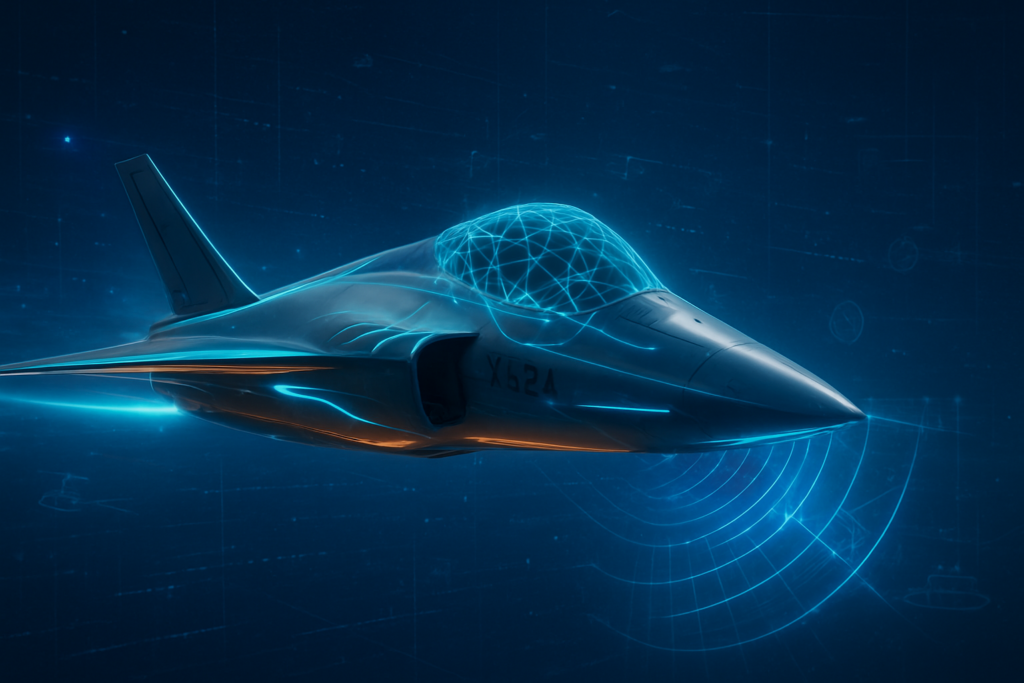
The United States Air Force has officially entered a new era of autonomous warfare with the integration of Raytheon’s (NYSE: RTX) PhantomStrike radar into the X-62A Variable In-flight Simulation Test Aircraft (VISTA). This upgrade marks a pivotal shift for the experimental fighter, moving it beyond basic flight maneuvers and into the complex realm of Beyond-Visual-Range (BVR) combat. By equipping the AI-driven aircraft with high-fidelity "eyes," the Air Force is accelerating its goal of fielding a massive fleet of autonomous "loyal wingman" drones that can see, track, and engage threats without human intervention.
This development is more than just a hardware installation; it is the physical manifestation of the Pentagon’s pivot toward the Collaborative Combat Aircraft (CCA) program. As of December 2025, the X-62A has transitioned from a dogfighting demonstrator into a fully functional "flying laboratory" for multi-agent combat. The integration of a dedicated fire-control radar allows the onboard AI agents to move from reactive flight to proactive tactical decision-making, setting the stage for the first-ever live, radar-driven autonomous combat sorties scheduled for early 2026.
The Technical Leap: Gallium Nitride and Air-Cooled Autonomy
The centerpiece of this upgrade is the PhantomStrike radar, a compact Active Electronically Scanned Array (AESA) system that leverages advanced Gallium Nitride (GaN) semiconductor technology. Unlike traditional fighter radars that require heavy, complex liquid-cooling systems, the PhantomStrike is entirely air-cooled. This allows it to weigh in at less than 150 pounds—roughly half the weight of legacy AESA systems—while maintaining the power to track multiple targets across vast distances. This reduction in Size, Weight, and Power (SWaP) is critical for autonomous platforms where every pound saved translates into more fuel, more munitions, or increased loiter time.
At the heart of the X-62A’s intelligence is the Enterprise Mission Computer version 2 (EMC2), colloquially known as the "Einstein Box." The latest 2025 hardware refresh has significantly boosted the Einstein Box’s processing power to handle the massive data throughput from the PhantomStrike radar. This allows the aircraft to run non-deterministic machine learning agents that can perform digital beam forming and steering. Unlike previous iterations that focused on Within-Visual-Range (WVR) dogfighting, the new Mission Systems Upgrade (MSU) enables the AI to engage in interleaved air-to-air and air-to-ground targeting, effectively giving the machine a level of situational awareness that rivals, and in some data-processing aspects exceeds, that of a human pilot.
Industry Implications: A New Market for "Mass-Producible" Defense
The successful integration of PhantomStrike positions Raytheon (NYSE: RTX) as a dominant player in the emerging CCA market. While traditional defense contracts often focus on high-cost, low-volume exquisite platforms, the PhantomStrike is designed for "affordable mass." By being 50% cheaper than standard fire-control radars, Raytheon is signaling to the Department of Defense that it can provide the sensory organs for thousands of autonomous drones at a fraction of the cost of an F-35’s sensor suite. This move puts pressure on other defense giants to pivot their sensor technologies toward modular, low-SWaP designs.
Furthermore, the X-62A project is a collaborative triumph for Lockheed Martin (NYSE: LMT), whose Skunk Works division developed the aircraft’s Open Mission Systems (OMS) architecture. This architecture allows AI agents from various software firms, such as Shield AI and EpiSci, to be swapped in and out like apps on a smartphone. This "plug-and-play" capability is disrupting the traditional defense procurement model, where hardware and software were often permanently tethered. It creates a competitive ecosystem where software startups can compete directly with established primes to provide the "brains" of the aircraft, while companies like Lockheed and Raytheon provide the "body" and "senses."
Redefining the Broader AI Landscape: From Dogfights to Strategy
The move to Beyond-Visual-Range combat represents a massive leap in AI complexity. In a close-quarters dogfight, AI agents primarily deal with physics and geometry—turning rates, airspeeds, and G-loads. However, BVR combat involves high-level strategic reasoning, such as electronic warfare management, decoy identification, and long-range missile kinematics. This shift aligns with the broader AI trend of moving from "narrow" task-oriented intelligence to "agentic" systems capable of managing multi-step, complex operations in contested environments.
This milestone also serves as a critical test for DARPA’s Air Combat Evolution (ACE) program, which focuses on building human trust in autonomy. By proving that an AI can safely and effectively manage a lethal radar system, the Air Force is addressing one of the biggest hurdles in military AI: the "trust gap." If a human mission commander can rely on an autonomous wingman to handle the "mechanics" of a radar lock and engagement, it frees the human to focus on high-level theater strategy, fundamentally changing the role of the fighter pilot from a "driver" to a "battle manager."
The Horizon: Project VENOM and the Thousand-Drone Fleet
Looking ahead, the lessons learned from the X-62A’s radar integration will be immediately funneled into Project VENOM (Viper Experimentation and Next-gen Operations Model). In this next phase, the Air Force is converting six standard F-16s into autonomous testbeds at Eglin Air Force Base. While the X-62A remains the primary research vehicle, Project VENOM will focus on scaling these AI capabilities from a single aircraft to a coordinated swarm. Experts predict that by 2027, we will see the first "loyal wingman" prototypes flying alongside F-35s in major Red Flag exercises.
The near-term challenge remains the refinement of the AI’s "rules of engagement" when operating a live fire-control radar. Ensuring that the machine can distinguish between friend, foe, and neutral parties in a cluttered electromagnetic environment is the next major hurdle. However, the success of the PhantomStrike integration suggests that the hardware limitations have been largely solved; the future of aerial combat now rests almost entirely on the speed of software iteration and the robustness of machine learning models in unpredictable combat scenarios.
A New Chapter in Aviation History
The integration of the PhantomStrike radar into the X-62A VISTA is a landmark moment that will likely be remembered as the point when autonomous flight became autonomous combat. By bridging the gap between flight control and mission systems, the US Air Force has proven that the "brain" and the "eyes" of a fighter can be decoupled from the human pilot without sacrificing lethality. This development marks the end of the experimental phase for AI dogfighting and the beginning of the operational phase for AI-driven air superiority.
In the coming months, observers should watch for the results of the first live-fire simulations involving the X-62A and its new radar suite. These tests will determine the pace at which the Air Force moves toward its goal of a 1,000-unit CCA fleet. As the X-62A continues to push the boundaries of what a machine can do in the cockpit, the aviation world is watching a fundamental transformation of the skies—one where the pilot’s greatest asset isn't their reflexes, but their ability to manage a fleet of intelligent, radar-equipped machines.
This content is intended for informational purposes only and represents analysis of current AI developments.
TokenRing AI delivers enterprise-grade solutions for multi-agent AI workflow orchestration, AI-powered development tools, and seamless remote collaboration platforms.
For more information, visit https://www.tokenring.ai/.