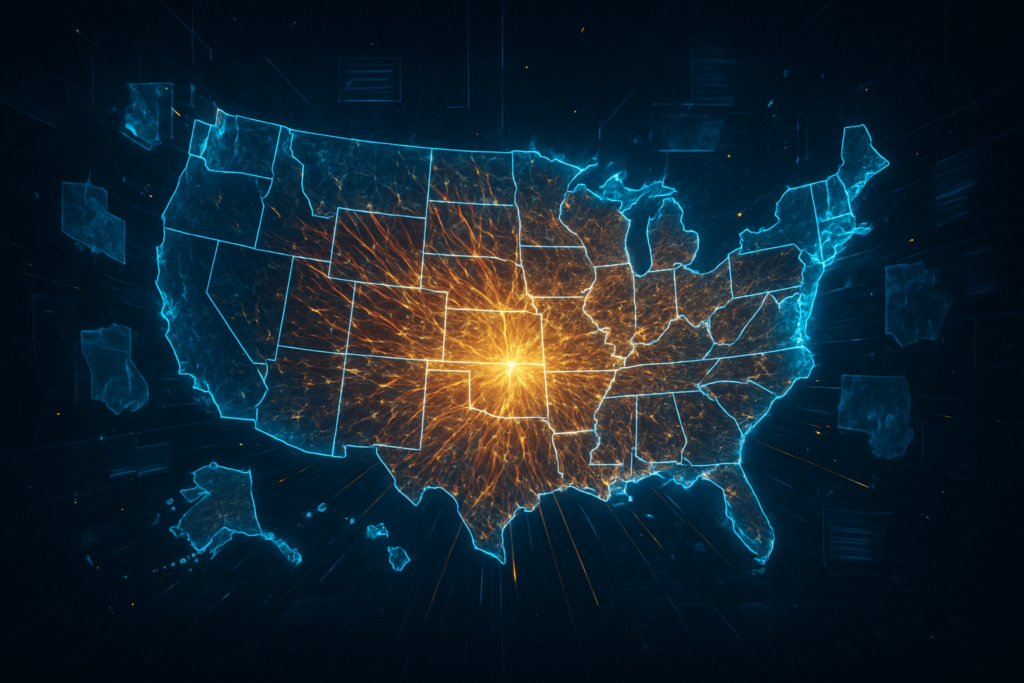
On December 11, 2025, President Donald Trump signed Executive Order 14365, titled "Ensuring a National Policy Framework for Artificial Intelligence." This sweeping directive marks a pivotal moment in the governance of emerging technologies, aiming to dismantle what the administration describes as an "onerous patchwork" of state-level AI regulations. By centralizing authority at the federal level, the order seeks to establish a uniform, minimally burdensome standard designed to accelerate innovation and secure American dominance in the global AI race.
The immediate significance of the order lies in its aggressive stance against state sovereignty over technology regulation. For months, states like California and Colorado have moved to fill a federal legislative vacuum, passing laws aimed at mitigating algorithmic bias, ensuring model transparency, and preventing "frontier" AI risks. Executive Order 14365 effectively declares war on these initiatives, arguing that a fragmented regulatory landscape creates prohibitive compliance costs that disadvantage American companies against international rivals, particularly those in China.
The "National Policy Framework": Centralizing AI Governance
Executive Order 14365 is built upon the principle of federal preemption, a legal doctrine that allows federal law to override conflicting state statutes. The order specifically targets state laws that require AI models to perform "bias audits" or "alter truthful outputs," which the administration characterizes as attempts to embed "ideological dogmas" into machine learning systems. A central pillar of the order is the "Truthful Output" standard, which asserts that AI systems should be free from state-mandated restrictions that might infringe upon First Amendment protections or force "deceptive" content moderation.
To enforce this new framework, the order directs the Attorney General to establish an AI Litigation Task Force within 30 days. This unit is tasked with challenging state AI laws in court, arguing they unconstitutionally regulate interstate commerce. Furthermore, the administration is leveraging the "power of the purse" by conditioning federal grants—specifically the Broadband Equity Access and Deployment (BEAD) funds—on a state’s willingness to align its AI policies with the federal framework. This move places significant financial pressure on states to repeal or scale back their independent regulations.
The order also instructs the Federal Trade Commission (FTC) and the Federal Communications Commission (FCC) to explore how existing federal statutes can be used to preempt state mandates. The FCC, in particular, is looking into creating a national reporting and disclosure standard for AI models that would supersede state-level requirements. This top-down approach differs fundamentally from the previous administration’s focus on risk management and safety "guardrails," shifting the priority entirely toward speed, deregulation, and ideological neutrality.
Silicon Valley's Sigh of Relief: Tech Giants and Startups React
The reaction from the technology sector has been overwhelmingly positive, as major players have long complained about the complexity of navigating diverse state rules. NVIDIA (NASDAQ: NVDA) CEO Jensen Huang has been a prominent supporter, stating that requiring "50 different approvals from 50 different states" would stifle the industry in its infancy. Similarly, Microsoft (NASDAQ: MSFT) and Alphabet (NASDAQ: GOOGL) have lobbied for a single national "rulebook" to provide the legal certainty needed for massive infrastructure investments in data centers and energy projects.
Meta Platforms (NASDAQ: META) has also aligned itself with the administration’s goal, arguing that a unified federal framework is essential for competing with state-driven AI initiatives in China. For these tech giants, the order represents a significant strategic advantage, as it removes the threat of "frontier" safety regulations that could have forced them to undergo rigorous third-party testing before releasing new models. Startups like OpenAI and Anthropic, while occasionally more cautious in their rhetoric, have also sought relief from the hundreds of pending state AI bills that threaten to bog down their development cycles.
However, the competitive implications are complex. While established giants benefit from the removal of state hurdles, some critics argue that a "minimally burdensome" federal standard might favor incumbents who can more easily influence federal agencies. By preempting state laws that might have encouraged competition or protected smaller players from algorithmic discrimination, the order could inadvertently solidify the dominance of the current "Magnificent Seven" tech companies.
A Clash of Sovereignty: The States Fight Back
The executive order has ignited a fierce political and legal battle, drawing a rare bipartisan backlash from state leaders. Democratic governors, including California’s Gavin Newsom and New York’s Kathy Hochul, have condemned the move as an overreach that leaves citizens vulnerable to deepfakes, privacy intrusions, and algorithmic bias. New York recently signaled its defiance by passing the RAISE Act (Responsible AI Safety and Education Act), asserting the state’s right to protect its residents from the risks posed by large-scale AI deployment.
Surprisingly, the opposition is not limited to one side of the aisle. Republican governors such as Florida’s Ron DeSantis and Utah’s Spencer Cox have also voiced concerns, viewing the order as a violation of state sovereignty and a "subsidy to Big Tech." These leaders argue that states must retain the power to protect their citizens from censorship and intellectual property violations, regardless of federal policy. A coalition of over 40 state Attorneys General has already cautioned that federal agencies lack the authority to preempt state consumer protection laws via executive order alone.
This development fits into a broader trend of "technological federalism," where the battle for control over the digital economy is increasingly fought between state capitals and Washington D.C. It echoes previous milestones in tech regulation, such as the fight over net neutrality and data privacy (CCPA), but with much higher stakes. The administration’s focus on "ideological neutrality" adds a new layer of complexity, framing AI regulation not just as a matter of safety, but as a cultural and constitutional conflict.
The Legal Battlefield and the "AI Preemption Act"
Looking ahead, the primary challenge for Executive Order 14365 will be its legal durability. Legal experts note that the President cannot unilaterally preempt state law without a clear mandate from Congress. Because there is currently no comprehensive federal AI statute, the "AI Litigation Task Force" may find it difficult to convince courts that state laws are preempted by mere executive fiat. This sets the stage for a series of high-profile court cases that could eventually reach the Supreme Court.
To address this legal vulnerability, the administration is already preparing a legislative follow-up. The "AI and Crypto Czar," David Sacks, is reportedly drafting a proposal for a federal AI Preemption Act. This act would seek to codify the principles of the executive order into law, explicitly forbidding states from enacting conflicting AI regulations. While the bill faces an uphill battle in a divided Congress, its introduction will be a major focus of the 2026 legislative session, with tech lobbyists expected to spend record amounts to ensure its passage.
In the near term, we can expect a "regulatory freeze" as companies wait to see how the courts rule on the validity of the executive order. Some states may choose to pause their enforcement of AI laws to avoid litigation, while others, like California, appear ready to double down. The result could be a period of intense uncertainty for the AI industry, ironically the very thing the executive order was intended to prevent.
A Comprehensive Wrap-Up
President Trump’s Executive Order 14365 represents a bold attempt to nationalize AI policy and prioritize innovation over state-level safety concerns. By targeting "onerous" state laws and creating a federal litigation task force, the administration has signaled its intent to be the sole arbiter of the AI landscape. For the tech industry, the order offers a vision of a streamlined, deregulated future; for state leaders and safety advocates, it represents a dangerous erosion of consumer protections and local sovereignty.
The significance of this development in AI history cannot be overstated. It marks the moment when AI regulation moved from a technical debate about safety to a high-stakes constitutional and political struggle. The long-term impact will depend on the success of the administration's legal challenges and its ability to push a preemption act through Congress.
In the coming weeks and months, the tech world will be watching for the first lawsuits filed by the AI Litigation Task Force and the specific policy statements issued by the FTC and FCC. As the federal government and the states lock horns, the future of American AI hangs in the balance, caught between the drive for rapid innovation and the demand for local accountability.
This content is intended for informational purposes only and represents analysis of current AI developments.
TokenRing AI delivers enterprise-grade solutions for multi-agent AI workflow orchestration, AI-powered development tools, and seamless remote collaboration platforms.
For more information, visit https://www.tokenring.ai/.