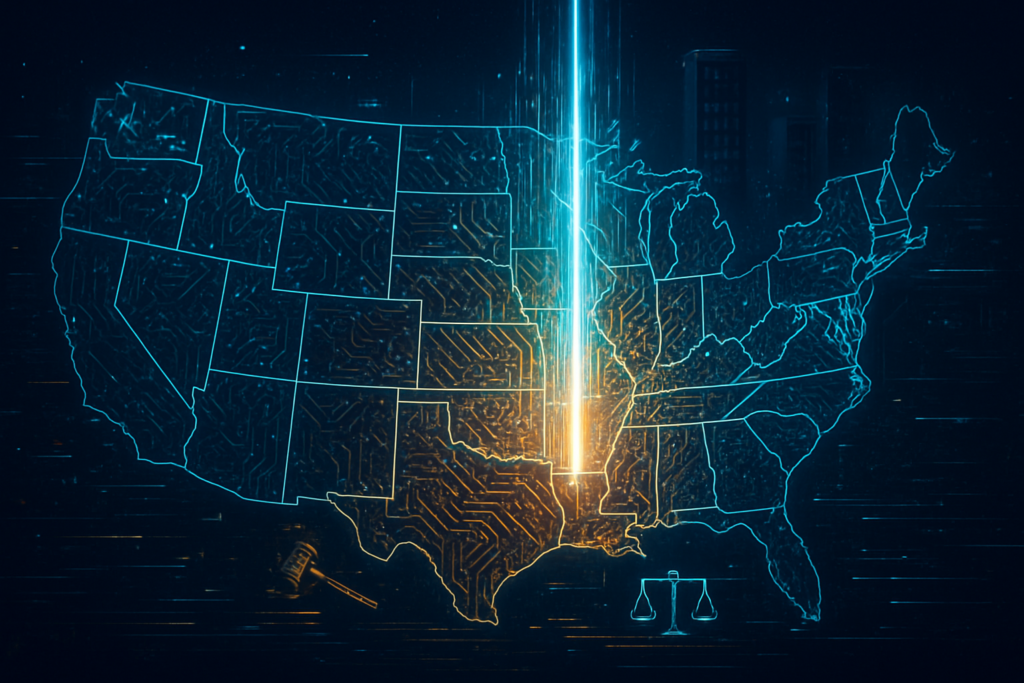
The second Trump administration has officially declared war on the "regulatory patchwork" of artificial intelligence, unveiling an aggressive national strategy designed to strip states of their power to oversee the technology. Centered on the "America’s AI Action Plan" and a sweeping Executive Order signed on December 11, 2025, the administration aims to establish a single, "minimally burdensome" federal standard. By leveraging billions in federal broadband funding as a cudgel, the White House is attempting to force states to abandon local AI safety and bias laws in favor of a centralized "truth-seeking" mandate.
However, the plan has ignited a rare bipartisan firestorm on Capitol Hill and in state capitals across the country. From progressive Democrats in California to "tech-skeptical" conservatives in Tennessee and Florida, a coalition of lawmakers is sounding the alarm over what they describe as an unconstitutional power grab. Critics argue that the administration’s drive for national uniformity will create a "regulatory vacuum," leaving citizens vulnerable to deepfakes, algorithmic discrimination, and privacy violations while the federal government prioritizes raw compute power over consumer protection.
A Technical Pivot: From Safety Thresholds to "Truth-Seeking" Benchmarks
Technically, the administration’s new framework represents a total reversal of the safety-centric policies of 2023 and 2024. The most significant technical shift is the explicit repeal of the 10^26 FLOPs compute threshold, a previous benchmark that required companies to report large-scale training runs to the government. The administration has labeled this metric "arbitrary math regulation," arguing that it stifles the scaling of frontier models. In its place, the National Institute of Standards and Technology (NIST) has been directed to pivot away from risk-management frameworks toward "truth-seeking" benchmarks. These new standards will measure a model’s "ideological neutrality" and scientific accuracy, specifically targeting and removing what the administration calls "woke" guardrails—such as built-in biases regarding climate change or social equity—from the federal AI toolkit.
To enforce this new standard, the plan tasks the Federal Communications Commission (FCC) with creating a Federal Reporting and Disclosure Standard. Unlike previous transparency requirements that focused on training data, this new standard focuses on high-level system prompts and technical specifications, allowing companies to protect their proprietary model weights as trade secrets. This shift from "predictive regulation" based on hardware capacity to "performance-based" oversight means that as long as a model adheres to federal "truth" standards, its raw power is essentially unregulated at the federal level.
This deregulation is paired with a aggressive "litigation task force" led by the Department of Justice, aimed at striking down state laws like California’s SB 53 and Colorado’s AI Act. The administration argues that AI development is inherently interstate commerce and that state-level "algorithmic discrimination" laws are unconstitutional barriers to national progress. Initial reactions from the AI research community are polarized; while some applaud the removal of "compute caps" as a win for American innovation, others warn that the move ignores the catastrophic risks associated with unvetted, high-scale autonomous systems.
Big Tech’s Federal Shield: Winners and Losers in the Preemption Battle
The push for federal preemption has created an uneasy alliance between the White House and Silicon Valley’s largest players. Microsoft (NASDAQ: MSFT), Alphabet (NASDAQ: GOOGL), and Meta Platforms (NASDAQ: META) have all voiced strong support for a single national rulebook, arguing that a "patchwork" of 50 different state laws would make it impossible to deploy AI at scale. For these tech giants, federal preemption serves as a strategic shield, effectively neutralizing the "bite" of state-level consumer protection laws that would have required expensive, localized model retraining.
Palantir Technologies (NYSE: PLTR) has been among the most vocal supporters, with executives praising the removal of "regulatory labyrinths" that they claim have slowed the integration of AI into national defense. Conversely, Tesla (NASDAQ: TSLA) and its CEO Elon Musk have had a more complicated relationship with the plan. While Musk supports the "truth-seeking" requirements, he has publicly clashed with the administration over the execution of the $500 billion "Stargate" infrastructure project, eventually withdrawing from several federal advisory boards in late 2025.
The plan also attempts to throw a bone to AI startups through the "Genesis Mission." To prevent a Big Tech monopoly, the administration proposes treating compute power as a "commodity" via an expanded National AI Research Resource (NAIRR). This would allow smaller firms to access GPU power without being locked into long-term contracts with major cloud providers. Furthermore, the explicit endorsement of open-source and open-weight models is seen as a strategic move to export a "U.S. AI Technology Stack" globally, favoring developers who rely on open platforms to compete with the compute-heavy labs of China.
The Constitutional Crisis: 10th Amendment vs. AI Dominance
The wider significance of this policy shift lies in the growing tension between federalism and the "AI arms race." By threatening to withhold up to $42.5 billion in Broadband Equity Access and Deployment (BEAD) funds from states with "onerous" AI regulations, the Trump administration is testing the limits of federal power. This "carrots and sticks" approach has unified a diverse group of opponents. A bipartisan coalition of 36 state attorneys general recently signed a letter to Congress, arguing that states must remain "laboratories of democracy" and that federal law should serve as a "floor, not a ceiling" for safety.
The skepticism is particularly acute among "tech-skeptical" conservatives like Sen. Josh Hawley (R-MO) and Sen. Marsha Blackburn (R-TN). They argue that state laws—such as Tennessee’s ELVIS Act, which protects artists from AI voice cloning—are essential protections for property rights and child safety that the federal government is too slow to address. On the other side of the aisle, Sen. Amy Klobuchar (D-MN) and Gov. Gavin Newsom (D-CA) view the plan as a deregulation scheme that specifically targets civil rights and privacy protections.
This conflict mirrors previous technological milestones, such as the early days of the internet and the rollout of 5G, but the stakes are significantly higher. In the 1990s, the federal government largely took a hands-off approach to the web, which many credit for its rapid growth. However, the Trump administration’s plan is not "hands-off"; it is an active federal intervention designed to prevent states from stepping in where the federal government chooses not to act. This "mandatory deregulation" sets a new precedent in the American legal landscape.
The Road Ahead: Litigation and the "Obernolte Bill"
Looking toward the near-term future, the battle for control over AI will move from the halls of the White House to the halls of justice. The DOJ's AI Litigation Task Force is expected to file its first wave of lawsuits against California and Colorado by the end of Q1 2026. Legal experts predict these cases will eventually reach the Supreme Court, potentially redefining the Commerce Clause for the digital age. If the administration succeeds, state-level AI safety boards could be disbanded overnight, replaced by the NIST "truth" standards.
In Congress, the fight will center on the "Obernolte Bill," a piece of legislation expected to be introduced by Rep. Jay Obernolte (R-CA) in early 2026. While the bill aims to codify the "America's AI Action Plan," Obernolte has signaled a willingness to create a "state lane" for specific types of regulation, such as deepfake pornography and election interference. Whether this compromise will satisfy the administration's hardliners or the state-rights advocates remains to be seen.
Furthermore, the "Genesis Mission's" focus on exascale computing—utilizing supercomputers like El Capitan—suggests that the administration is preparing for a massive push into scientific AI. If the federal government can successfully centralize AI policy, we may see a "Manhattan Project" style acceleration of AI in energy and healthcare, though critics remain concerned that the cost of this speed will be the loss of local accountability and consumer safety.
A Decisive Moment for the American AI Landscape
The "America’s AI Action Plan" represents a high-stakes gamble on the future of global technology leadership. By dismantling state-level guardrails and repealing compute thresholds, the Trump administration is doubling down on a "growth at all costs" philosophy. The key takeaway from this development is clear: the U.S. government is no longer just encouraging AI; it is actively clearing the path by force, even at the expense of traditional state-level protections.
Historically, this may be remembered as the moment the U.S. decided that the "patchwork" of democracy was a liability in the face of international competition. However, the fierce resistance from both parties suggests that the "One Rulebook" approach is far from a settled matter. The coming weeks will be defined by a series of legal and legislative skirmishes that will determine whether AI becomes a federally managed utility or remains a decentralized frontier.
For now, the world’s largest tech companies have a clear win in the form of federal preemption, but the political cost of this victory is a deepening divide between the federal government and the states. As the $42.5 billion in broadband funding hangs in the balance, the true cost of "American AI First" is starting to become visible.
This content is intended for informational purposes only and represents analysis of current AI developments.
TokenRing AI delivers enterprise-grade solutions for multi-agent AI workflow orchestration, AI-powered development tools, and seamless remote collaboration platforms.
For more information, visit https://www.tokenring.ai/.